Parvaresh Rizi Ehsan, Baig Sonia, Loh Tze Ping, Toh Sue-Anne, Khoo Chin Meng, Tai E Shyong
Department of Medicine, Yong Loo Lin School of Medicine, National University of Singapore, Singapore, Singapore.
Department of Medicine, National University Health System, Singapore, Singapore.
Front Physiol. 2019 Jul 16;10:856. doi: 10.3389/fphys.2019.00856. eCollection 2019.
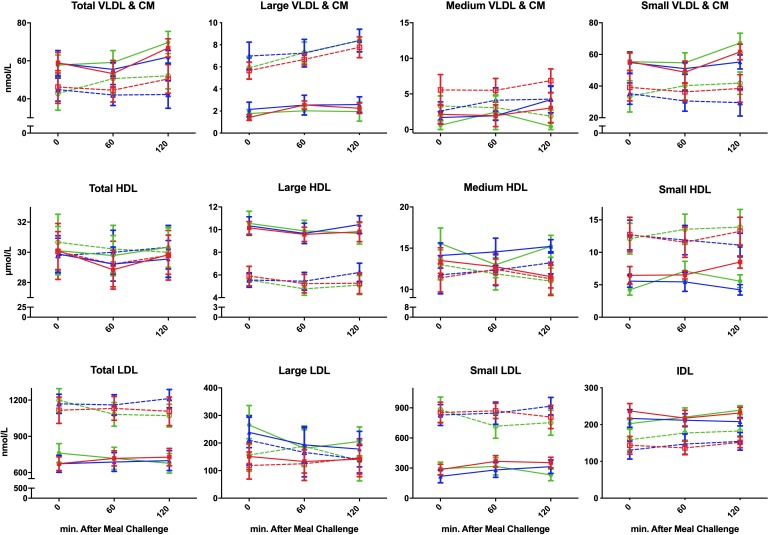
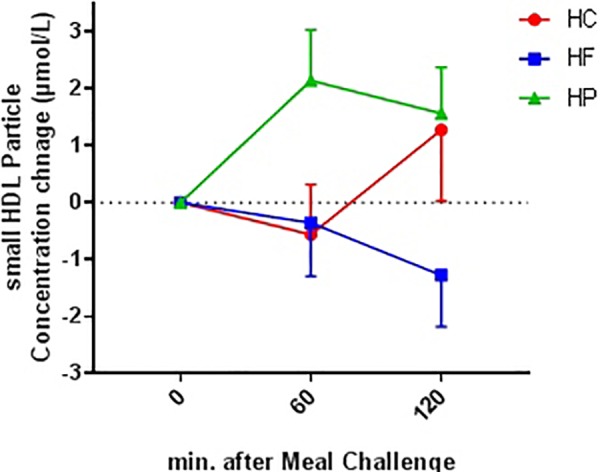
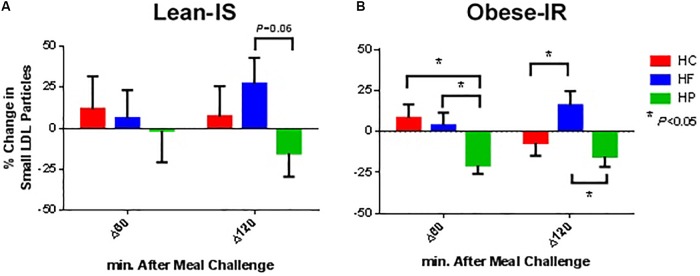
The concentrations of lipoprotein particles [high-density lipoproteins (HDLs), low-density lipoproteins (LDLs), very-low-density lipoproteins (VLDLs), and chylomicrons] are associated with the risk of cardiovascular diseases. Most studies have examined these associations in the fasting state. Previous studies have shown lipoprotein particle concentration change following meal, and these changes are different in individuals with obesity. In this study, we aimed to assess whether various meal compositions lead to adverse short-term (2-h) postprandial lipoproteinemia in obese insulin resistant (obese-IR) subjects as compared to lean insulin sensitive (lean-IS) subjects. In a randomized crossover trial, nine lean-IS and nine obese-IR Chinese men aged 22-35 years were challenged with isoenergetic and isovolumic meals rich in protein (HP), fat (HF), or carbohydrate (HC). Plasma samples were collected after a 10-h fast, as well as 1-h and 2-h post-meal and analyzed using nuclear magnetic resonance. Plasma concentration of large VLDLs and chylomicron particles was higher and increased more after all meals in obese-IR compared to lean-IS subjects. The HP meal decreased small LDL particle concentration in obese-IR subjects, and increased small HDL particle concentration in all subjects. The HF meal led to a decrease in small HDL concentration in all subjects. In conclusion, obese-IR subjects revealed a detrimental response to meal challenges even as early as 2-h after meal intake.
脂蛋白颗粒[高密度脂蛋白(HDL)、低密度脂蛋白(LDL)、极低密度脂蛋白(VLDL)和乳糜微粒]的浓度与心血管疾病风险相关。大多数研究在空腹状态下检测了这些关联。先前的研究表明,进食后脂蛋白颗粒浓度会发生变化,且肥胖个体的这些变化有所不同。在本研究中,我们旨在评估与瘦型胰岛素敏感(lean-IS)受试者相比,各种膳食组成是否会导致肥胖胰岛素抵抗(obese-IR)受试者出现不良的短期(2小时)餐后脂蛋白血症。在一项随机交叉试验中,9名年龄在22 - 35岁的瘦型胰岛素敏感中国男性和9名肥胖胰岛素抵抗中国男性接受了富含蛋白质(HP)、脂肪(HF)或碳水化合物(HC)的等能量、等体积膳食的挑战。在禁食10小时后、餐后1小时和2小时采集血样,并使用核磁共振进行分析。与瘦型胰岛素敏感受试者相比,肥胖胰岛素抵抗受试者在进食所有膳食后,大的极低密度脂蛋白和乳糜微粒颗粒的血浆浓度更高且升高幅度更大。HP膳食降低了肥胖胰岛素抵抗受试者中小低密度脂蛋白颗粒的浓度,并增加了所有受试者中小高密度脂蛋白颗粒的浓度。HF膳食导致所有受试者中小高密度脂蛋白浓度降低。总之,肥胖胰岛素抵抗受试者即使在进食后2小时就对膳食挑战表现出有害反应。