Department of Nutritional Sciences, Oklahoma State University, Stillwater, OK 74078, USA.
Department of Kinesiology, James Madison University, Harrisonburg, Virginia, VA 22807, USA.
Nutrients. 2019 Jan 16;11(1):180. doi: 10.3390/nu11010180.
A large post-meal triglyceride (TG) response is an independent risk factor for cardiovascular disease, but postprandial lipemia assessments are not clinically practical in their current form. Therefore, we assessed the validity of an abbreviated, clinically feasible protocol in measuring postprandial lipemia.
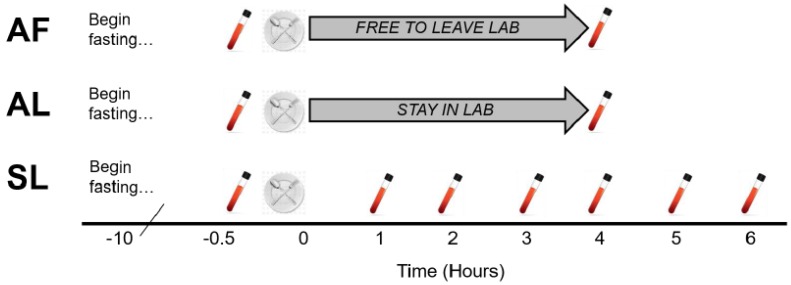
Eighteen healthy adults (8 male and 10 female) completed 3 high-fat meal trials in random order: (1) a Standard in Lab (SL) protocol wherein blood draws (to determine TG) were made from a catheter at baseline and hourly for 6 h; (2) an Abbreviated in Lab (AL) protocol in which participants remained in the laboratory but blood draws were only made at baseline and 4 h post-meal; and (3) an Abbreviated with Freedom (AF) protocol in which participants vacated the laboratory between the meal and the 4-h blood draw.
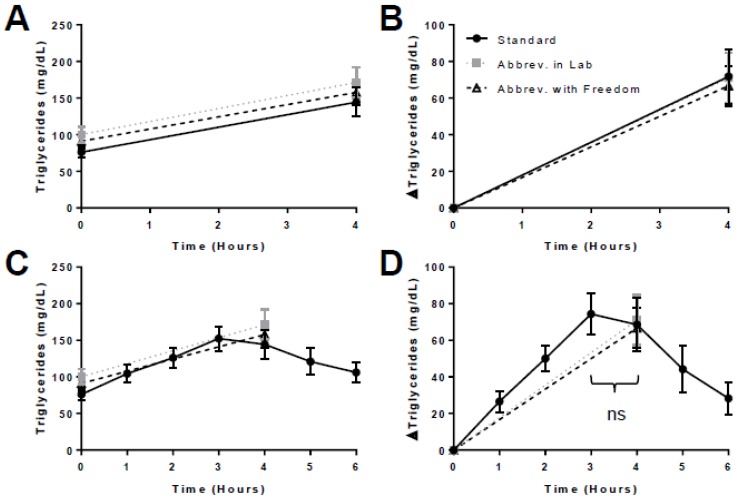
TG increase from baseline was very similar ( = 0.93) across the 3 trials (SL: 68.5 ± 62.7 mg/dL; AL: 71.1 ± 58.0 mg/dL; AF: 66.7 ± 46.4 mg/dL), as were 4-h TG levels (SL: 144.6 ± 84.2 mg/dL; AL: 171.4 ± 88.2 mg/dL; AF: 157.7 ± 76.7 mg/dL; = 0.49). Similarly, total and incremental area under the curve (AUC) were not significantly different across the trials ( = 0.12 and 0.91, respectively).
The TG results of the clinically feasible, abbreviated protocol were similar to those of the more exhaustive standard protocol. The AF protocol could be a valid and feasible clinical tool for measurement of postprandial lipemia and assessment of cardiovascular risk, although studies in larger and more diverse cohorts are needed.
餐后甘油三酯(TG)反应较大是心血管疾病的独立危险因素,但目前的餐后脂血症评估在临床上并不实用。因此,我们评估了一种简化的、临床上可行的方案来测量餐后脂血症的有效性。
18 名健康成年人(8 名男性和 10 名女性)按随机顺序完成了 3 次高脂肪餐试验:(1)标准实验室(SL)方案,通过导管在基线和餐后 6 小时每小时采血(以确定 TG);(2)简化实验室(AL)方案,参与者仍留在实验室,但仅在基线和餐后 4 小时采血;(3)简化与自由(AF)方案,参与者在餐食和 4 小时采血之间离开实验室。
3 次试验中 TG 从基线的增加非常相似( = 0.93)(SL:68.5 ± 62.7 mg/dL;AL:71.1 ± 58.0 mg/dL;AF:66.7 ± 46.4 mg/dL),4 小时 TG 水平也相似(SL:144.6 ± 84.2 mg/dL;AL:171.4 ± 88.2 mg/dL;AF:157.7 ± 76.7 mg/dL; = 0.49)。同样,试验之间总和增量曲线下面积(AUC)没有显著差异( = 0.12 和 0.91,分别)。
临床上可行的简化方案的 TG 结果与更详尽的标准方案相似。AF 方案可能是测量餐后脂血症和评估心血管风险的有效可行的临床工具,尽管需要在更大和更多样化的队列中进行研究。