Department of Microbiology, University of Texas Southwestern Medical Center, Dallas, Texas, USA.
Department of Microbiology, University of Tennessee-Knoxville, Knoxville, Tennessee, USA.
mBio. 2019 Aug 6;10(4):e01732-19. doi: 10.1128/mBio.01732-19.
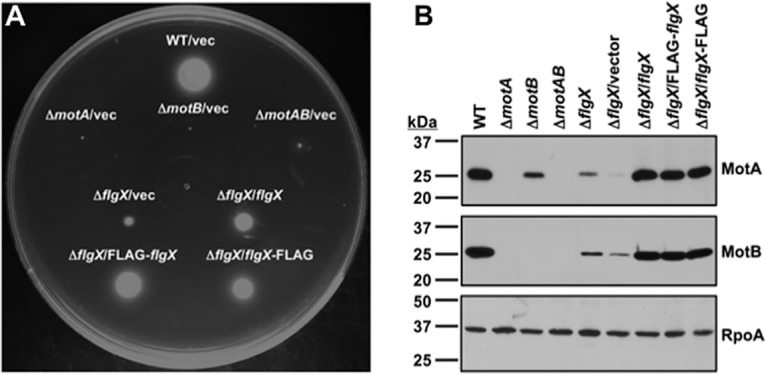
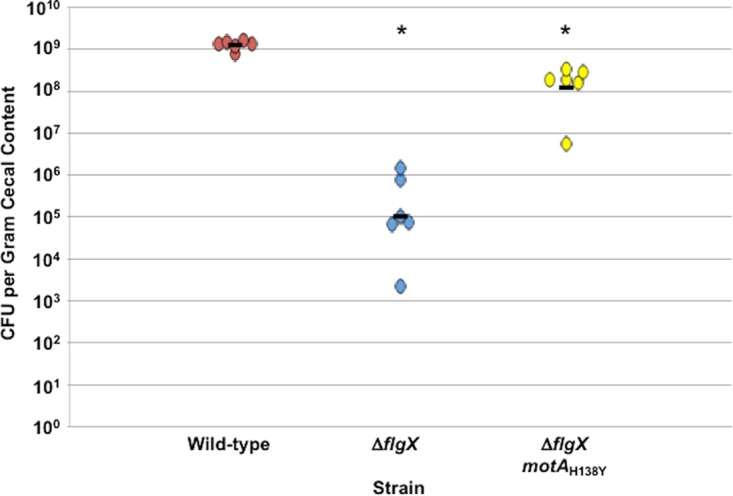
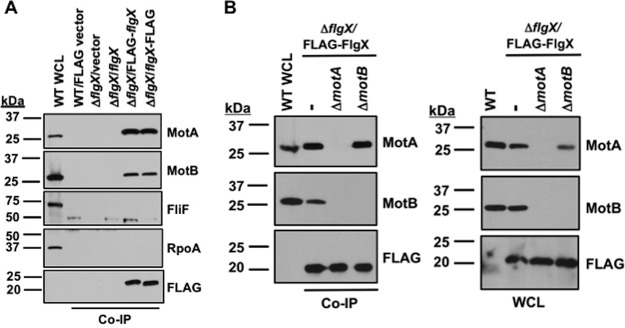
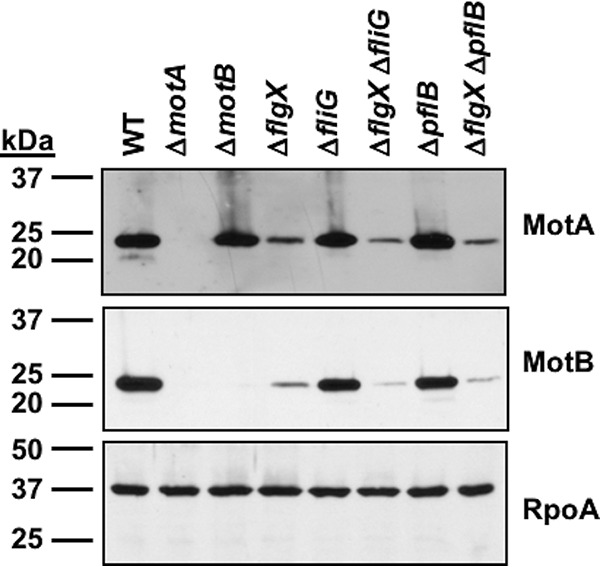
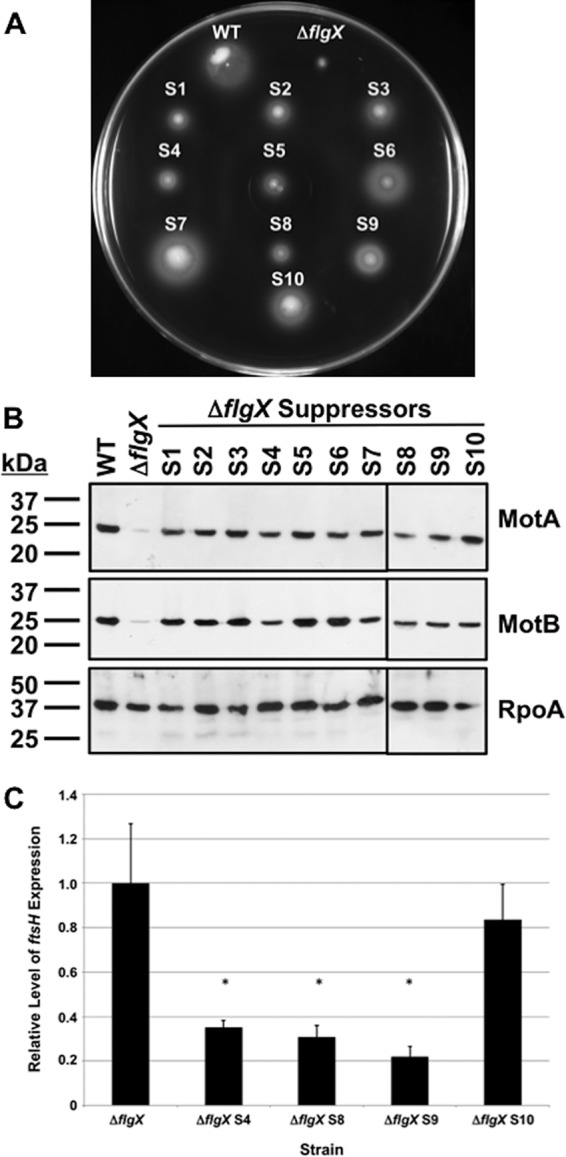
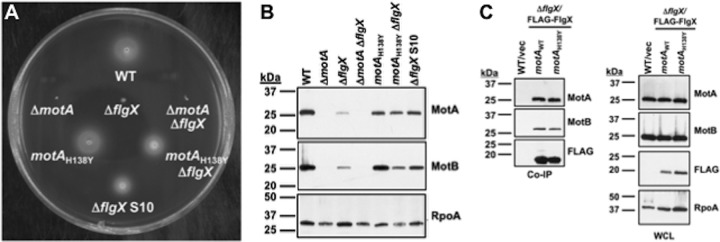
The stator units of the flagellum supply power to the flagellar motor via ion transport across the cytoplasmic membrane and generate torque on the rotor for rotation. Flagellar motors across bacterial species have evolved adaptations that impact and enhance stator function to meet the demands of each species, including producing stator units using different fuel types or various stator units for different motility modalities. produces one of the most complex and powerful flagellar motors by positioning 17 stator units at a greater radial distance than in most other bacteria to increase power and torque for high velocity of motility. We report another evolutionary adaptation impacting flagellar stators by identifying FlgX as a chaperone for stator units to ensure sufficient power and torque for flagellar rotation and motility. We discovered that FlgX maintains MotA and MotB stator protein integrity likely through a direct interaction with MotA that prevents their degradation. Suppressor analysis suggested that the physiology of drives the requirement for FlgX to protect stator units from proteolysis by the FtsH protease complex. Δ was strongly attenuated for colonization of the natural avian host, but colonization capacity was greatly restored by a single mutation in MotA. These findings suggest that the likely sole function of FlgX is to preserve stator unit integrity for the motility required for host interactions. Our findings demonstrate another evolved adaptation in motile bacteria to ensure the equipment of the flagellar motor with sufficient power to generate torque for motility. The bacterial flagellum is a reversible rotating motor powered by ion transport through stator units, which also exert torque on the rotor component to turn the flagellum for motility. Species-specific adaptations to flagellar motors impact stator function to meet the demands of each species to sufficiently power flagellar rotation. We identified another evolutionary adaptation by discovering that FlgX of preserves the integrity of stator units by functioning as a chaperone to protect stator proteins from degradation by the FtsH protease complex due to the physiology of the bacterium. FlgX is required to maintain a level of stator units sufficient to power the naturally high-torque flagellar motor of for motility in intestinal mucosal layers to colonize hosts. Our work continues to identify an increasing number of adaptations to flagellar motors across bacterial species that provide the mechanics necessary for producing an effective rotating nanomachine for motility.
鞭毛的定子单元通过跨细胞质膜的离子转运为鞭毛马达供电,并在转子上产生扭矩以实现旋转。不同种细菌的鞭毛马达已经进化出适应特性,这些特性影响并增强了定子的功能,以满足每种细菌的需求,包括使用不同燃料类型的定子单元或不同运动方式的各种定子单元。通过将 17 个定子单元定位于比大多数其他细菌更大的径向距离来产生一种最复杂和强大的鞭毛马达,从而增加动力和扭矩,以实现高速运动。我们报告了另一种影响鞭毛定子的进化适应,通过鉴定 FlgX 作为 的定子单元伴侣,确保了足够的动力和扭矩,以实现鞭毛旋转和运动。我们发现 FlgX 保持了 MotA 和 MotB 定子蛋白的完整性,可能是通过与 MotA 的直接相互作用,防止其降解。抑制分析表明, 的生理学驱动了 FlgX 保护定子单元免受 FtsH 蛋白酶复合物蛋白水解的要求。 缺失突变体在天然禽宿主中的定植能力显著减弱,但 MotA 中的单个突变极大地恢复了其定植能力。这些发现表明,FlgX 的可能唯一功能是保持定子单元的完整性,以维持与宿主相互作用所需的运动能力。我们的研究结果表明,在运动细菌中存在另一种进化适应,以确保为产生运动所需的扭矩为鞭毛马达提供足够的动力。细菌鞭毛是一种可逆旋转马达,通过离子通过定子单元的运输来提供动力,定子单元也对转子组件施加扭矩,以转动鞭毛进行运动。特定于物种的鞭毛马达适应特性会影响定子的功能,以满足每个物种的需求,从而为鞭毛旋转提供足够的动力。我们通过发现 FlgX 作为伴侣,通过充当伴侣来保护定子蛋白免受 FtsH 蛋白酶复合物的降解,从而保持 的定子单元的完整性,从而发现了另一种进化适应。由于细菌的生理学,FlgX 被发现可保护定子蛋白免受降解。FlgX 对于维持足够的定子单元水平以提供动力以实现高扭矩天然鞭毛马达的运动,从而在肠黏膜层中定植宿主是必需的。我们的工作继续识别越来越多的细菌物种的鞭毛马达适应特性,这些特性为产生有效的旋转纳米机器提供了运动所需的力学特性。