CAS Key Laboratory of Tropical Marine Bio Resources and Ecology, Guangdong Key Laboratory of Marine Materia Medica, Innovation Academy of South China Sea Ecology and Environmental Engineering, South China Sea Institute of Oceanology, Chinese Academy of Sciences, Guangzhou, China.
Tropical Marine Biological Research Station in Hainan, Chinese Academy of Sciences and Hainan Key Laboratory of Tropical Marine Biotechnology, Sanya, China.
PLoS Genet. 2022 Jul 14;18(7):e1010316. doi: 10.1371/journal.pgen.1010316. eCollection 2022 Jul.
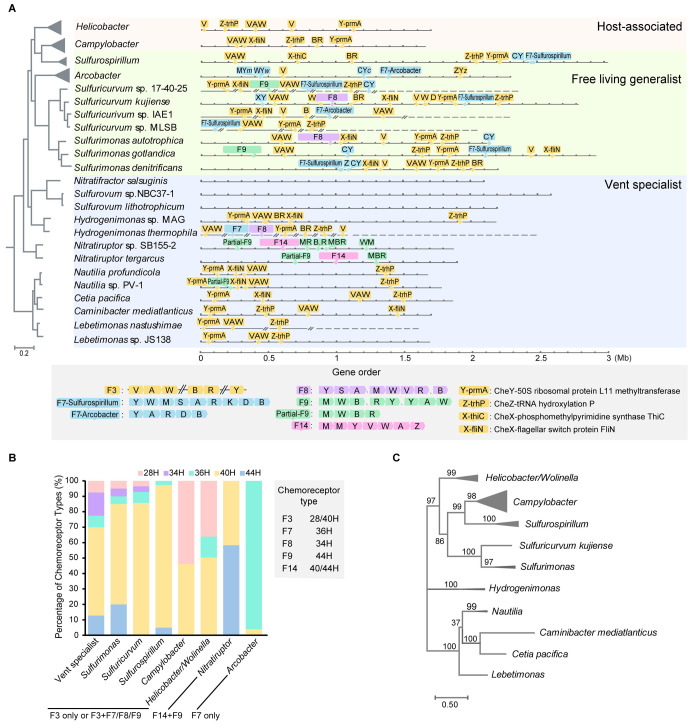
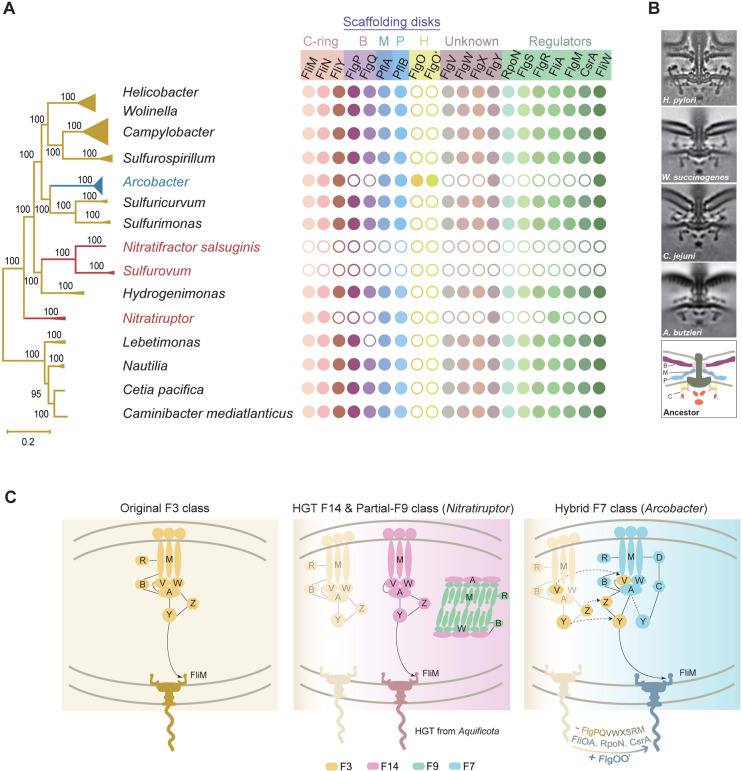
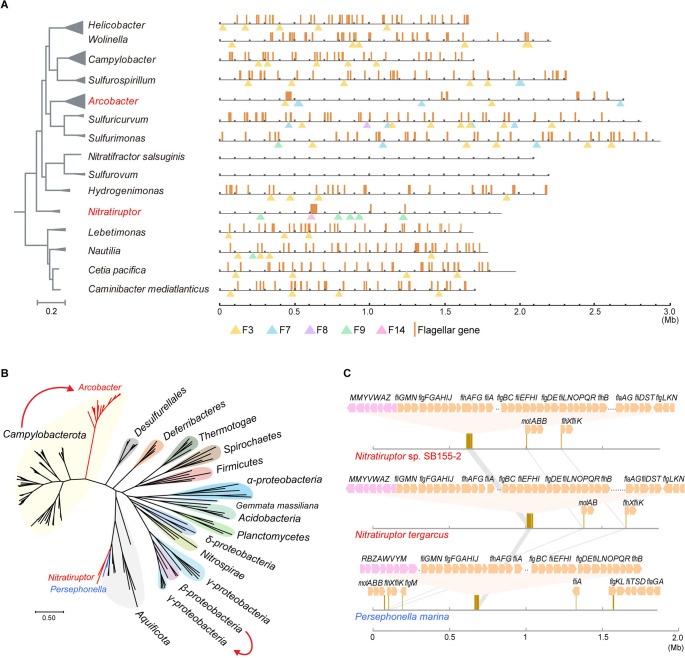
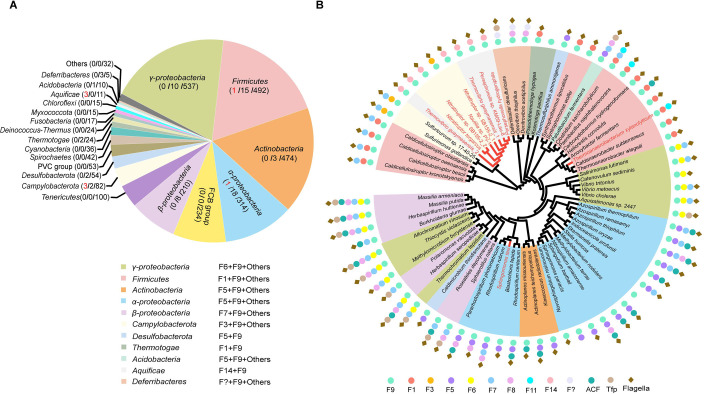
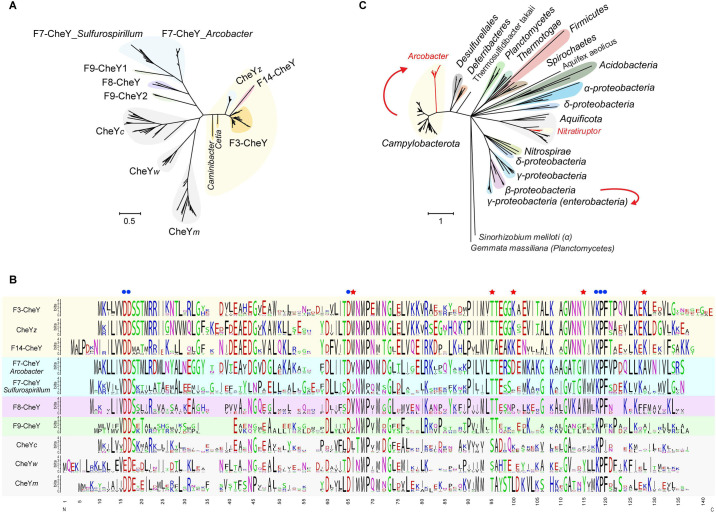
The evolution of macromolecular complex is a fundamental biological question, which is related to the origin of life and also guides our practice in synthetic biology. The chemosensory system is one of the complex structures that evolved very early in bacteria and displays enormous diversity and complexity in terms of composition and array structure in modern species. However, how the diversity and complexity of the chemosensory system evolved remains unclear. Here, using the Campylobacterota phylum with a robust "eco-evo" framework, we investigated the co-evolution of the chemosensory system and one of its important signaling outputs, flagellar machinery. Our analyses show that substantial flagellar gene alterations will lead to switch of its primary chemosensory class from one to another, or result in a hybrid of two classes. Unexpectedly, we discovered that the high-torque generating flagellar motor structure of Campylobacter jejuni and Helicobacter pylori likely evolved in the last common ancestor of the Campylobacterota phylum. Later lineages that experienced significant flagellar alterations lost some key components of complex scaffolding structures, thus derived simpler structures than their ancestor. Overall, this study revealed the co-evolutionary path of the chemosensory system and flagellar system, and highlights that the evolution of flagellar structural complexity requires more investigation in the Bacteria domain based on a resolved phylogenetic framework, with no assumptions on the evolutionary direction.
生物大分子复合物的进化是一个基本的生物学问题,它与生命的起源有关,也指导着我们在合成生物学中的实践。化感感应系统是细菌中进化非常早的复杂结构之一,在现代物种中,其组成和排列结构具有巨大的多样性和复杂性。然而,化感感应系统的多样性和复杂性是如何进化的仍然不清楚。在这里,我们利用具有强大“生态进化”框架的弯曲杆菌门,研究了化感感应系统与其重要信号输出之一——鞭毛机器的共同进化。我们的分析表明,大量的鞭毛基因改变将导致其主要化感感应类别的转变,从一种转变为另一种,或者导致两种类型的混合。出乎意料的是,我们发现,空肠弯曲菌和幽门螺杆菌的高扭矩产生的鞭毛马达结构可能是在弯曲杆菌门的最后共同祖先中进化而来的。后来经历了显著鞭毛改变的谱系失去了一些复杂支架结构的关键组成部分,因此衍生出比其祖先更简单的结构。总的来说,这项研究揭示了化感感应系统和鞭毛系统的共同进化路径,并强调了鞭毛结构复杂性的进化需要在基于解决的系统发育框架的细菌域中进行更多的调查,而无需对进化方向做出假设。