Nano-Crystallography Unit, RIKEN-JEOL Collaboration Center, Tsurumi, Yokohama, Kanagawa, 230-0045, Japan.
Institute for Integrated Cell-Material Sciences (WPI-iCeMS), Institute for Advanced Study, and AIST-Kyoto University Chemical Energy Materials Open Innovation Laboratory (ChEM-OIL), Kyoto University, Yoshida, Sakyo-ku, Kyoto, 606-8501, Japan.
Nat Commun. 2019 Aug 6;10(1):3537. doi: 10.1038/s41467-019-11469-2.
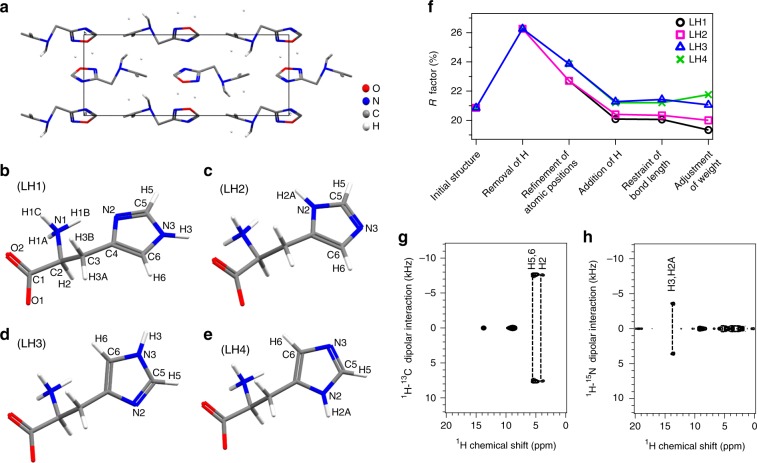
Understanding hydrogen-bonding networks in nanocrystals and microcrystals that are too small for X-ray diffractometry is a challenge. Although electron diffraction (ED) or electron 3D crystallography are applicable to determining the structures of such nanocrystals owing to their strong scattering power, these techniques still lead to ambiguities in the hydrogen atom positions and misassignments of atoms with similar atomic numbers such as carbon, nitrogen, and oxygen. Here, we propose a technique combining ED, solid-state NMR (SSNMR), and first-principles quantum calculations to overcome these limitations. The rotational ED method is first used to determine the positions of the non-hydrogen atoms, and SSNMR is then applied to ascertain the hydrogen atom positions and assign the carbon, nitrogen, and oxygen atoms via the NMR signals for H, C, N, and N with the aid of quantum computations. This approach elucidates the hydrogen-bonding networks in L-histidine and cimetidine form B whose structure was previously unknown.
理解对于 X 射线衍射技术来说太小的纳米晶体和微晶体中的氢键网络是一项挑战。虽然电子衍射(ED)或电子 3D 晶体学由于其强大的散射能力适用于确定此类纳米晶体的结构,但这些技术仍然导致氢原子位置的不确定性和原子的错误分配,例如具有相似原子数的碳、氮和氧。在这里,我们提出了一种结合 ED、固态 NMR(SSNMR)和第一性原理量子计算的技术来克服这些限制。首先使用旋转 ED 方法来确定非氢原子的位置,然后应用 SSNMR 来确定氢原子的位置,并借助量子计算通过 H、C、N 和 N 的 NMR 信号来确定 C、N 和 O 原子。该方法阐明了先前未知结构的 L-组氨酸和西咪替丁 B 型的氢键网络。