Department of Medicine, Memorial Sloan Kettering Cancer Center, New York, NY, USA.
Department of Internal Medicine, The University of Texas Medical Branch, Galveston, TX, USA.
BMC Cancer. 2019 Aug 7;19(1):778. doi: 10.1186/s12885-019-6006-5.
Adjunct testosterone therapy improves lean body mass, quality of life, and physical activity in patients with advanced cancers; however, the effects of testosterone on cardiac morphology and function are unknown. Accordingly, as an ancillary analysis of a randomized, placebo-controlled trial investigating the efficacy of testosterone supplementation on body composition in men and women with advanced cancers, we explored whether testosterone supplementation could prevent or reverse left ventricular (LV) atrophy and dysfunction.
Men and women recently diagnosed with late stage (≥IIB) or recurrent head and neck or cervical cancer who were scheduled to receive standard of care chemotherapy or concurrent chemoradiation were administered an adjunct 7 week treatment of weekly intramuscular injections of either 100 mg testosterone (T, n = 1 M/5F) or placebo (P, n = 6 M/4F) in a double-blinded randomized fashion. LV morphology (wall thickness), systolic function (ejection fraction, EF), diastolic function (E/A; E'/E), arterial elastance (Ea), end-systolic elastance (Ees), and ventricular-arterial coupling (Ea/Ees) were assessed.
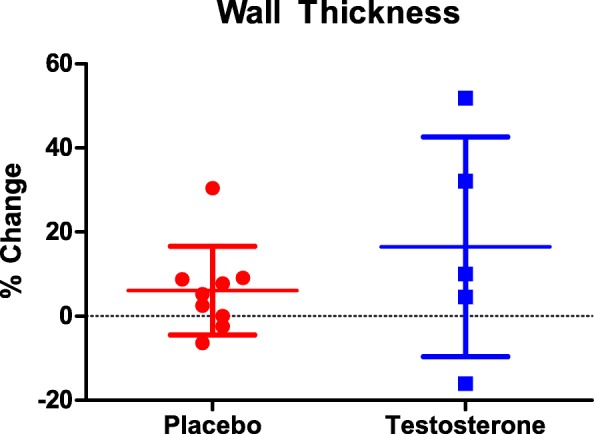
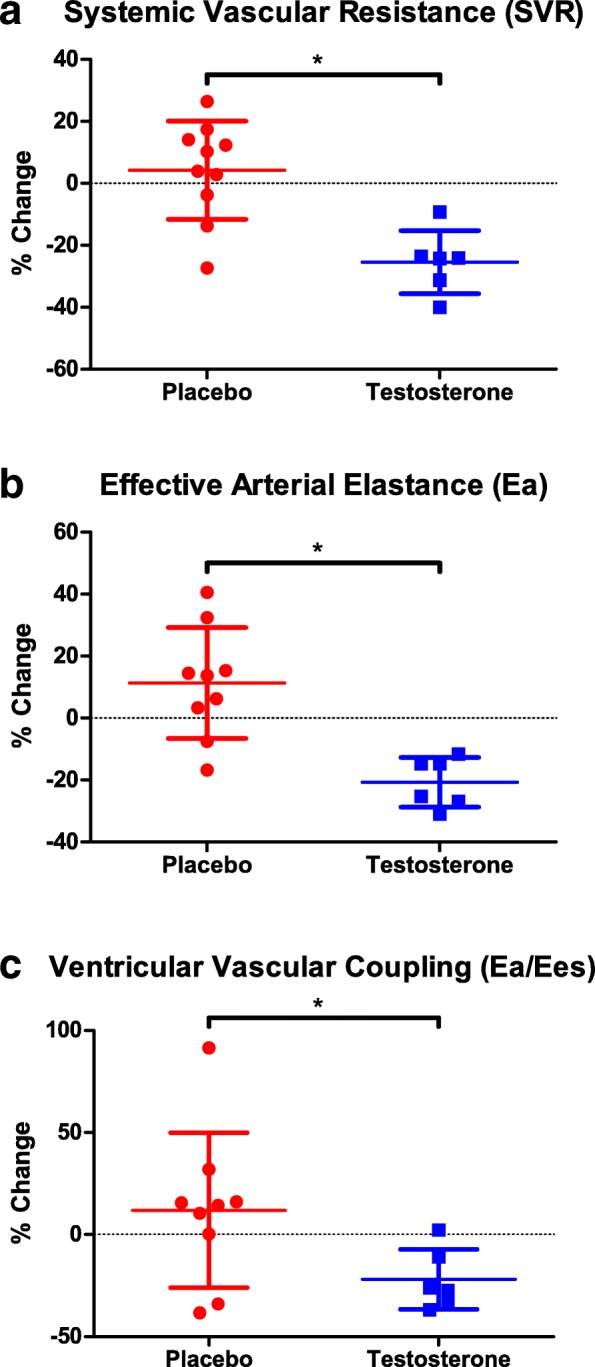
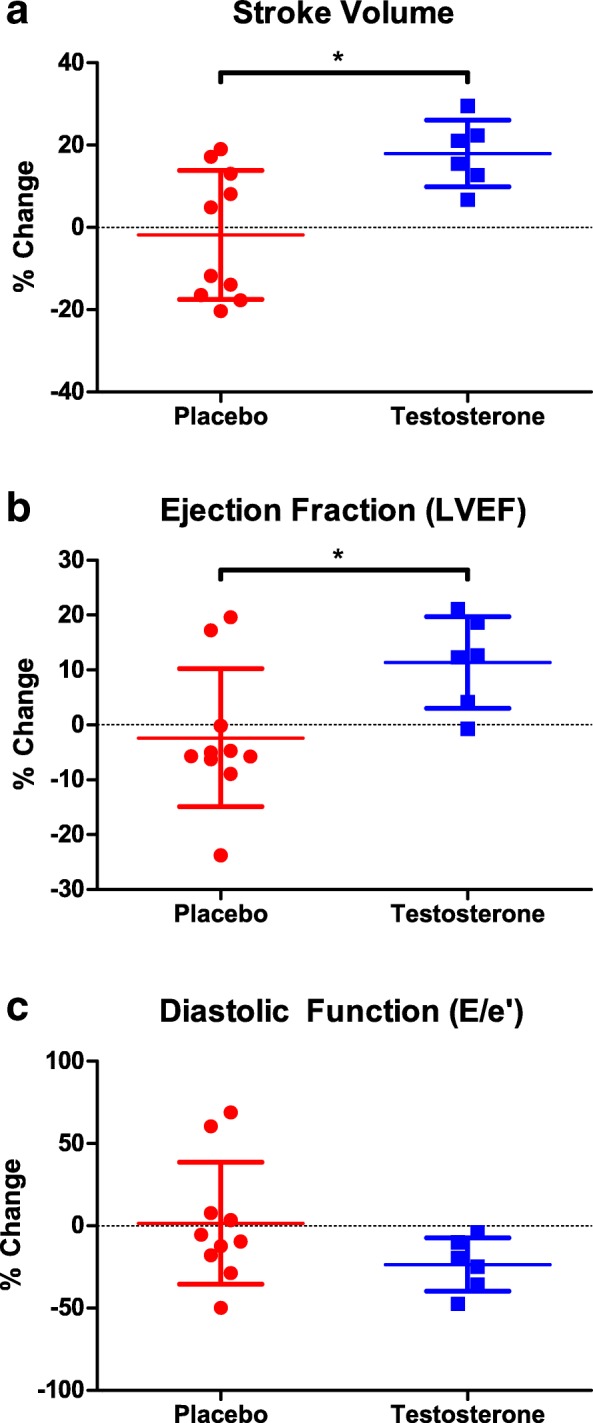
No significant differences were observed in LV posterior wall thickness in placebo (pre: 1.10 ± 0.1 cm; post: 1.16 ± 0.2 cm; p = 0.11) or testosterone groups (pre: 0.99 ± 0.1 cm; post: 1.14 ± 0.20 cm; p = 0.22). Compared with placebo, testosterone significantly improved LVEF (placebo: - 1.8 ± 4.3%; testosterone: + 6.2 ± 4.3%; p < 0.05), Ea (placebo: 0.0 ± 0.2 mmHg/mL; testosterone: - 0.3 ± 0.2 mmHg/mL; p < 0.05), and Ea/Ees (placebo: 0.0 ± 0.1; testosterone: - 0.2 ± 0.1; p < 0.05).
In patients with advanced cancers, testosterone was associated with favorable changes in left ventricular systolic function, arterial elastance, and ventricular-arterial coupling. Given the small sample size, the promising multisystem benefits of testosterone warrants further evaluation in a definitive randomized trial.
This study was prospectively registered on ClinicalTrials.gov (NCT00878995; date of registration: April 9, 2009).
雄激素治疗可改善晚期癌症患者的瘦体重、生活质量和体力活动;然而,雄激素对心脏形态和功能的影响尚不清楚。因此,作为一项雄激素补充对男性和女性晚期癌症患者身体成分影响的随机、安慰剂对照试验的辅助分析,我们探讨了雄激素补充是否可以预防或逆转左心室(LV)萎缩和功能障碍。
最近诊断为晚期(≥ IIB)或复发的头颈部或颈部癌症的男性和女性,计划接受标准护理化疗或同期放化疗,以每周肌内注射 100mg 雄激素(T,n=1M/5F)或安慰剂(P,n=6M/4F)的方式进行为期 7 周的辅助治疗,采用双盲随机方式。评估 LV 形态(壁厚度)、收缩功能(射血分数,EF)、舒张功能(E/A;E'/E)、动脉弹性(Ea)、收缩末期弹性(Ees)和心室-动脉偶联(Ea/Ees)。
安慰剂组(治疗前:1.10±0.1cm;治疗后:1.16±0.2cm;p=0.11)或雄激素组(治疗前:0.99±0.1cm;治疗后:1.14±0.20cm;p=0.22)的 LV 后壁厚度无显著差异。与安慰剂相比,雄激素显著改善 LVEF(安慰剂:-1.8±4.3%;雄激素:+6.2±4.3%;p<0.05)、Ea(安慰剂:0.0±0.2mmHg/mL;雄激素:-0.3±0.2mmHg/mL;p<0.05)和 Ea/Ees(安慰剂:0.0±0.1;雄激素:-0.2±0.1;p<0.05)。
在晚期癌症患者中,雄激素与左心室收缩功能、动脉弹性和心室-动脉偶联的有利变化有关。鉴于样本量较小,雄激素具有多系统获益的潜力,值得在一项确定性随机试验中进一步评估。
本研究前瞻性地在 ClinicalTrials.gov 注册(NCT00878995;注册日期:2009 年 4 月 9 日)。