Centre of Stomatology, Department of Conservative Dentistry and Endodontics, Xiangya Hospital, Central South University, No.87 Xiangya Road, Changsha, 410008, Hunan, China.
Xiangya School of Public Health, Department of Epidemiology and Health Statistics, Central South University, Changsha, Hunan, China.
BMC Oral Health. 2019 Aug 8;19(1):181. doi: 10.1186/s12903-019-0867-5.
The purpose of this experiment was to assess the push out bond strength of Polydimethylsiloxane sealers (GuttaFlow 2 and GuttaFlow Bioseal by Colte'ne/Whaledent, Altstätten, Switzerland). AH Plus (Dentsply, DeTrey, Konstanz, Germany) was used as a reference material for comparison.
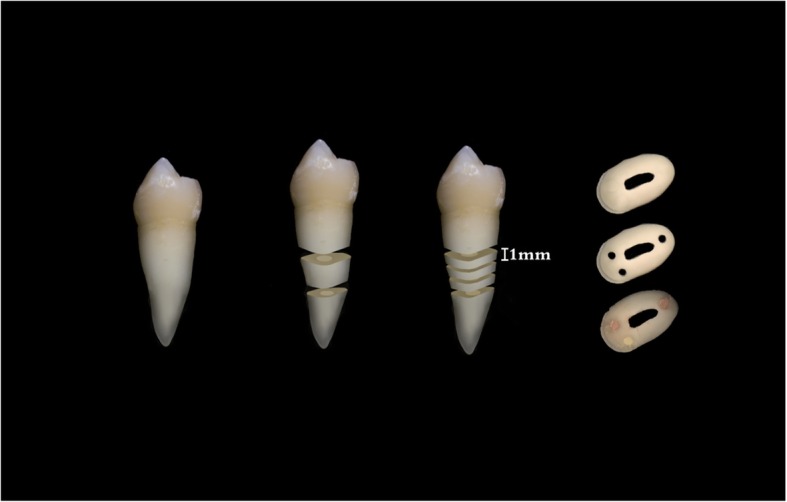
Thirty root slices were prepared from the middle third of 10 mandibular premolars. Each slice was 1 ± 0.1 mm thick. Three holes, 0.8 mm wide each, were drilled on the axial side of each root slice. These holes were subjected to standardized irrigations and then dried using paper points. Finally, for each root slice, each hole was filled with exactly one of the following three root canal sealers: AH Plus, GuttaFlow 2 and GuttaFlow Bioseal. After all the holes were filled in that way, the root slices were stored on top of phosphate-buffered saline solution (pH 7.2) soaked gauze for 7 days at the temperature of 37 degrees Celsius. Then, for each root canal sealer on a root slice, the universal testing machine was used to measure the push out bond strength. The differences in push out bond strengths between the three sealer samples were assessed using the Friedman test, while the paired comparisons were assessed using Wilcoxon signed rank test with Bonferroni correction. All statistical tests were two-tailed and the significance level was set at the 5%.
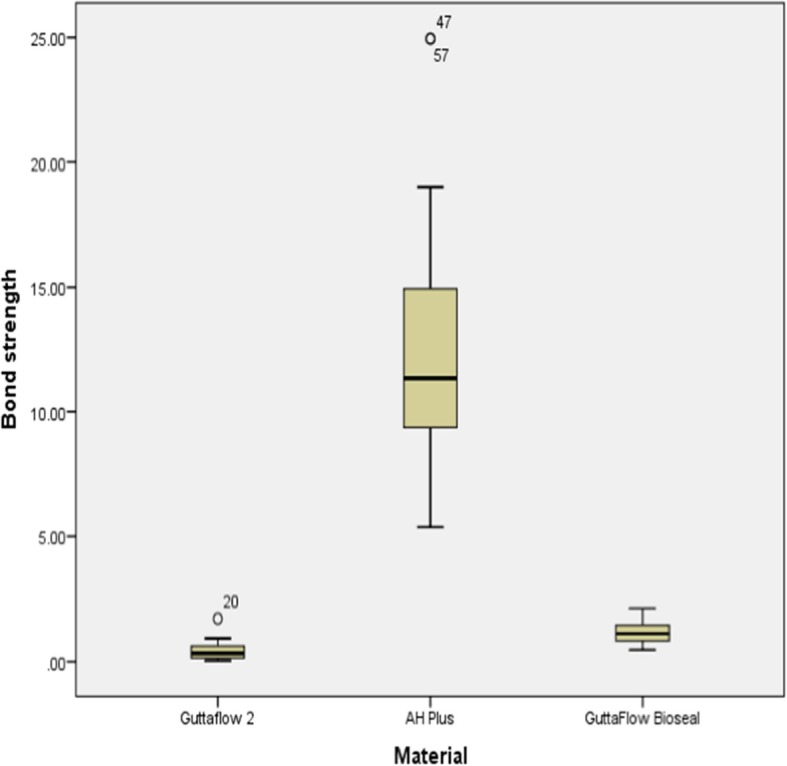
According to the Friedman test the distributions of push out bond strengths of AH Plus, GuttaFlow 2 and GuttaFlow Bioseal were different (P < 0.05). Paired comparisons indicated that AH Plus had a significantly superior push out bond strength than GuttaFlow 2 and GuttaFlow Bioseal, while the push out bond strength of GuttaFlow Bioseal was significantly stronger than that of GuttaFlow 2 (P < 0.01).
Based on these findings, AH Plus is a better root canal sealer than GuttaFlow 2 and GuttaFlow Bioseal.
本实验旨在评估聚二甲基硅氧烷密封剂(GuttaFlow 2 和 GuttaFlow Bioseal 由 Colte'ne/Whaledent,阿尔特施塔特,瑞士)的推出粘结强度。AH Plus(登士柏,DeTrey,康斯坦茨,德国)被用作比较的参考材料。
从 10 颗下颌前磨牙的中间三分之一处制备 30 个根切片。每个切片厚 1±0.1mm。在每个根切片的轴向侧钻三个孔,每个孔宽 0.8mm。这些孔经过标准化冲洗,然后用纸尖干燥。最后,对于每个根切片,每个孔都用以下三种根管密封剂之一填充:AH Plus、GuttaFlow 2 和 GuttaFlow Bioseal。用这种方式填充所有孔后,将根切片存放在盛有磷酸盐缓冲盐水(pH 7.2)的纱布上,在 37 摄氏度下储存 7 天。然后,对于根切片上的每种根管密封剂,使用万能试验机测量推出粘结强度。使用 Friedman 检验评估三种密封剂样品之间推出粘结强度的差异,而使用 Wilcoxon 符号秩检验进行配对比较,并进行 Bonferroni 校正。所有统计检验均为双侧检验,显著性水平设为 5%。
根据 Friedman 检验,AH Plus、GuttaFlow 2 和 GuttaFlow Bioseal 的推出粘结强度分布不同(P<0.05)。配对比较表明,AH Plus 的推出粘结强度明显优于 GuttaFlow 2 和 GuttaFlow Bioseal,而 GuttaFlow Bioseal 的推出粘结强度明显强于 GuttaFlow 2(P<0.01)。
根据这些发现,AH Plus 是一种比 GuttaFlow 2 和 GuttaFlow Bioseal 更好的根管密封剂。