Finnish Foundation for Alcohol Studies, P.O. Box 30, FI-00271, Helsinki, Finland.
Faculty of Social Sciences, Health Sciences, Tampere University, FI-33014, Tampere, Finland.
BMC Public Health. 2019 Aug 9;19(1):1077. doi: 10.1186/s12889-019-7391-z.
Gambling for money is a popular leisure time activity in most countries, which has major social and economic impacts not only affecting the gambler, but his/her significant others, and the society. Gambling impact studies can help researchers and policymakers compare the health and social costs and benefits of different gambling policies and can be used when considering which gambling policies will reduce or increase costs or benefits the most. In a public health approach, the impacts of gambling, negative and positive, are assessed across the entire severity spectrum of the activity. Although some studies have created basic principles for conducting impact studies, a theoretical model is currently lacking. The aim of this debate is to review complementing and contrasting views on the effects of gambling to create a conceptual model, where a public health perspective is applied.
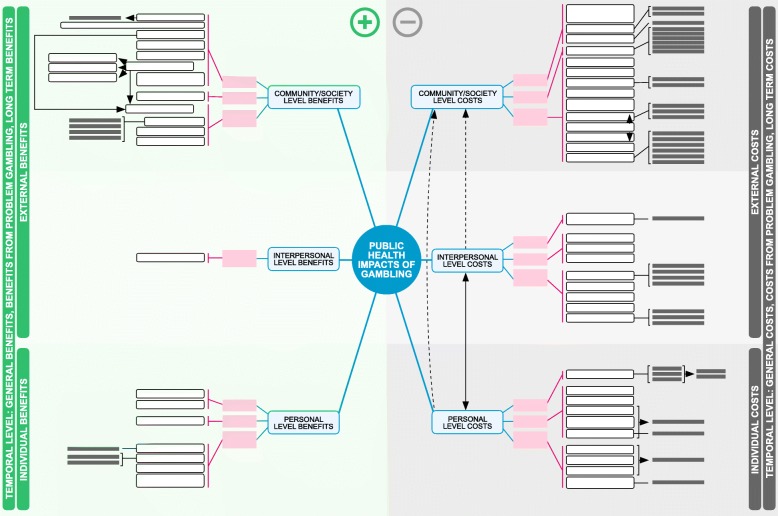
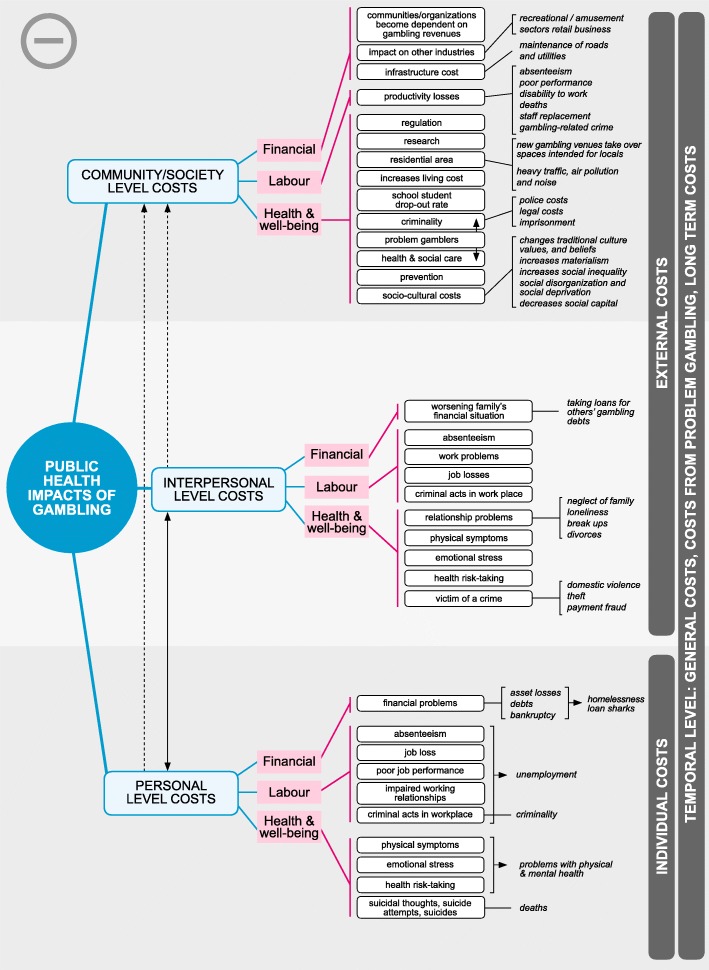
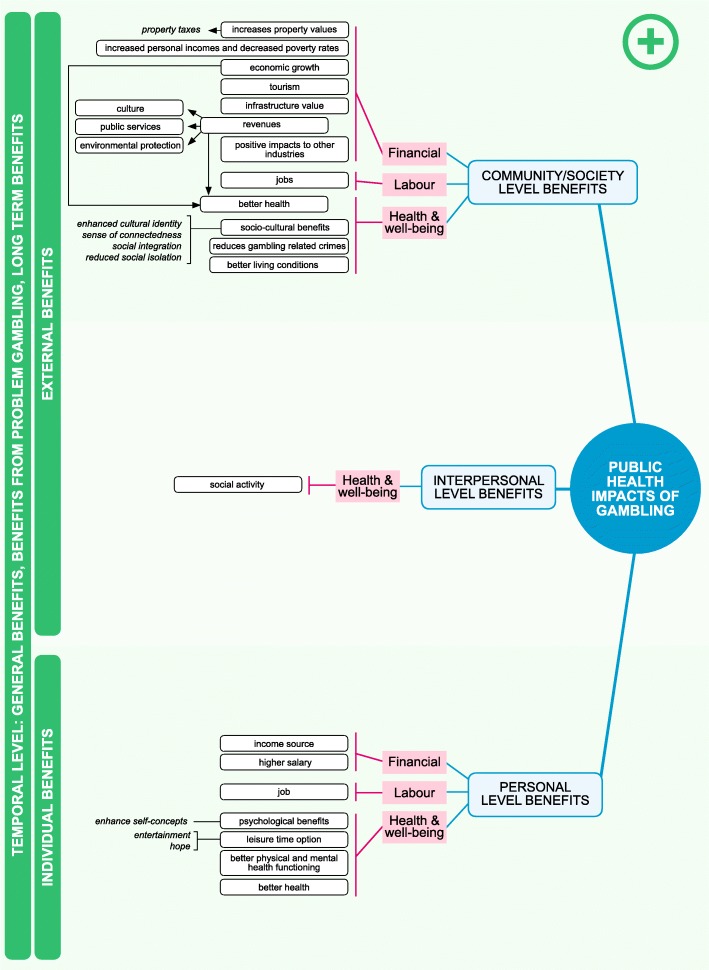
The effects of gambling can be structuralized using a conceptual model, where impacts are divided into negative and positive; costs and benefits. Costs and benefits are categorized into three classes: financial, labor and health, and well-being. These classes manifest in personal, interpersonal, and societal levels. Individual impacts cause effects on a personal level to gamblers themselves. External impacts influence the interpersonal and society/community levels and concern other people. The temporal level refers to the development, severity and scope of the gambling impact. These include general impacts, impacts of problem gambling and long-term impacts of gambling.
The conceptual model offers a base on which to start building common methodology for assessing the impact of gambling on the society. While measuring monetary impacts is not always straightforward, the main issue is how to measure the social impacts, which are typically ignored in calculations, as are personal and interpersonal impacts. The reviewed empirical work largely concentrated on the costs of gambling, especially costs on the community level. The Model can be used to identify areas where research is scarce. Filling the gaps in knowledge is essential in forming a balanced evidence base on the impacts of gambling. Ideally, this evidence could be the starting point in formulating public policies on gambling.
在大多数国家,赌博是一种流行的休闲活动,它不仅对赌徒本人,而且对其重要他人和整个社会都有重大的社会和经济影响。赌博影响研究可以帮助研究人员和政策制定者比较不同赌博政策的健康和社会成本和效益,并可用于考虑哪些赌博政策将减少或增加成本或效益。在公共卫生方法中,评估赌博活动的影响,无论是负面的还是正面的,都是在整个活动严重程度范围内进行的。虽然一些研究已经制定了进行影响研究的基本原则,但目前缺乏理论模型。本次辩论的目的是审查赌博影响的补充和对比观点,以创建一个概念模型,其中应用了公共卫生视角。
可以使用概念模型来结构化赌博的影响,将影响分为负面和正面;成本和效益。成本和效益分为三类:财务、劳动力和健康以及福祉。这些类别体现在个人、人际关系和社会层面。个人影响导致赌徒自身在个人层面产生影响。外部影响影响人际关系和社会/社区层面,并涉及其他人。时间层面是指赌博影响的发展、严重程度和范围。这些包括一般影响、问题赌博的影响和赌博的长期影响。
该概念模型为评估赌博对社会的影响建立共同方法提供了基础。虽然衡量货币影响并不总是那么简单,但主要问题是如何衡量社会影响,这些影响通常在计算中被忽略,就像个人和人际关系影响一样。已审查的实证工作主要集中在赌博的成本上,尤其是社区层面的成本。该模型可用于确定研究匮乏的领域。填补知识空白对于构建关于赌博影响的平衡证据基础至关重要。理想情况下,这一证据可以成为制定赌博公共政策的起点。