de Jong Nicole, Wisse Barbara, Heesink José A M, van der Zee Karen I
Department of Psychology, University of Groningen, Groningen, Netherlands.
Durham University Business School, Durham, United Kingdom.
Front Psychol. 2019 Jul 25;10:1720. doi: 10.3389/fpsyg.2019.01720. eCollection 2019.
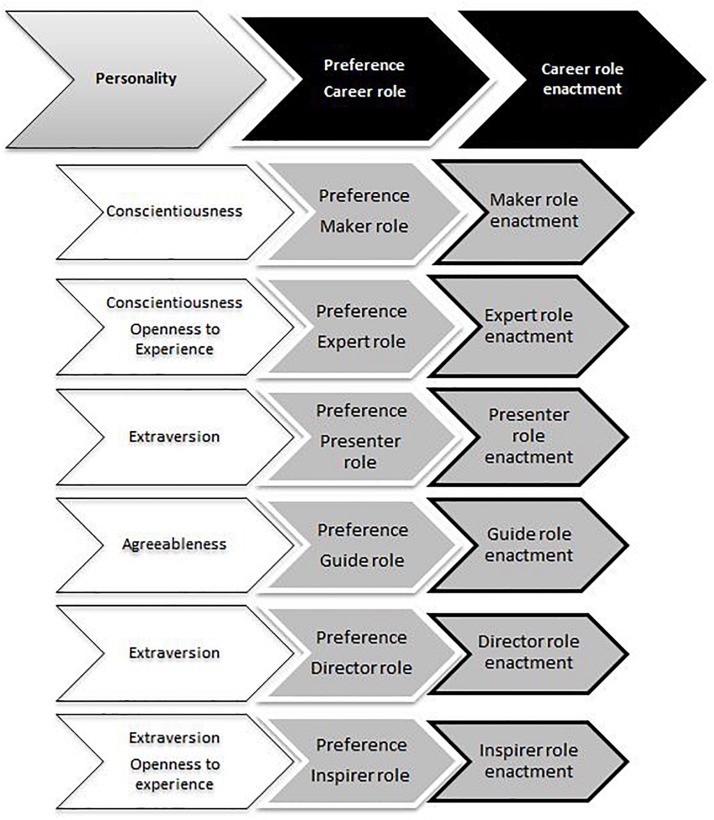
It has been argued that how a person's career unfolds is increasingly affected by his or her own values, personality characteristics, goals and preferences. The current study addresses the issue of how we can explain that personality traits are associated with the enactment of certain career roles. Two survey studies (e.g., a two wave worker sample and a cross-sectional worker sample) were conducted to investigate the relationships between personality traits, career role preferences and career role enactment. As expected, results indicate that peoples' personality traits predicted the preference for certain roles in the work context which, in turn, predicted the career roles they actually occupy. Specifically, our findings show that Extraversion, Conscientiousness and Openness to experience influence various career role preferences (i.e., Maker, Expert, Presenter, Guide, Director, and Inspirer role preferences) and, subsequently, the enactment of these career roles. Other traits, such as Neuroticism and Agreeableness, seem less important in predicting role preferences and subsequent role enactment. These results underline the importance of acknowledging not only individual trait differences but especially role preferences in explaining how careers develop over time. Further implications, limitations and research ideas are discussed.
有人认为,一个人的职业生涯如何发展越来越受到其自身价值观、个性特征、目标和偏好的影响。当前的研究探讨了我们如何解释个性特征与某些职业角色的扮演之间的关联这一问题。进行了两项调查研究(例如,一个两阶段的员工样本和一个横断面的员工样本),以调查个性特征、职业角色偏好和职业角色扮演之间的关系。正如预期的那样,结果表明,人们的个性特征预测了在工作环境中对某些角色的偏好,而这种偏好反过来又预测了他们实际占据的职业角色。具体而言,我们的研究结果表明,外向性、尽责性和经验开放性会影响各种职业角色偏好(即创造者、专家、展示者、引导者、指导者和激励者角色偏好),并随后影响这些职业角色的扮演。其他特征,如神经质和宜人性,在预测角色偏好和随后的角色扮演方面似乎不太重要。这些结果强调了不仅要认识到个体特征差异,而且尤其要认识到角色偏好在解释职业生涯如何随时间发展方面的重要性。还讨论了进一步的影响、局限性和研究思路。