Center for Human Nutrition, Department of International Health, Johns Hopkins Bloomberg School of Public Health, Baltimore, Maryland.
The JiVitA Project, Gaibandha, Bangladesh.
Ann N Y Acad Sci. 2020 May;1468(1):3-15. doi: 10.1111/nyas.14207. Epub 2019 Aug 12.
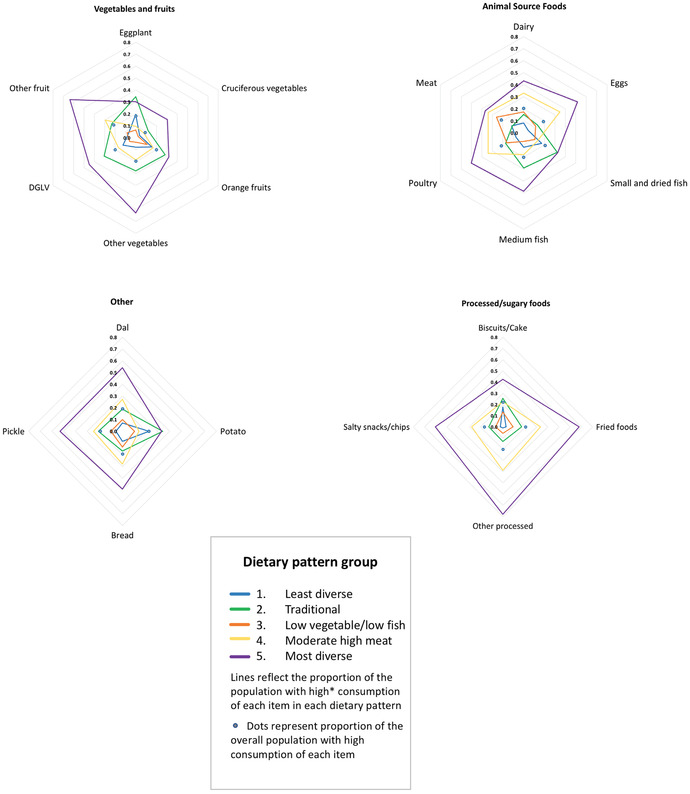
Little is known of the usual food intakes of rural adolescents in South Asia. This study describes dietary patterns, based on >91,000 7-day food frequencies among 30,702 girls and boys, aged 9-15 years in rural northwest Bangladesh. Three intake assessments per child, taken across a calendar year, were averaged to represent individual annual intake patterns for 22 food groups. Latent class analysis was used to assign individuals to dietary patterns based on class membership probabilities. The following five dietary patterns (class membership probabilities) were identified: (1) "least diverse" (0.20); (2) "traditional" (0.28); (3) "low vegetable/low fish" (0.23), (4) "moderately high meat" (0.20); and (5) "most diverse" (0.09). The least diverse pattern had the lowest median consumption of most foods and traditional had a relatively higher intake of most vegetables and fish. The most diverse pattern consumed both healthy and processed foods much more often than other patterns. The two most diverse patterns (4 and 5) were associated with higher socioeconomic status, body mass index, height-for-age Z-score, and male gender, and the least diverse pattern showed inverse associations with these characteristics. The most diverse pattern may represent an early wave of the nutrition transition in rural Bangladesh.
目前对于南亚农村青少年的常见食物摄入量知之甚少。本研究描述了基于孟加拉国西北部农村地区 30702 名 9-15 岁男女孩的 91000 多次 7 天食物频率调查的饮食模式。每个孩子的三次摄入量评估,横跨一整年进行,平均代表了 22 种食物组的个人年度摄入量模式。潜在类别分析根据类别成员概率分配个体的饮食模式。确定了以下五种饮食模式(类别成员概率):(1)“最不多样化”(0.20);(2)“传统”(0.28);(3)“低蔬菜/低鱼类”(0.23);(4)“适度高肉类”(0.20);和(5)“最多样化”(0.09)。最不多样化的模式大多数食物的消费中位数最低,而传统模式的大多数蔬菜和鱼类摄入相对较高。最多样化的模式比其他模式更频繁地食用健康和加工食品。两种最多样化的模式(4 和 5)与较高的社会经济地位、体重指数、身高年龄 Z 分数和男性性别有关,而最不多样化的模式则与这些特征呈负相关。最多样化的模式可能代表了孟加拉国农村营养转型的早期浪潮。