National Centre for Optics, Vision and Eye Care, Faculty of Health and Social Sciences, University of South-Eastern Norway, Hasbergs vei 36, 3616, Kongsberg, Norway.
BMC Ophthalmol. 2019 Aug 13;19(1):180. doi: 10.1186/s12886-019-1178-y.
Undetected vision problems is an important cause of reduced academic achievement, performance in everyday life and self-esteem. This receives little attention in national health care services in Norway even though most of these vision problems are easily correctable. There are no published data on how many Norwegian schoolchildren are affected by correctable vision problems. This study aims to determine the vision status in primary and secondary schoolchildren referred from vision screening during the 10 year period of 2003-2013.
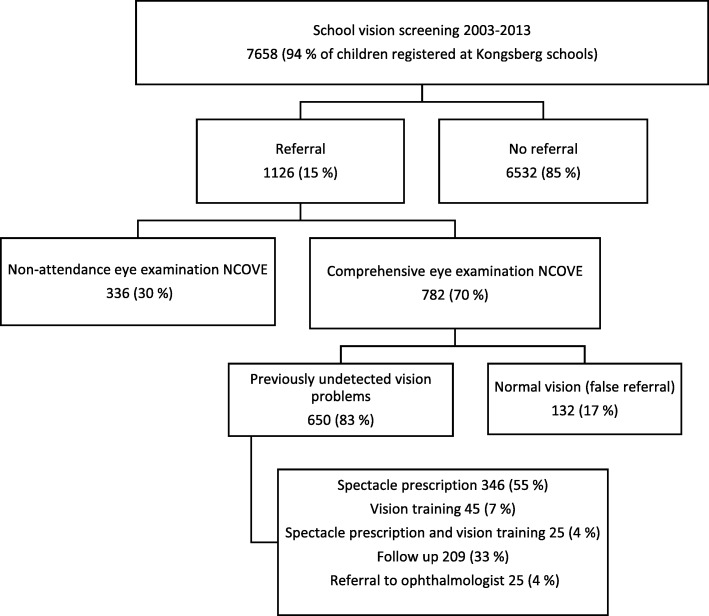
Of the 1126 children (15%) aged 7-15 years referred to the university eye clinic by the school screening program, all 782 who attended the eye clinic were included in the study. Patient records were retrospectively reviewed with regard to symptoms, refractive error, best corrected visual acuity (BCVA) of logMAR, binocular vision, ocular health and management outcomes.
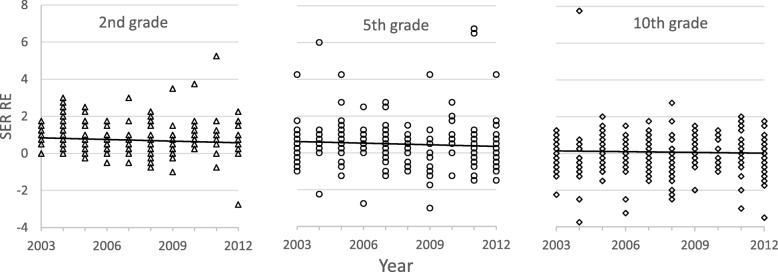
Previously undetected vision problems were confirmed in 650 (83%) of the children. The most frequent outcomes were glasses (346) or follow-up (209), but types of treatment modalities varied with age. Mean refractive errors were hyperopic for all age groups but reduced with age (ANOVA, p < 0.001). Overall, 51% were hyperopic, 32% emmetropic and 17% myopic. Refractive errors did not change across the decade (linear regression, all p > 0.05). Mean logMAR BCVAs were better than 0.0 and improved with age (ANOVA, p < 0.001). The most prevalent symptoms were headaches (171), near vision problems (149) and reduced distance vision (107).
The vision screening identified children with previously undetected visual problems. This study shows that the types of visual problems varied with age and that most problems could be solved with glasses. Our results stress the importance of regular eye examinations and that vision examinations should be included in primary health care services. Furthermore, there is a need for raised awareness among parents and teaching staff regarding vision problems in children.
未被发现的视力问题是导致学业成绩下降、日常生活表现不佳和自尊心受损的一个重要原因。尽管挪威的国家医疗保健服务中,这些视力问题大多可以通过简单的矫正来治疗,但这一问题并没有得到太多关注。目前还没有关于有多少挪威学童受到可矫正视力问题影响的公开数据。本研究旨在确定 2003 年至 2013 年的 10 年间,通过视力筛查转诊至大学眼科诊所的小学生和中学生的视力状况。
在被学校筛查项目转诊的 1126 名 7-15 岁儿童中,共有 782 名参加了眼科诊所检查的儿童被纳入研究。对患者的病历进行回顾性审查,内容包括症状、屈光不正、最佳矫正视力(logMAR)、双眼视觉、眼部健康和治疗结果。
在 650 名(83%)儿童中发现了先前未被发现的视力问题。最常见的结果是配眼镜(346 例)或随访(209 例),但治疗方式因年龄而异。所有年龄组的平均屈光不正均为远视,但随年龄增长而降低(方差分析,p<0.001)。总体而言,51%为远视,32%为正视,17%为近视。在这十年间,屈光不正并未发生变化(线性回归,p>0.05)。平均 logMAR 最佳矫正视力优于 0.0,且随年龄增长而提高(方差分析,p<0.001)。最常见的症状是头痛(171 例)、近视力问题(149 例)和远视力下降(107 例)。
视力筛查发现了以前未被发现的视觉问题的儿童。本研究表明,视觉问题的类型随年龄而变化,大多数问题可以通过戴眼镜来解决。我们的研究结果强调了定期进行眼部检查的重要性,建议将视力检查纳入初级卫生保健服务中。此外,还需要提高家长和教师对儿童视力问题的认识。