University of KwaZulu Natal, College of Health Sciences, Private Bag X54001, Durban, 4000, South Africa.
Queens University Belfast, University Rd, Belfast, BT7 1NN, UK.
BMC Public Health. 2023 Aug 18;23(1):1575. doi: 10.1186/s12889-023-16484-z.
Despite being easily corrected with eyeglasses, over two-thirds of the world's child population presents with vision impairment (VI) due to uncorrected refractive errors. While systematic reviews have shown that VI can significantly impact children's depression and anxiety, none have reviewed the existing literature on the association between spectacle correction and well-being. This review aims to address this knowledge gap.
The main outcome measures were i) cognitive and education well-being which included mathematics and english literacy, reading fluency, school function, academic performance and grades; ii) psychological and mental health well-being which included physical anxiety, learning anxiety and mental health test scores and iii) quality of life.
We searched eight databases for articles published between 1999 to 2021 that assessed the associations between spectacle correction and children's (0 to 18 years) well-being. There were no restrictions on language or geographic location. Two reviewers independently screened all publications using validated quality checklists. The findings of the review were analysed using narrative synthesis. [PROSPERO CRD42020196847].
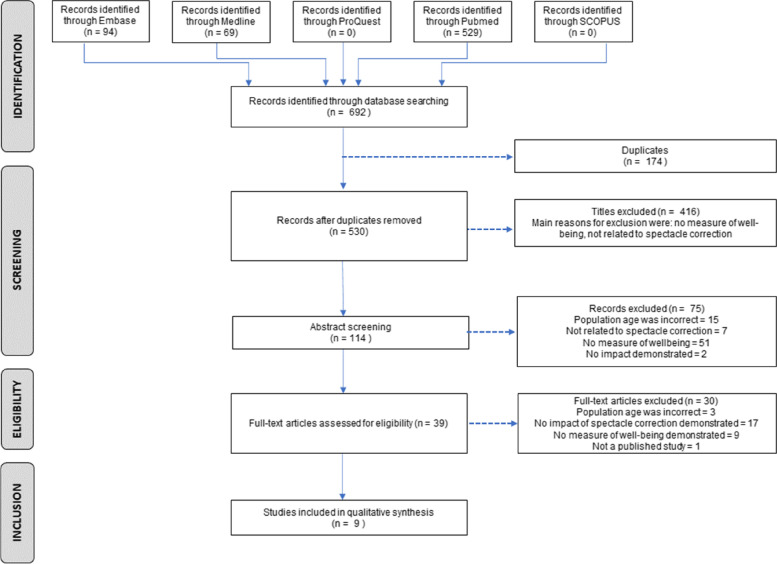
Of 692 records found in the databases, six randomised control trials, one cohort, one cross-sectional and one qualitative study (N = 9, 1.3%) were eligible for analysis. Data were collected from 25 522 children, 20 parents and 25 teachers across the nine studies. Seven were rated as good quality (67 to 100% of quality criteria fulfilled), and two were satisfactory (33 to 66% of quality criteria fulfilled). Spectacle correction was found to improve children's educational well-being (n = 4 very strong evidence; n = 2 strong evidence), quality of life (n = 1, very strong evidence) and decrease anxiety and increase mental health scores (n = 1, strong evidence).
Evidence suggests that spectacle correction improves children's cognitive and educational well-being, psychological well-being, mental health, and quality of life. More research is needed, given the paucity of published literature and the focus on only three aspects of well-being.
尽管通过眼镜很容易矫正,全世界仍有超过三分之二的儿童因未矫正的屈光不正而存在视力障碍(VI)。虽然系统评价表明 VI 会显著影响儿童的抑郁和焦虑,但没有一项评价过关于眼镜矫正与幸福感之间关系的现有文献。本综述旨在弥补这一知识空白。
主要结局指标为:i)认知和教育幸福感,包括数学和英语读写能力、阅读流畅度、学校功能、学业成绩和成绩;ii)心理和心理健康幸福感,包括身体焦虑、学习焦虑和心理健康测试分数;iii)生活质量。
我们在 1999 年至 2021 年期间检索了评估眼镜矫正与儿童(0 至 18 岁)幸福感之间关联的八项数据库的文章。本研究无语言或地理位置限制。两名评审员使用验证的质量检查表独立筛选所有出版物。使用叙述性综合分析方法分析综述结果。[PROSPERO CRD42020196847]。
在数据库中发现的 692 条记录中,有六项随机对照试验、一项队列研究、一项横断面研究和一项定性研究(N=9,1.3%)符合分析条件。数据来自九个研究中的 25522 名儿童、20 名家长和 25 名教师。其中 7 项研究被评为高质量(满足 67%至 100%的质量标准),2 项研究为满意度(满足 33%至 66%的质量标准)。眼镜矫正被发现可以改善儿童的教育幸福感(n=4 项非常有力的证据;n=2 项有力的证据)、生活质量(n=1 项,非常有力的证据),并降低焦虑和提高心理健康评分(n=1 项,有力的证据)。
有证据表明,眼镜矫正可改善儿童的认知和教育幸福感、心理健康、心理健康和生活质量。鉴于发表文献较少且仅关注幸福感的三个方面,需要进行更多的研究。