Department of Internal Medicine, University of Miami/Jackson Memorial Hospital, Miami, FL, USA.
Sylvester Comprehensive Cancer Center, Miami, FL, USA.
Breast Cancer Res Treat. 2019 Nov;178(2):433-440. doi: 10.1007/s10549-019-05403-9. Epub 2019 Aug 14.
There are few studies that directly investigate disparities in outcome within the African diaspora in the US. We investigated the association between nativity of Black women diagnosed with breast cancer (Caribbean or USA place of birth) and ethnicity, age at diagnosis, treatment, tumor characteristics and outcome.
The data were obtained from the University of Miami Health System, and Jackson Health System. Individual-level data from 1132 cases was used to estimate hazard rations (HRs) of women born in the Caribbean (Caribbean Blacks, CB) or in the USA (US Black, USB) using Cox proportional hazards regression analysis for overall survival.
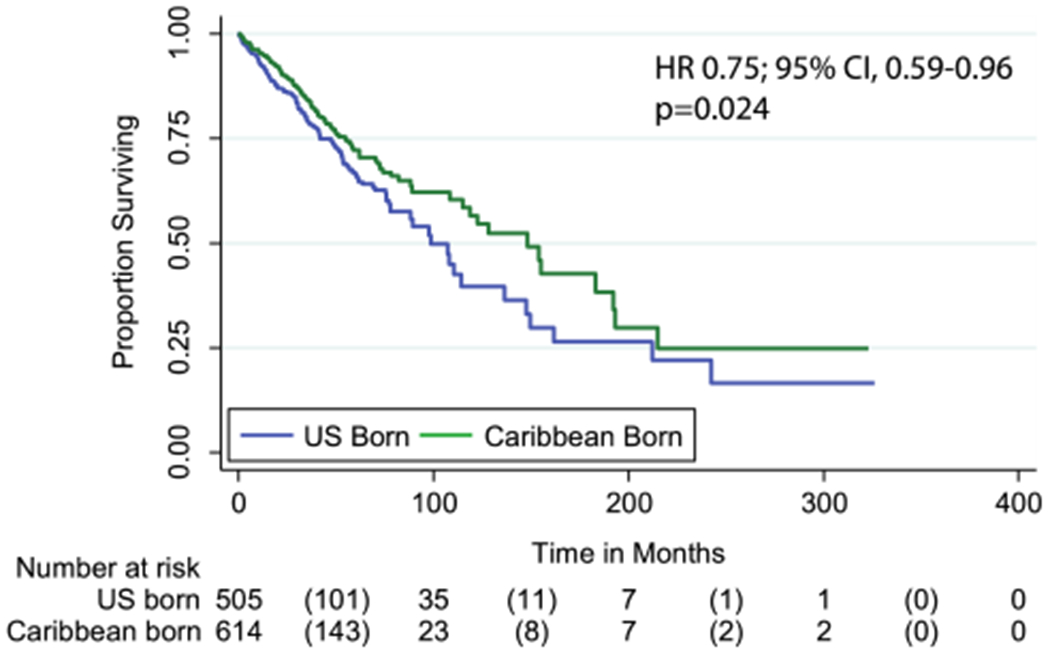
The cohort contains data from 624 (54.9%) USB women and 507 (45%) CB women diagnosed with breast cancer between 2006 and 2017. Compared to CB patients, USB patients had more Estrogen Receptor negative (31.4% vs. 39.1%, P = 0.018) and triple negative breast cancers (19.6% vs. 27.9%, P = 0.003). CB women presented at more advanced stages III/IV (44.2% vs. 35.2%; P = 0.016). CB patients showed a better overall survival (hazard ratio, HR = 0.75; 95% CI 0.59-0.96; P = 0.024). Overall Black Hispanic patients had a better overall survival (HR = 0.51; 95% CI 0.28-0.93; P = 0.028) compared to non-Hispanic Black patients.
In conclusion the study found that CB immigrants diagnosed with breast cancer have an improved overall survival when compared with USB patients. This finding suggests that within the African diaspora in the USA, additional factors beyond race contribute to worse outcomes in African Americans.
目前鲜有研究直接调查美国非裔散居群体内部的结果差异。我们调查了在美国被诊断患有乳腺癌的黑人女性(加勒比海或美国出生地)的出生地与族裔、诊断时的年龄、治疗、肿瘤特征和结果之间的关系。
数据来自迈阿密大学健康系统和杰克逊健康系统。使用 Cox 比例风险回归分析,对 1132 例个体数据进行分析,以估计出生于加勒比海地区(加勒比海黑人,CB)或美国(美国黑人,USB)的女性的总体生存率的风险比(HRs)。
该队列包含了 2006 年至 2017 年间被诊断患有乳腺癌的 624 名(54.9%)USB 女性和 507 名(45%)CB 女性的数据。与 CB 患者相比,USB 患者的雌激素受体阴性(31.4%对 39.1%,P=0.018)和三阴性乳腺癌(19.6%对 27.9%,P=0.003)的比例更高。CB 女性的疾病分期更晚,III/IV 期(44.2%对 35.2%;P=0.016)。CB 患者的总体生存率更好(风险比,HR=0.75;95%置信区间 0.59-0.96;P=0.024)。总体上,与非西班牙裔黑人患者相比,西班牙裔黑人 Hispanic 患者的总体生存率更高(HR=0.51;95%置信区间 0.28-0.93;P=0.028)。
总之,该研究发现,与 USB 患者相比,被诊断患有乳腺癌的 CB 移民的总体生存率更高。这一发现表明,在美国的非裔散居群体中,除了种族之外,还有其他因素导致非裔美国人的结果更差。