Research Center "E. Piaggio", University of Pisa, Largo Lucio Lazzarino, 1, 56122, Pisa, Italy.
Laboratory of Ecohydrology, Ecole Polytechnique Fédérale de Lausanne, Lausanne, 1015, Switzerland.
Sci Rep. 2019 Aug 15;9(1):11890. doi: 10.1038/s41598-019-48347-2.
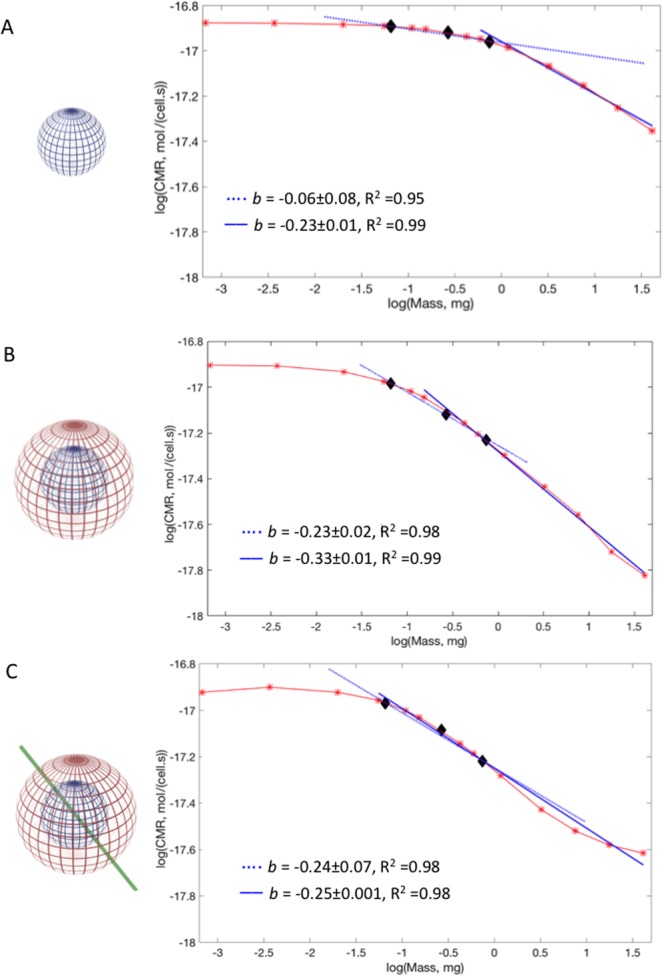
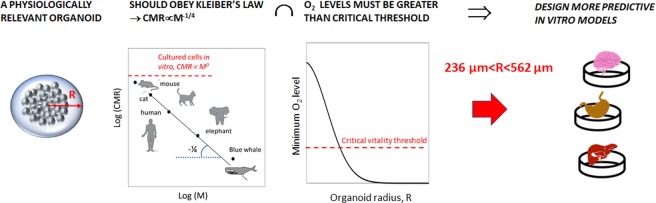
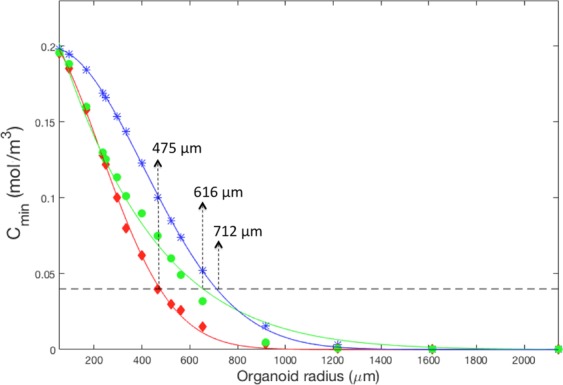
The functional and structural resemblance of organoids to mammalian organs suggests that they might follow the same allometric scaling rules. However, despite their remarkable likeness to downscaled organs, non-luminal organoids are often reported to possess necrotic cores due to oxygen diffusion limits. To assess their potential as physiologically relevant in vitro models, we determined the range of organoid masses in which quarter power scaling as well as a minimum threshold oxygen concentration is maintained. Using data on brain organoids as a reference, computational models were developed to estimate oxygen consumption and diffusion at different stages of growth. The results show that mature brain (or other non-luminal) organoids generated using current protocols must lie within a narrow range of masses to maintain both quarter power scaling and viable cores. However, micro-fluidic oxygen delivery methods could be designed to widen this range, ensuring a minimum viable oxygen threshold throughout the constructs and mass dependent metabolic scaling. The results provide new insights into the significance of the allometric exponent in systems without a resource-supplying network and may be used to guide the design of more predictive and physiologically relevant in vitro models, providing an effective alternative to animals in research.
类器官在功能和结构上与哺乳动物器官相似,这表明它们可能遵循相同的异速生长比例法则。然而,尽管类器官与缩小版的器官非常相似,但由于氧气扩散限制,非腔道类器官通常会出现坏死核心。为了评估它们作为具有生理相关性的体外模型的潜力,我们确定了类器官质量的范围,在此范围内可以保持四分之一幂次比例和最小氧气浓度阈值。利用脑类器官的数据作为参考,开发了计算模型来估计不同生长阶段的氧气消耗和扩散。结果表明,使用当前方案生成的成熟脑(或其他非腔道)类器官必须位于一个狭窄的质量范围内,以维持四分之一幂次比例和有活力的核心。然而,可以设计微流控氧气输送方法来扩大这个范围,确保整个结构和质量依赖性代谢比例都有最小的存活氧气阈值。这些结果为没有资源供应网络的系统中异速生长指数的意义提供了新的见解,并可用于指导更具预测性和生理相关性的体外模型的设计,为研究中替代动物提供了一种有效的方法。