iBB - Institute for Bioengineering, Instituto Superior Técnico, Universidade de Lisboa, Lisbon, Portugal.
Department of Bioengineering, Instituto Superior Técnico, Universidade de Lisboa, Lisbon, Portugal.
Front Cell Infect Microbiol. 2019 Jul 31;9:273. doi: 10.3389/fcimb.2019.00273. eCollection 2019.
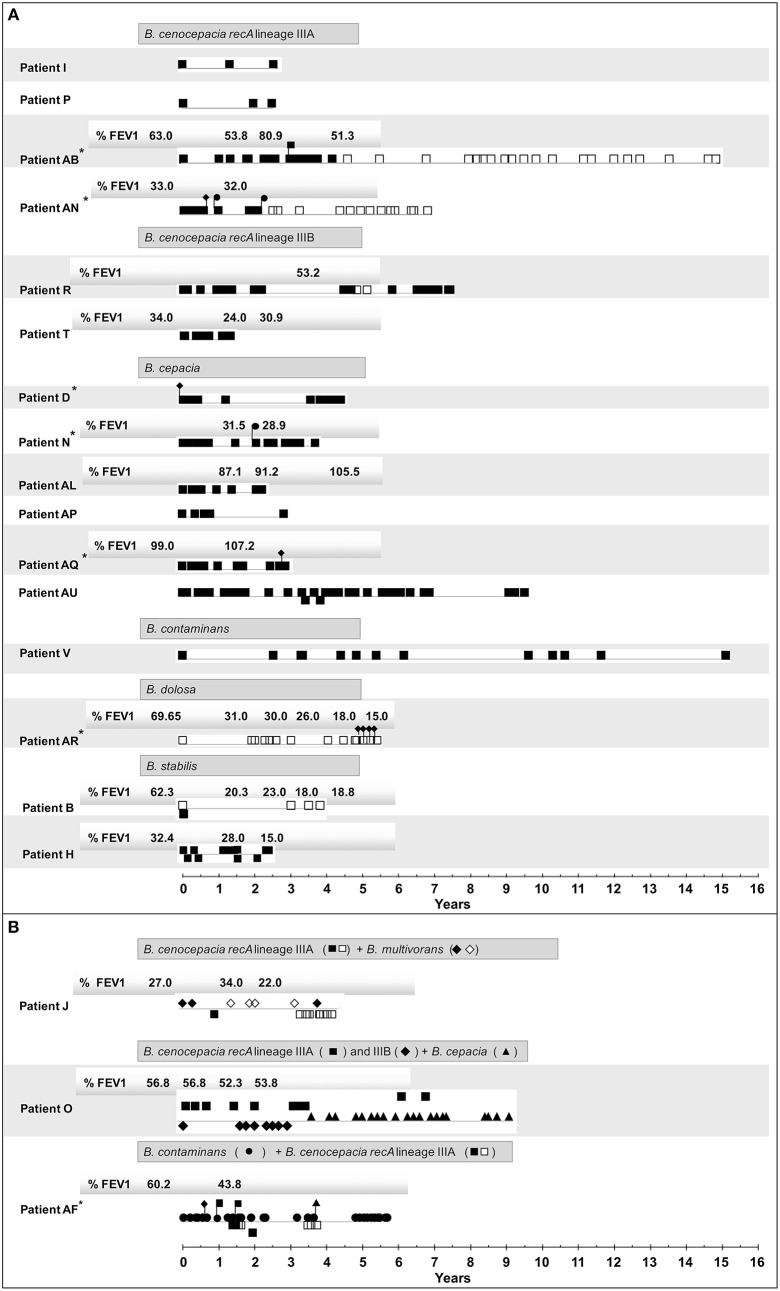
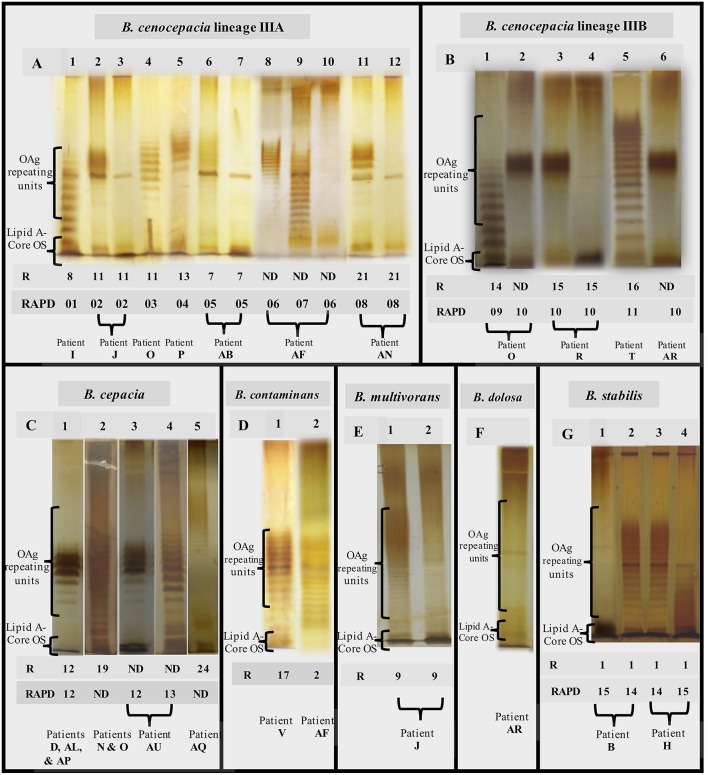
complex (Bcc) bacteria can adapt to the lung environment of cystic fibrosis (CF) patients resulting in the emergence of a very difficult to eradicate heterogeneous population leading to chronic infections associated with rapid lung function loss and increased mortality. Among the important phenotypic modifications is the variation of the lipopolysaccharide (LPS) structure at level of the O-antigen (OAg) presence, influencing adherence, colonization and the ability to evade the host defense mechanisms. The present study was performed to understand whether the loss of OAg expression during CF infection can be considered a general phenomenon in different Bcc species favoring its chronicity. In fact, it is still not clear why different Bcc species/strains differ in their ability to persist in the CF lung and pathogenic potential. The systematic two-decade-retrospective-longitudinal-screening conducted covered 357 isolates retrieved from 19 chronically infected patients receiving care at a central hospital in Lisbon. The study involved 21 Bcc strains of six/seven Bcc species/lineages, frequently or rarely isolated from CF patients worldwide. Different strains/clonal variants obtained during infection gave rise to characteristic OAg-banding patterns. The two most prevalent and feared species, and , showed a tendency to lose the OAg along chronic infection. . lineage IIIA strains known to lead to particularly destructive infections exhibit the most frequent OAg loss, compared with lineage IIIB. The switch frequency increased with the duration of infection and the level of lung function deterioration. For the first time, it is shown that the rarely found and , whose representation in the cohort of patients examined is abnormally high, keep the OAg even during 10- or 15-year infections. Data from co-infections with different Bcc species reinforced these conclusions. Concerning the two other rarely found species examined, . exhibited a stable OAg expression phenotype over the infection period while for the single clone of the more distantly related . species, the OAg-chain was absent from the beginning of the 5.5-year infection until the patient dead. This work reinforces the relevance attributed to the OAg-expression switch suggesting marked differences in the various Bcc species.
复杂(Bcc)细菌可以适应囊性纤维化(CF)患者的肺部环境,从而产生一种非常难以根除的异质群体,导致与快速肺功能丧失和死亡率增加相关的慢性感染。在重要的表型修饰中,脂多糖(LPS)结构在 O-抗原(OAg)存在水平上的变化,影响粘附、定植和逃避宿主防御机制的能力。本研究旨在了解 CF 感染过程中 OAg 表达的丧失是否可以被认为是不同 Bcc 物种慢性化的普遍现象。事实上,不同的 Bcc 物种/菌株在其在 CF 肺部持续存在和致病潜力方面的差异仍不清楚。这项系统性的 20 年回顾性纵向筛查涵盖了 19 名在里斯本一家中心医院接受治疗的慢性感染患者中回收的 357 株分离株。该研究涉及来自世界范围内 CF 患者中经常或很少分离到的六个/七个 Bcc 物种/谱系的 21 株 Bcc 菌株。感染过程中获得的不同菌株/克隆变异体产生了特征性的 OAg 带型。两种最普遍和最可怕的物种 和 ,在慢性感染过程中表现出失去 OAg 的趋势。已知导致特别破坏性感染的 IIIA 谱系菌株表现出最频繁的 OAg 缺失,而 IIIB 谱系则较少。随着感染时间的延长和肺功能恶化程度的增加,转换频率增加。首次表明,在本研究中检查的患者队列中异常高的罕见物种 和 ,即使在 10 年或 15 年的感染中也保留 OAg。来自不同 Bcc 物种共同感染的数据强化了这些结论。关于所检查的另外两种罕见的物种, ,在感染期间表现出稳定的 OAg 表达表型,而对于更遥远相关的. 物种的单个克隆,OAg 链从感染开始就不存在,直到患者死亡。这项工作强化了归因于 OAg 表达开关的相关性,表明各种 Bcc 物种之间存在明显差异。