Department of Medical Physics, Maria Sklodowska-Curie Institute - Oncology Center Gliwice Branch, Wybrzeze Armii Krajowej 15, 44-101, Gliwice, Poland.
I Radiation And Clinical Oncology Department, Maria Sklodowska-Curie Institute - Oncology Center Gliwice Branch, Wybrzeze Armii Krajowej 15, Gliwice, 44-101, Poland.
Metabolomics. 2019 Aug 16;15(8):110. doi: 10.1007/s11306-019-1576-4.
Nutritional treatment in head and neck squamous cell carcinoma cancer (HNSCC) patients undergoing radio-/chemo-radiotherapy (RT/CHRT) is complex and requires a multidisciplinary approach. In this study the real-time dynamic changes in serum metabolome during RT/CHRT in HNSCC patients were monitored using NMR-based metabolomics.
The main goal was to find the metabolic markers that could help prevent of acute radiation sequelae (ARS) escalation.
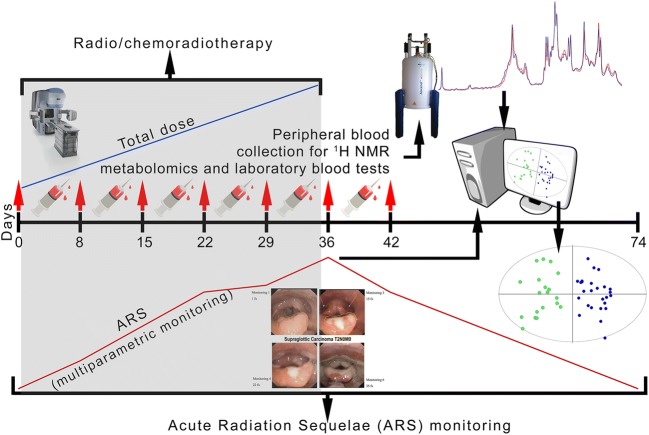
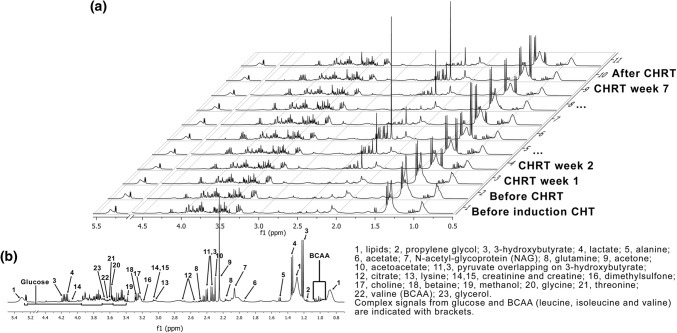
170 HNSCC patients were treated radically with RT/CHRT. Blood samples were collected weekly, starting from the day before the treatment and stopping within the week after the RT/CHRT completion, resulting in a total number of 1328 samples. H NMR spectra were acquired on Bruker 400 MHz spectrometer at 310 K and analyzed using principal component analysis (PCA) and orthogonal partial least squares discriminant analysis (OPLS-DA). Additional statistical analyses were performed on the quantified metabolites.
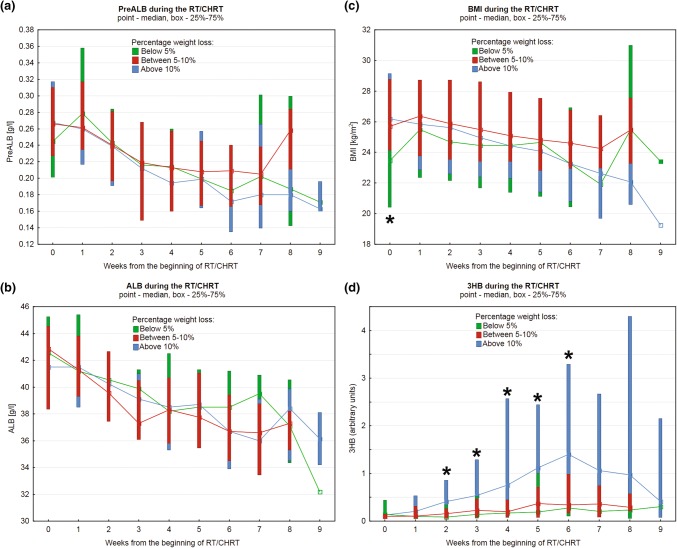
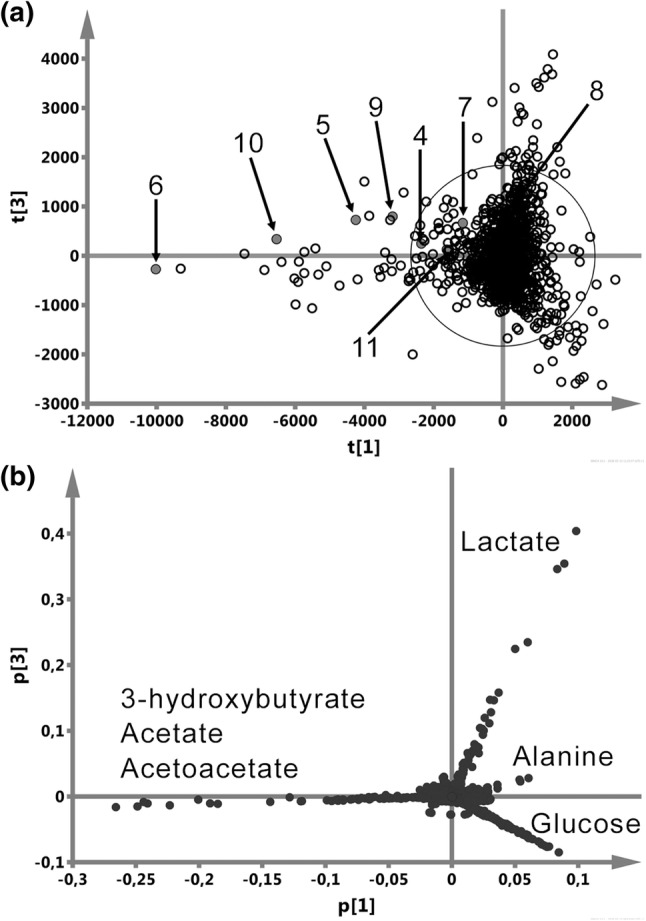
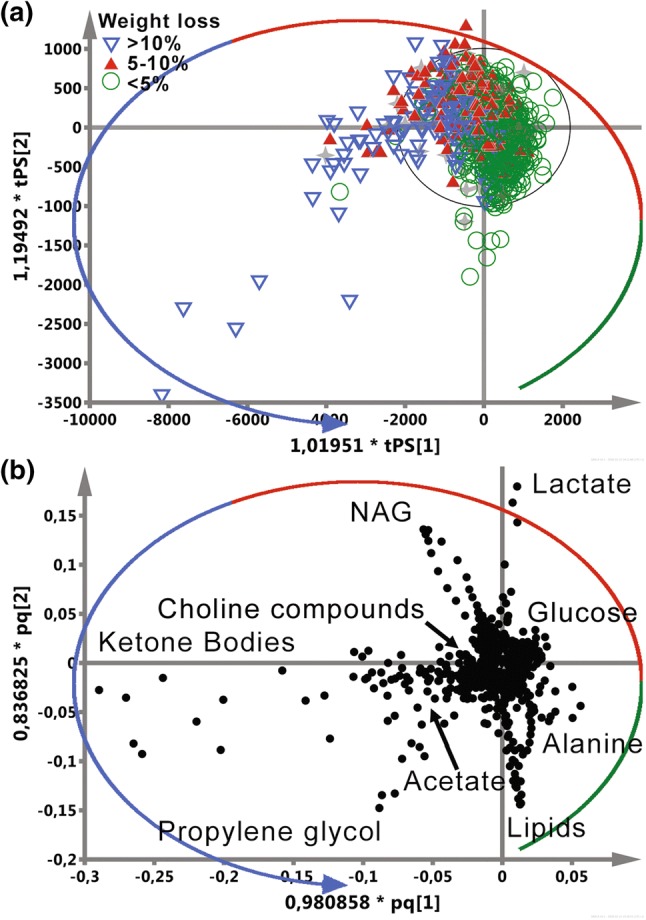
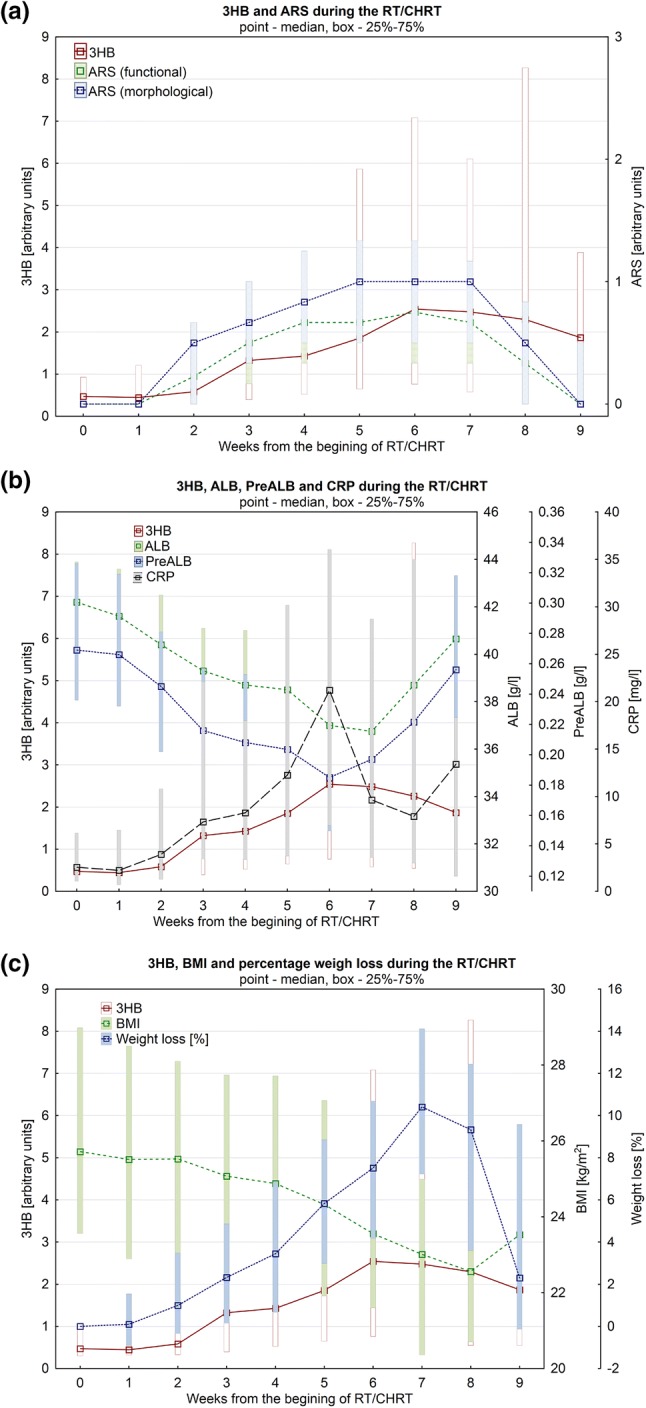
PCA has detected a group of distinct outliers corresponding to ketone bodies (3HB, Ace, AceAce). These outliers were found to identify the individuals at high risk of weight loss, mainly by the 3HB changes, which was confirmed by the patients' medical data. In the OPLS-DA models a transition from the lowest to the highest weight loss is seen, defining the metabolic time trajectories for the patients from the studied groups during RT/CHRT. 3HB is a relatively sensitive marker that allows earlier identification of the patients at higher risk of > 10% weight loss.
Our findings indicate that metabolic alterations, characteristic for malnutrition or cachexia, can be detected already at the beginning of the treatment, making it possible to monitor the patients with a higher risk of weight loss.
头颈部鳞状细胞癌(HNSCC)患者在接受放化疗(RT/CHRT)期间的营养治疗较为复杂,需要多学科的方法。在这项研究中,使用基于 NMR 的代谢组学监测 HNSCC 患者在 RT/CHRT 期间血清代谢组的实时动态变化。
主要目标是找到有助于预防急性放射后遗症(ARS)恶化的代谢标志物。
170 例 HNSCC 患者接受根治性 RT/CHRT 治疗。从治疗前一天开始每周采集一次血样,持续到 RT/CHRT 完成后的一周内,总共采集了 1328 个样本。在 Bruker 400 MHz 光谱仪上在 310 K 下获得 H NMR 光谱,并使用主成分分析(PCA)和正交偏最小二乘判别分析(OPLS-DA)进行分析。对定量代谢物进行了额外的统计分析。
PCA 检测到一组与酮体(3HB、Ace、AceAce)相对应的明显异常值。这些异常值被发现可以识别体重减轻风险较高的个体,主要通过 3HB 的变化来识别,这得到了患者医疗数据的证实。在 OPLS-DA 模型中,可以看到从体重减轻最低到最高的转变,定义了在 RT/CHRT 期间患者的代谢时间轨迹。3HB 是一个相对敏感的标志物,它可以更早地识别体重减轻风险较高的患者。
我们的研究结果表明,在治疗开始时就可以检测到营养不良或恶病质的代谢变化,从而可以监测体重减轻风险较高的患者。