Sapienza University of Rome, Department of Physics, Roma, Italy.
Lineberger Comprehensive Cancer Center (LCCC), University of North Carolina at Chapel Hill, Chapel Hill, NC, United States of America.
PLoS One. 2019 Aug 19;14(8):e0217889. doi: 10.1371/journal.pone.0217889. eCollection 2019.
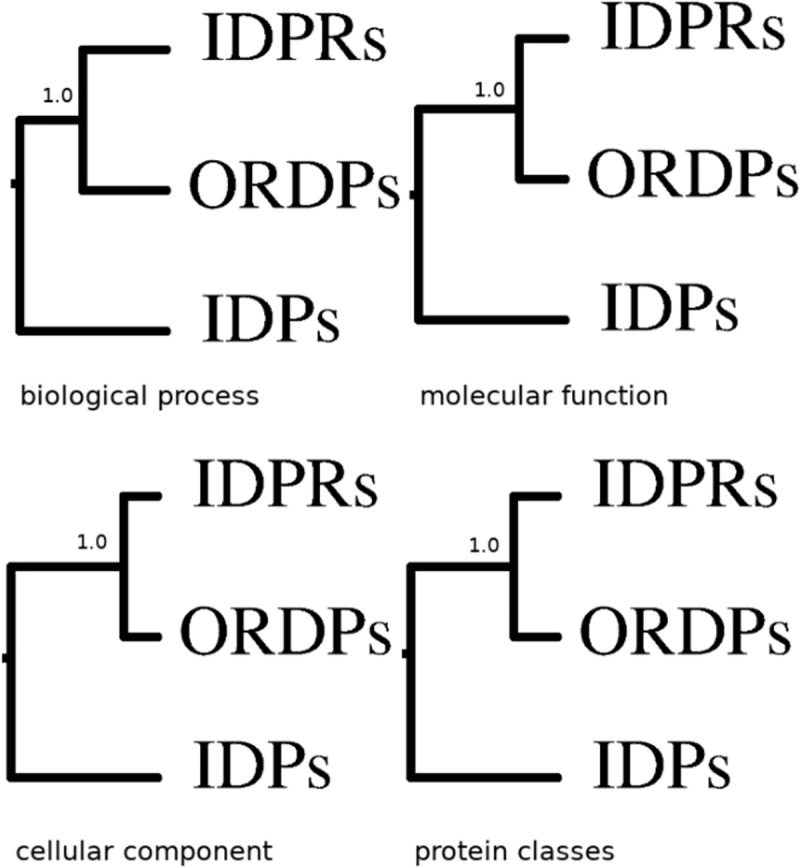
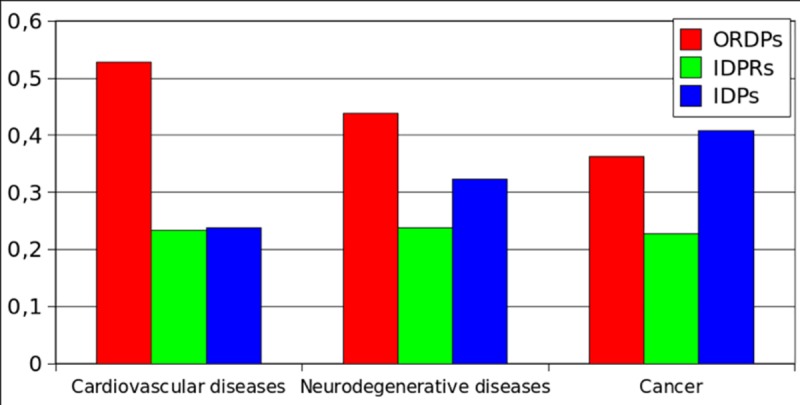
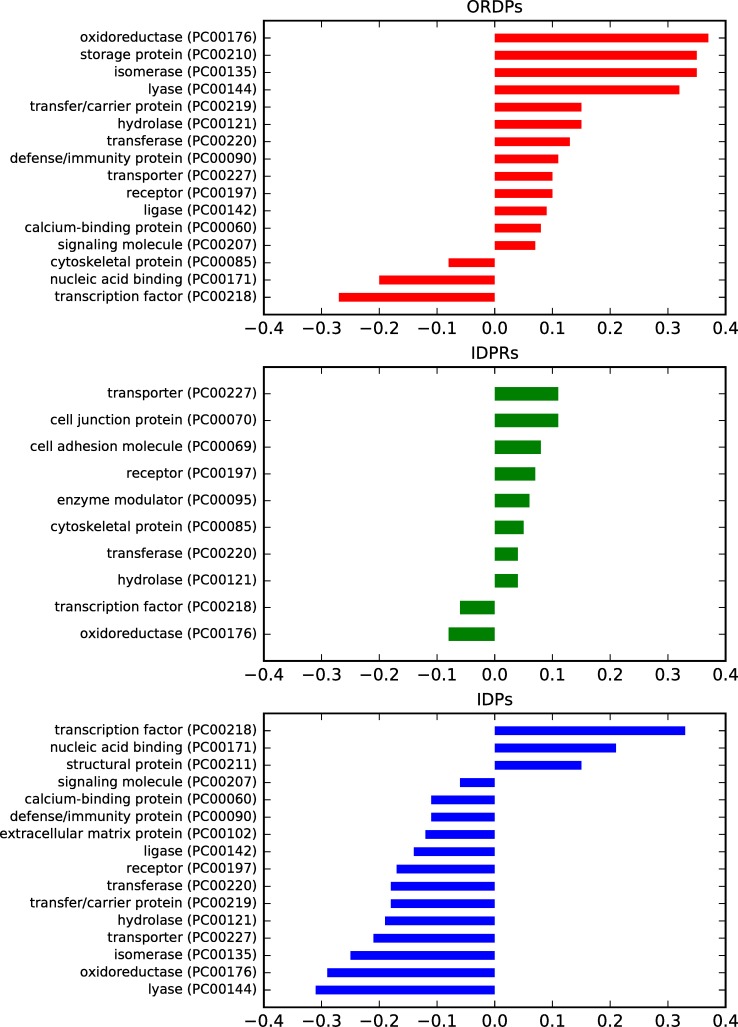
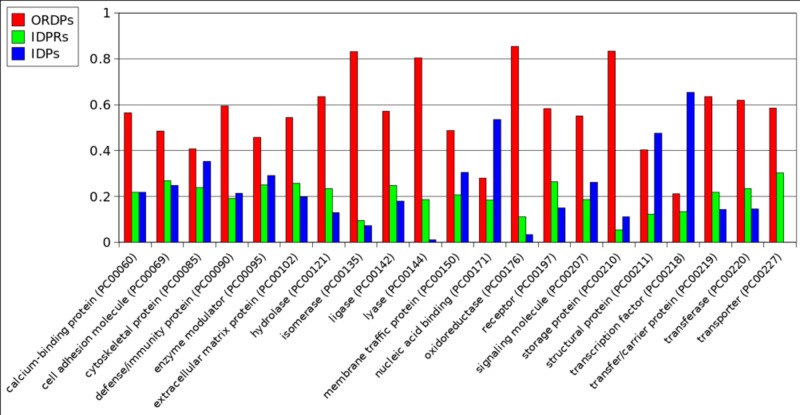
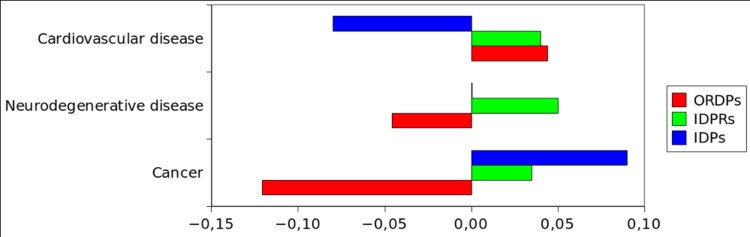
Many studies about classification and the functional annotation of intrinsically disordered proteins (IDPs) are based on either the occurrence of long disordered regions or the fraction of disordered residues in the sequence. Taking into account both criteria we separate the human proteome, taken as a case study, into three variants of proteins: i) ordered proteins (ORDPs), ii) structured proteins with intrinsically disordered regions (IDPRs), and iii) intrinsically disordered proteins (IDPs). The focus of this work is on the different functional roles of IDPs and IDPRs, which up until now have been generally considered as a whole. Previous studies assigned a large set of functional roles to the general category of IDPs. We show here that IDPs and IDPRs have non-overlapping functional spectra, play different roles in human diseases, and deserve to be treated as distinct categories of proteins. IDPs enrich only a few classes, functions, and processes: nucleic acid binding proteins, chromatin binding proteins, transcription factors, and developmental processes. In contrast, IDPRs are spread over several functional protein classes and GO annotations which they partly share with ORDPs. As regards to diseases, we observe that IDPs enrich only cancer-related proteins, at variance with previous results reporting that IDPs are widespread also in cardiovascular and neurodegenerative pathologies. Overall, the operational separation of IDPRs from IDPs is relevant towards correct estimates of the occurrence of intrinsically disordered proteins in genome-wide studies and in the understanding of the functional spectra associated to different flavors of protein disorder.
许多关于无规卷曲蛋白质(IDPs)分类和功能注释的研究都是基于长的无规区域的出现或序列中无规残基的分数。考虑到这两个标准,我们将人类蛋白质组作为一个案例研究,分为三种变体的蛋白质:i)有序蛋白质(ORDPs),ii)具有无规区域的结构蛋白质(IDPRs),和 iii)无规卷曲蛋白质(IDPs)。这项工作的重点是 IDPs 和 IDPRs 的不同功能作用,迄今为止,它们通常被视为一个整体。先前的研究将大量的功能作用分配给 IDPs 的一般类别。我们在这里表明,IDPs 和 IDPRs 具有非重叠的功能谱,在人类疾病中发挥不同的作用,值得作为蛋白质的不同类别进行处理。IDPs 仅富集少数几类、功能和过程:核酸结合蛋白、染色质结合蛋白、转录因子和发育过程。相比之下,IDPRs 分布在几个功能蛋白类和 GO 注释中,它们与 ORDPs 部分共享。就疾病而言,我们观察到 IDPs 仅富集与癌症相关的蛋白质,与先前报告的 IDPs 也广泛存在于心血管和神经退行性病变中的结果相反。总体而言,将 IDPRs 与 IDPs 分开操作对于正确估计基因组范围内研究中无规卷曲蛋白质的出现以及理解不同风味的蛋白质无规卷曲相关的功能谱是相关的。