Awuni Baba, Tarkang Elvis, Manu Emmanuel, Amu Hubert, Ayanore Martin Amogre, Aku Fortress Yayra, Ziema Sorengmen Amos, Bosoka Samuel Adolf, Adjuik Martin, Kweku Margaret
School of Public Health, University of Health and Allied Sciences, Ho PMB 31, Volta Region, Ghana.
Department of Population and Behavioural Sciences, School of Public Health, University of Health and Allied Sciences, Ho PMB 31, Volta Region, Ghana.
Trop Med Infect Dis. 2019 Aug 18;4(3):115. doi: 10.3390/tropicalmed4030115.
Human rabies, often contracted through dog bites, is a serious but neglected public health problem in the tropics, including Ghana. Due to its high fatality rate, adequate knowledge and vaccination of domestic dogs against the disease are very crucial in reducing its burden. We examined dog owners' knowledge level on rabies and factors that influenced anti-rabies vaccination of dogs in the Upper East Region of Ghana.
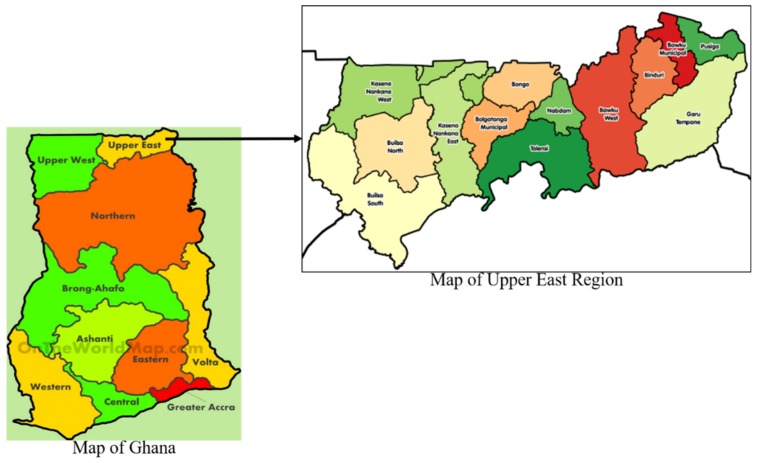
This descriptive cross-sectional study was conducted among 260 randomly sampled dog owners in six communities from six Districts using a multistage sampling technique, in the Upper East Region of Ghana. An interviewer-administered questionnaire was used to collect data from the respondents. Descriptive and inferential analyses were done using STATA 14.1.
While knowledge about rabies was 199 (76.5%), that about anti-rabies vaccination was 137 (52.7%). District of residence (χ = 112.59, < 0.001), sex (χ = 6.14, = 0.013), education (χ = 20.45, < 0.001) as well as occupation (χ = 11.97, = 0.007) were significantly associated with rabies knowledge. District of residence (χ = 57.61, < 0.001), Educational level (χ = 15.37, = 0.004), occupation (χ = 11.66, = 0.009), religion (χ = 8.25, = 0.016) and knowledge on rabies (χ = 42.13, < 0.001) were also statistically associated with dog vaccination against rabies. Dog owners with good knowledge on rabies for instance, were more likely to vaccinate their dogs against rabies compared to those with poor knowledge [AOR = 1.99 (95% CI: 0.68, 5.86), = 0.210]. Dog owners with tertiary level of education were also 76.31 times more likely (95% CI: 6.20, 938.49, = 0.001) to have good knowledge about rabies compared to those with no formal education.
Dog owners in the Upper East Region of Ghana had good knowledge about rabies. This, however, did not translate into correspondingly high levels of dog vaccination against the disease. Rabies awareness and vaccination campaigns should, therefore, be intensified in the region, especially among the least educated and female dog owners.
人类狂犬病通常通过犬咬伤传播,在包括加纳在内的热带地区是一个严重但被忽视的公共卫生问题。由于其高死亡率,让家犬充分了解并接种狂犬病疫苗对于减轻其负担至关重要。我们调查了加纳上东部地区犬主对狂犬病的了解程度以及影响犬只接种狂犬病疫苗的因素。
本描述性横断面研究采用多阶段抽样技术,在加纳上东部地区六个区的六个社区对260名随机抽取的犬主进行。通过访谈员实施的问卷从受访者收集数据。使用STATA 14.1进行描述性和推断性分析。
虽然对狂犬病的知晓率为199人(76.5%),但对狂犬病疫苗接种的知晓率为137人(52.7%)。居住地区(χ = 112.59,P < 0.001)、性别(χ = 6.14,P = 0.013)、教育程度(χ = 20.45,P < 0.001)以及职业(χ = 11.97,P = 0.007)与狂犬病知识显著相关。居住地区(χ = 57.61,P < 0.001)、教育水平(χ = 15.37,P = 0.004)、职业(χ = 11.66,P = 0.009)、宗教(χ = 8.25,P = 0.016)以及对狂犬病的了解(χ = 42.13,P < 0.001)也与犬只接种狂犬病疫苗在统计学上相关。例如,与知识欠缺的犬主相比,对狂犬病有充分了解的犬主给其犬只接种狂犬病疫苗的可能性更大[AOR = 1.99(95% CI:0.68,5.86),P = 0.210]。与未接受正规教育的犬主相比,受过高等教育的犬主对狂犬病有充分了解的可能性高76.31倍(95% CI:6.20,938.49,P = 0.001)。
加纳上东部地区的犬主对狂犬病有较好的了解。然而,这并未转化为相应的高比例犬只接种该疾病疫苗的情况。因此,该地区应加强狂犬病宣传和疫苗接种活动,特别是在受教育程度最低的人群和女性犬主中。