Biomedical Group (BIO277), Department of Nursing, Faculty of Health Sciences, University of Granada, Granada, Spain.
Instituto Investigación Biosanitaria ibs.Granada, ibs.Granada, C/ Doctor Azpitarte 4, 4ª planta, Granada, 18012, Spain.
Sci Rep. 2019 Aug 19;9(1):12037. doi: 10.1038/s41598-019-48595-2.
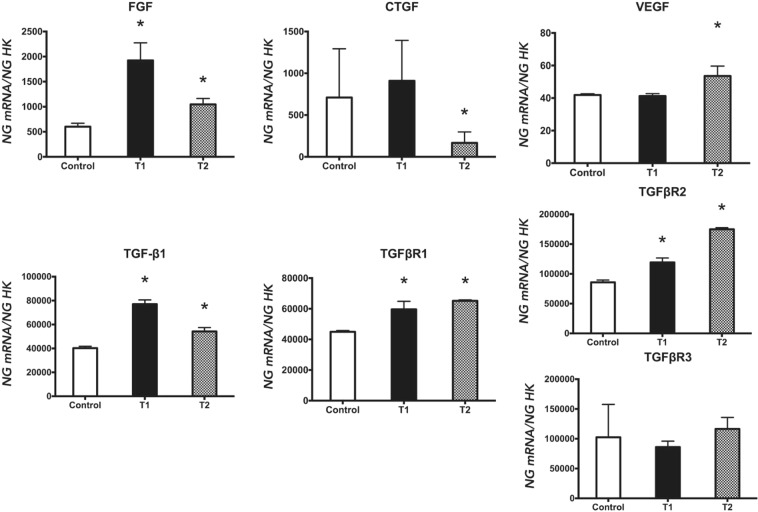
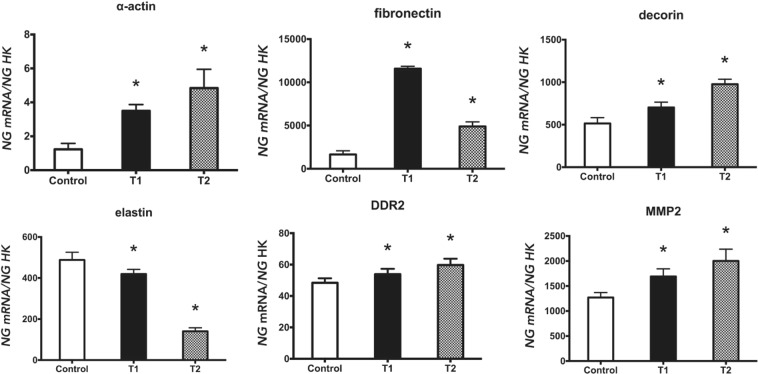
Low-Level Laser Therapy is used as regenerative therapy in different clinical fields. This is due to its photobiomodulation effect via cell signaling on different cell populations, Including fibroblasts, cells involved in tissue regeneration and healing. The aim was to analyze the effect of 940 nm diode laser on the gene expression of different markers involved in fibroblast growth, differentiation, and migration. Real-time polymerase chain reaction (q-RT-PCR) was used to quantify the expression of fibroblast growth factor (FGF), connective tissue growth factor (CTGF), vascular-endothelial growth factor (VEGF), transforming growth factor β1 (TGF-β1), TGFβ-receptors (TGFβR1, TGFβR2, and TGFβR3), discoidin-domain receptor-2 (DDR2), matrix metalloproteinase-2 (MMP2), α-actin, fibronectin, decorin, and elastin on human fibroblast, treated with single dose (T1) or two doses (T2) of diode laser at 0.5 Watts and 4 J/cm. A significant increase in the expression of FGF, TGF-β1, TGFβR1, TGFβR2, α-actin, fibronectin, decorin, DDR2 and MMP2 was observed after both treatments. A decrease was observed in expression of elastin (T1 and T2), and CTGF (T2). These changes underlie the biostimulatory effect of laser on fibroblasts, which translates into an increase in short-term proliferation and in long-term differentiation to myofibroblasts. These data support the therapeutic potential of diode laser for wound repair.
低水平激光疗法被用作不同临床领域的再生疗法。这是由于其通过细胞信号传导对不同细胞群(包括成纤维细胞、参与组织再生和修复的细胞)产生光生物调节作用。目的是分析 940nm 二极管激光对涉及成纤维细胞生长、分化和迁移的不同标志物的基因表达的影响。实时聚合酶链反应(q-RT-PCR)用于定量测定成纤维细胞生长因子(FGF)、结缔组织生长因子(CTGF)、血管内皮生长因子(VEGF)、转化生长因子β1(TGF-β1)、TGFβ 受体(TGFβR1、TGFβR2 和 TGFβR3)、盘状结构域受体 2(DDR2)、基质金属蛋白酶-2(MMP2)、α-肌动蛋白、纤维连接蛋白、饰胶蛋白和弹性蛋白在人成纤维细胞中的表达,这些细胞经单剂量(T1)或双剂量(T2)二极管激光(0.5 瓦特和 4J/cm)处理。两种处理后,FGF、TGF-β1、TGFβR1、TGFβR2、α-肌动蛋白、纤维连接蛋白、饰胶蛋白、DDR2 和 MMP2 的表达均显著增加。弹性蛋白(T1 和 T2)和 CTGF(T2)的表达减少。这些变化是激光对成纤维细胞产生生物刺激作用的基础,这转化为短期增殖增加和长期分化为肌成纤维细胞。这些数据支持二极管激光治疗伤口修复的治疗潜力。