Sun Zheng, Huang Shi, Zhu Pengfei, Yue Feng, Zhao Helen, Yang Ming, Niu Yueqing, Jing Gongchao, Su Xiaoquan, Li Huiying, Callewaert Chris, Knight Rob, Liu Jiquan, Smith Ed, Wei Karl, Xu Jian
Single-Cell Center and Shandong Key Laboratory of Energy Genetics, Qingdao Institute of BioEnergy and Bioprocess Technology, Chinese Academy of Sciences, Qingdao, Shandong, China.
University of Chinese Academy of Sciences, Beijing, China.
mSystems. 2019 Aug 20;4(4):e00293-19. doi: 10.1128/mSystems.00293-19.
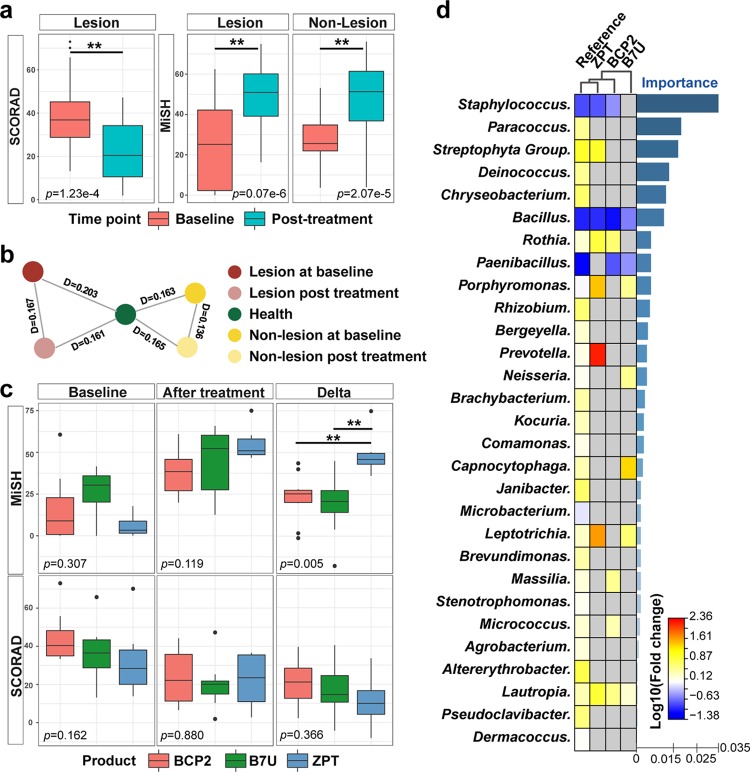
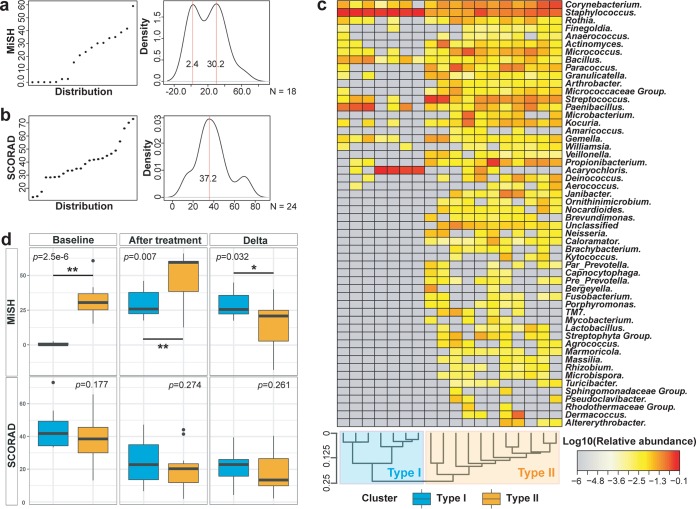
A quantitative and objective indicator for skin health via the microbiome is of great interest for personalized skin care, but differences among skin sites and across human populations can make this goal challenging. A three-city (two Chinese and one American) comparison of skin microbiota from atopic dermatitis (AD) and healthy pediatric cohorts revealed that, although city has the greatest effect size (the skin microbiome can predict the originated city with near 100% accuracy), a microbial index of skin health (MiSH) based on 25 bacterial genera can diagnose AD with 83 to ∼95% accuracy within each city and 86.4% accuracy across cities (area under the concentration-time curve [AUC], 0.90). Moreover, nonlesional skin sites across the bodies of AD-active children (which include shank, arm, popliteal fossa, elbow, antecubital fossa, knee, neck, and axilla) harbor a distinct but lesional state-like microbiome that features relative enrichment of over healthy individuals, confirming the extension of microbiome dysbiosis across body surface in AD patients. Intriguingly, pretreatment MiSH classifies children with identical AD clinical symptoms into two host types with distinct microbial diversity and treatment effects of corticosteroid therapy. These findings suggest that MiSH has the potential to diagnose AD, assess risk-prone state of skin, and predict treatment response in children across human populations. MiSH, which is based on the skin microbiome, can quantitatively assess pediatric skin health across cohorts from distinct countries over large geographic distances. Moreover, the index can identify a risk-prone skin state and compare treatment effect in children, suggesting applications in diagnosis and patient stratification.
通过微生物群来确定皮肤健康的定量和客观指标,对于个性化皮肤护理具有重要意义,但皮肤部位之间以及不同人群之间的差异可能使这一目标具有挑战性。一项针对三个城市(两个中国城市和一个美国城市)的特应性皮炎(AD)和健康儿童队列的皮肤微生物群比较研究表明,尽管城市对结果的影响最大(皮肤微生物群能够以近100%的准确率预测儿童来自哪个城市),但基于25个细菌属的皮肤健康微生物指数(MiSH)在每个城市中诊断AD的准确率为83%至95%,在三个城市间的综合准确率为86.4%(浓度-时间曲线下面积[AUC]为0.90)。此外,AD活跃期儿童身体上的非皮损部位(包括小腿、手臂、腘窝、肘部、肘前窝、膝盖、颈部和腋窝)具有独特的、类似皮损状态的微生物群,其特征是相对于健康个体, 相对富集,这证实了AD患者体表微生物群失调的范围扩大。有趣的是,治疗前的MiSH可将具有相同AD临床症状的儿童分为两种宿主类型,这两种类型具有不同的微生物多样性和皮质类固醇治疗效果。这些发现表明,MiSH有潜力诊断AD、评估皮肤的易患风险状态,并预测不同人群中儿童的治疗反应。基于皮肤微生物群的MiSH能够定量评估来自不同国家、跨越较大地理距离的队列中的儿童皮肤健康状况。此外,该指数可以识别儿童易患风险的皮肤状态并比较治疗效果,表明其在诊断和患者分层方面具有应用价值。