Yan Dan, He Bingshu, Guo Jie, Li Shulan, Wang Jun
Associate Professor, Hubei Province Key Laboratory of Occupational Hazard Identification and Control, Wuhan University of Science and Technology, China. Conception and design of the study, acquisition and interpretation of data.
MS, Department of Orthopedics, Hubei Provincial Women and Children's Hospital, China. Conception and design of the study, acquisition and interpretation of data.
Acta Cir Bras. 2019 Aug 19;34(6):e201900604. doi: 10.1590/s0102-865020190060000004.
In view of the principal role of Toll-like receptor 4 (TLR4) in mediating sterile inflammatory response contributing to osteoarthritis (OA) pathogenesis, we used lipopolysaccharide (LPS), a known TLR4 activator, to clarify whether modulation of TLR4 contributed to the protective actions of intra-articular administration of curcumin in a classical rat OA model surgically induced by anterior cruciate ligament transection (ACLT).
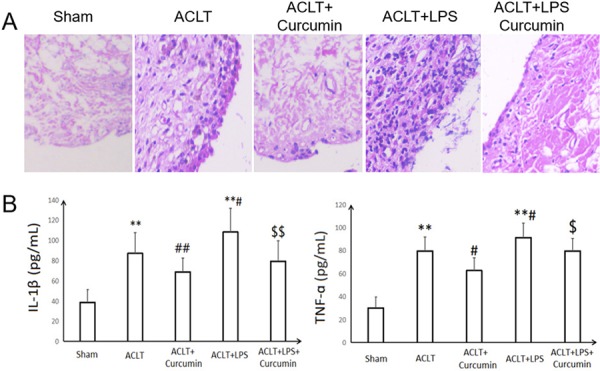
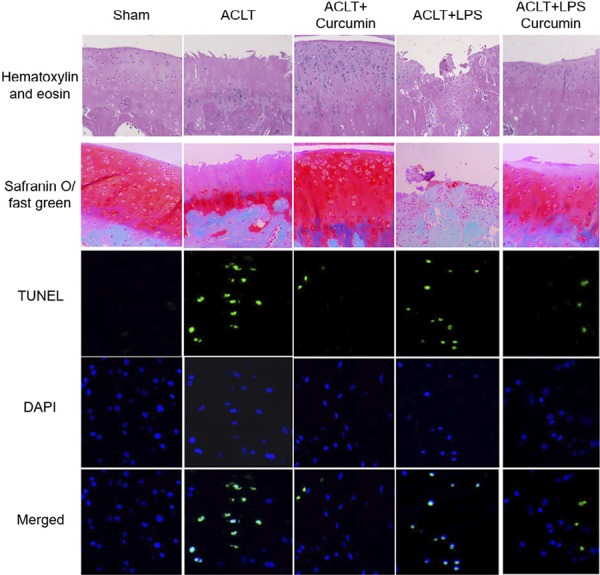
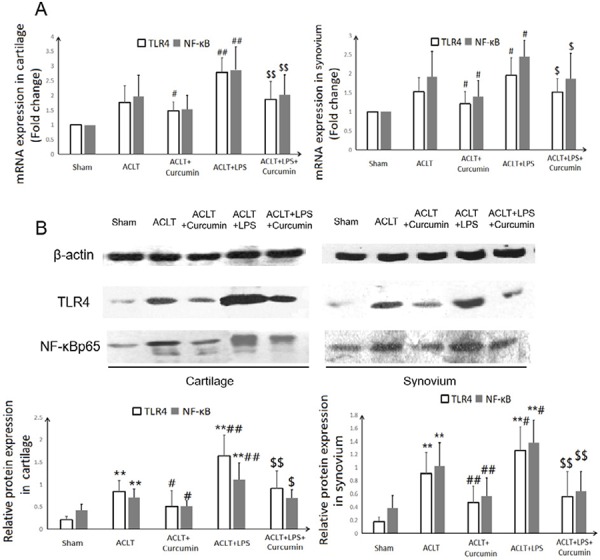
The rats underwent ACLT and received 50μl of curcumin at the concentration of 1 mg mL-1 and 10 μg LPS by intra-articular injection once a week for 8 weeks. Morphological changes of the cartilage and synovial tissues were observed. Apoptotic chondrocytes were detected using TUNEL assay. The concentrations of IL-1β and TNF-ɑ in synovial fluid were determined using ELISA kits. The mRNA and protein expression levels of TLR4 and NF-κB p65 were detected by real-time PCR and Western blotting, respectively.
Intra-articular administration of curcumin significantly improved articular cartilage injury, suppressed synovial inflammation and down-regulated the overexpression of TLR4 and its downstream NF-κB caused by LPS-induced TLR4 activation in rat osteoarthritic knees.
The data suggested that the inhibition of TLR4 signal might be an important mechanism underlying a protective effect of local curcumin administration on OA.
鉴于Toll样受体4(TLR4)在介导促成骨关节炎(OA)发病机制的无菌性炎症反应中起主要作用,我们使用脂多糖(LPS)(一种已知的TLR4激活剂)来阐明调节TLR4是否有助于关节内注射姜黄素在前交叉韧带横断(ACLT)手术诱导的经典大鼠OA模型中的保护作用。
大鼠接受ACLT手术,并通过关节内注射每周一次,持续8周,给予浓度为1mg/mL的50μl姜黄素和10μg LPS。观察软骨和滑膜组织的形态学变化。使用TUNEL法检测凋亡软骨细胞。使用ELISA试剂盒测定滑液中IL-1β和TNF-α的浓度。分别通过实时PCR和蛋白质印迹法检测TLR4和NF-κB p65的mRNA和蛋白质表达水平。
关节内注射姜黄素可显著改善关节软骨损伤,抑制滑膜炎症,并下调LPS诱导的大鼠骨关节炎膝关节中TLR4激活及其下游NF-κB的过表达。
数据表明,抑制TLR4信号可能是局部给予姜黄素对OA产生保护作用的重要机制。