Department of Human Genetics, Leiden University Medical Center, Leiden, The Netherlands.
Genomics Coordination Center & Department of Genetics, University Medical Center, Groningen, University of Groningen, Groningen, The Netherlands.
Hum Mutat. 2019 Dec;40(12):2230-2238. doi: 10.1002/humu.23896. Epub 2019 Sep 3.
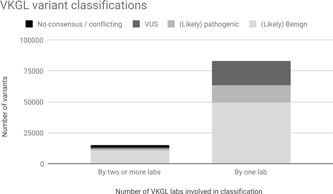
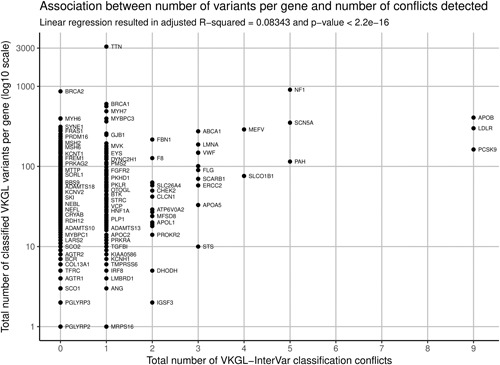
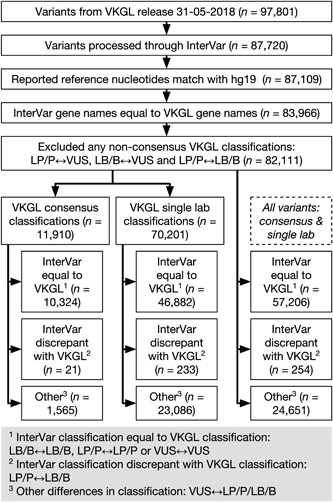
Each year diagnostic laboratories in the Netherlands profile thousands of individuals for heritable disease using next-generation sequencing (NGS). This requires pathogenicity classification of millions of DNA variants on the standard 5-tier scale. To reduce time spent on data interpretation and increase data quality and reliability, the nine Dutch labs decided to publicly share their classifications. Variant classifications of nearly 100,000 unique variants were catalogued and compared in a centralized MOLGENIS database. Variants classified by more than one center were labeled as "consensus" when classifications agreed, and shared internationally with LOVD and ClinVar. When classifications opposed (LB/B vs. LP/P), they were labeled "conflicting", while other nonconsensus observations were labeled "no consensus". We assessed our classifications using the InterVar software to compare to ACMG 2015 guidelines, showing 99.7% overall consistency with only 0.3% discrepancies. Differences in classifications between Dutch labs or between Dutch labs and ACMG were mainly present in genes with low penetrance or for late onset disorders and highlight limitations of the current 5-tier classification system. The data sharing boosted the quality of DNA diagnostics in Dutch labs, an initiative we hope will be followed internationally. Recently, a positive match with a case from outside our consortium resulted in a more definite disease diagnosis.
每年,荷兰的诊断实验室都使用下一代测序(NGS)对数千人进行遗传性疾病的分析。这需要在标准的 5 级分类尺度上对数百万个 DNA 变体进行致病性分类。为了减少数据解释所花费的时间,提高数据质量和可靠性,9 家荷兰实验室决定公开分享他们的分类。将近 100,000 个独特变体的变体分类被编目并在集中的 MOLGENIS 数据库中进行比较。当分类意见一致时,由多个中心分类的变体被标记为“共识”,并与 LOVD 和 ClinVar 国际共享。当分类意见相左(LB/B 与 LP/P)时,被标记为“冲突”,而其他非共识观察结果则被标记为“无共识”。我们使用 InterVar 软件对我们的分类进行了评估,与 ACMG 2015 指南进行了比较,显示总体一致性为 99.7%,仅相差 0.3%。荷兰实验室之间或荷兰实验室与 ACMG 之间的分类差异主要存在于外显率低或发病晚的基因中,这突显了当前 5 级分类系统的局限性。数据共享提高了荷兰实验室的 DNA 诊断质量,我们希望这一举措能在国际上得到效仿。最近,与我们联盟外的一个病例的匹配结果导致了更明确的疾病诊断。