Department of Pharmacy, College of Pharmacy and Institute of Pharmaceutical Science and Technology, Hanyang University, Ansan, Gyeonggi-do 15588, Korea.
Int J Mol Sci. 2019 Aug 21;20(17):4082. doi: 10.3390/ijms20174082.
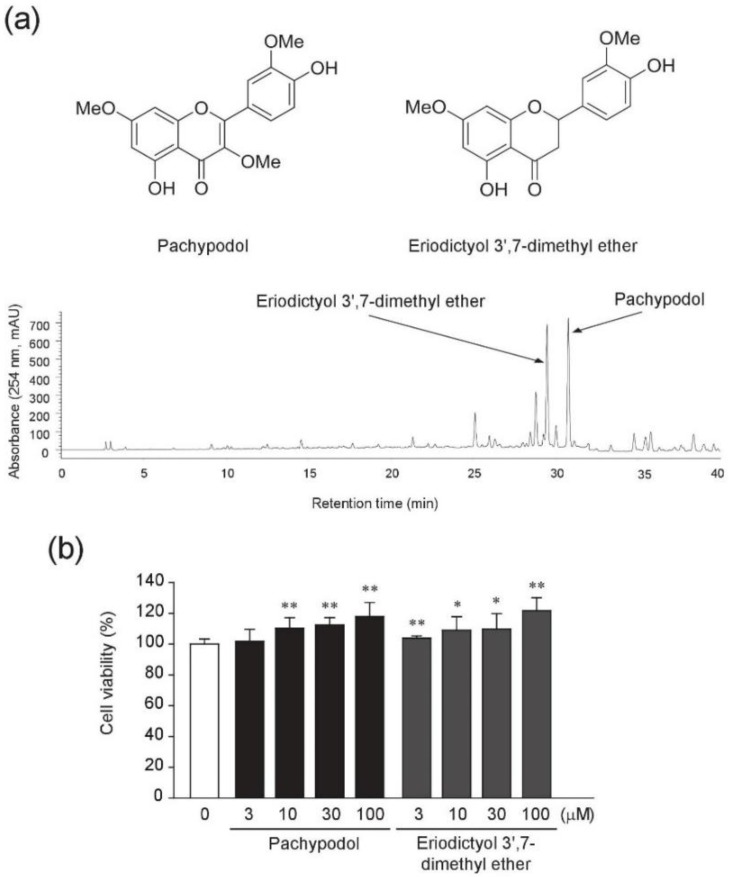
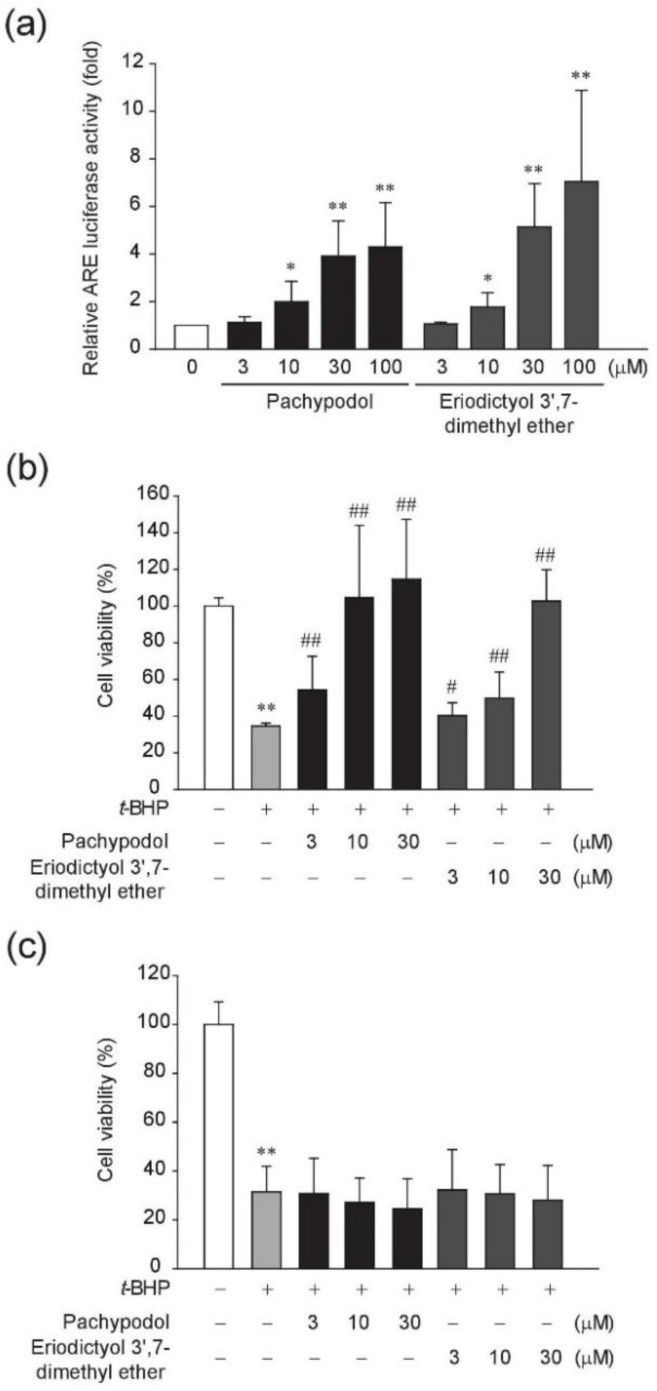
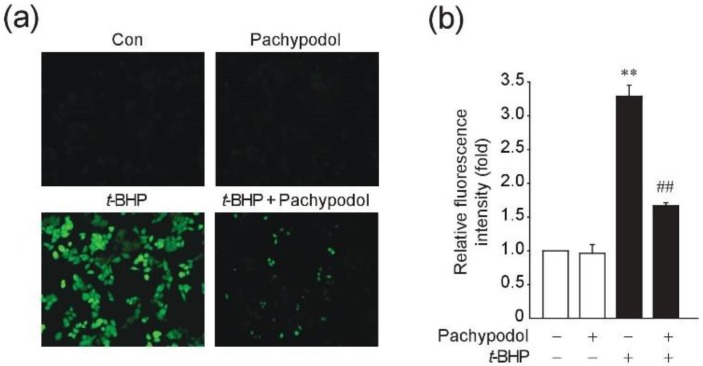
Oxidative stress has been implicated in the pathogenesis of many diseases including chronic liver diseases. Nrf2 is a master transcriptional factor regulating the induction of cellular antioxidant defense systems. Here, the Nrf2-activating effect of the crude methanol extract of dried leaves of Bentham was demonstrated by measuring the antioxidant response element (ARE)-driven luciferase activity and pachypodol, 4',5-dihydroxy-3,3',7-trimethoxyflavone, was isolated by bioactivity-guided fractionation and further separation using chromatographic techniques. To our knowledge, this is the first study to evaluate the antioxidant and cytoprotective effects of pachypodol in HepG2 cells as well as the underlying molecular mechanisms. Indeed, pachypodol protected HepG2 cells from cell death caused by -butylhydroperoxide-induced oxidative stress and also attenuated ROS production. The ability of pachypodol to activate Nrf2/ARE pathway was further confirmed by observing Nrf2 expression in nuclear fraction, mRNA levels of Nrf2 target antioxidants, and cellular glutathione content in HepG2 cells. Extracellular signal-regulated kinase (ERK) is one of the important kinases involved in Nrf2 activation. Pachypodol increased ERK phosphorylation and ERK inhibition by PD98059 totally abrogated the increase in ARE luciferase activity, nuclear Nrf2 accumulation and mRNA levels of antioxidant enzymes by pachypodol. In conclusion, pachypodol isolated from can protect hepatocytes from oxidative injury, possibly mediated by enhancing endogenous antioxidant defense system through ERK-dependent Nrf2 activation.
氧化应激与许多疾病的发病机制有关,包括慢性肝病。Nrf2 是调节细胞抗氧化防御系统诱导的主要转录因子。在这里,通过测量抗氧化反应元件 (ARE) 驱动的荧光素酶活性,证明了 Bentham 干叶甲醇提取物对 Nrf2 的激活作用,并用生物活性导向的分段和使用色谱技术进一步分离,分离出 4',5-二羟基-3,3',7-三甲氧基黄酮。据我们所知,这是首次评估 4',5-二羟基-3,3',7-三甲氧基黄酮在 HepG2 细胞中的抗氧化和细胞保护作用及其潜在的分子机制。事实上,4',5-二羟基-3,3',7-三甲氧基黄酮可保护 HepG2 细胞免受 -丁基过氧化物诱导的氧化应激引起的细胞死亡,并减轻 ROS 产生。通过观察 HepG2 细胞中核部分的 Nrf2 表达、Nrf2 靶抗氧化剂的 mRNA 水平和细胞内谷胱甘肽含量,进一步证实了 4',5-二羟基-3,3',7-三甲氧基黄酮激活 Nrf2/ARE 途径的能力。细胞外信号调节激酶 (ERK) 是参与 Nrf2 激活的重要激酶之一。4',5-二羟基-3,3',7-三甲氧基黄酮增加 ERK 磷酸化,而 ERK 抑制剂 PD98059 完全阻断了 4',5-二羟基-3,3',7-三甲氧基黄酮对 ARE 荧光素酶活性、核 Nrf2 积累和抗氧化酶 mRNA 水平的增加。总之,从 中分离出的 4',5-二羟基-3,3',7-三甲氧基黄酮可保护肝细胞免受氧化损伤,可能通过增强内源性抗氧化防御系统,通过 ERK 依赖性 Nrf2 激活介导。