Santoni Matteo, Cimadamore Alessia, Massari Francesco, Piva Francesco, Aurilio Gaetano, Martignetti Angelo, Scarpelli Marina, Di Nunno Vincenzo, Gatto Lidia, Battelli Nicola, Cheng Liang, Lopez-Beltran Antonio, Montironi Rodolfo
Oncology Unit, Macerata Hospital, 62100 Macerata, Italy.
Section of Pathological Anatomy, School of Medicine, Polytechnic University of the Marche Region, United Hospitals, 60126 Ancona, Italy.
Cancers (Basel). 2019 Aug 22;11(9):1225. doi: 10.3390/cancers11091225.
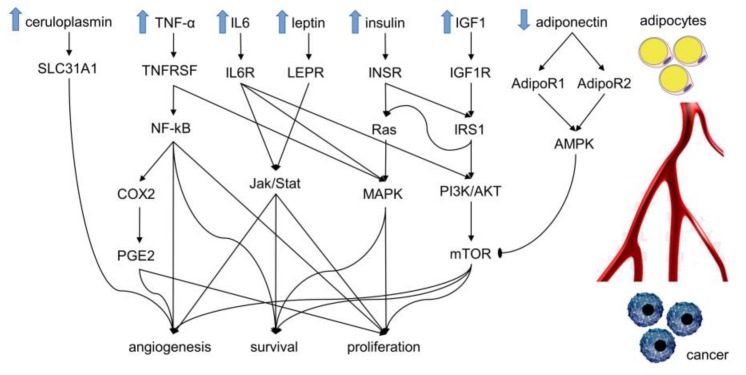
: In human populations, a certain amount of data correlate obesity/body mass index (BMI) with urothelial cancer (UC) and prostate cancer (PCa) occurrence, however this is not fully elucidated at all stages of disease. In an attempt to shed light on uncertain areas in such field, in the present review we illustrate the main molecular mechanisms linking obesity and cancer, focusing on the correlation between obesity and tumor risk, disease progression and response to chemo- and immunotherapy in patients with UC and the predictive/prognostic role of obesity in PCa patients treated with the currently available therapeutic approaches. : We did a large-scale literature search on existing scientific websites focusing on keywords "obesity", "body mass index (BMI)", "urothelial cancer", "prostate cancer", "docetaxel", "cabazitaxel", "abiraterone acetate", "enzalutamide", and "radium223". : Many adipocytes-induced molecules support tumor proliferation through activation of various cellular pathways. The available evidence in the postoperative setting do the role of BMI in oncological outcomes prediction still not completely clear. Likewise, in metastatic UC patients controversial results link the role of obesity/BMI with clinical outcomes of tumor response to chemotherapy. Adipose stromal cells recruitment, induced by PCa cells, from white adipose tissue to the tumor sites inducing cell invasiveness was associated with poor survival. Conflicting data, although more oriented towards a better survival outcome, resulted in obese patients treated with docetaxel. In PCa cell-lines a certain cabazitaxel chemo resistance adipose stromal cells (ASC)-mediated was demonstrated. In metastatic castration-resistant PCa patients with high BMI (>25 kg/m) receiving abiraterone acetate there were significant worse survival outcomes, while in enzalutamide patients BMI did not affect survival outcome. In radium 223 patients higher BMI significantly correlated with favorable overall survival. : The main focus of this review was to understand the interplay between obesity/BMI and UC/PCa. Several pathogenic cellular pathways exploring the issue are discussed, opening the way to challenging tailored treatments on the basis of BMI. Improving the knowledge of molecular connections between obesity and UC and PCa could favor the development of new therapies likely reducing chemo- and immunotherapy drug resistance.
在人群中,一定量的数据将肥胖症/体重指数(BMI)与尿路上皮癌(UC)和前列腺癌(PCa)的发生联系起来,然而在疾病的所有阶段这一点尚未完全阐明。为了阐明该领域中不确定的方面,在本综述中,我们阐述了将肥胖与癌症联系起来的主要分子机制,重点关注肥胖与肿瘤风险、疾病进展以及UC患者对化疗和免疫治疗的反应之间的相关性,以及肥胖在接受当前可用治疗方法的PCa患者中的预测/预后作用。
我们在现有科学网站上进行了大规模文献检索,重点关注关键词“肥胖症”、“体重指数(BMI)”、“尿路上皮癌”、“前列腺癌”、“多西他赛”、“卡巴他赛”、“醋酸阿比特龙”、“恩杂鲁胺”和“镭-223”。
许多脂肪细胞诱导的分子通过激活各种细胞途径来支持肿瘤增殖。术后环境中关于BMI在肿瘤学结果预测中的作用的现有证据仍不完全清楚。同样,在转移性UC患者中,关于肥胖/BMI与肿瘤对化疗反应的临床结果之间的关系存在有争议的结果。PCa细胞诱导白色脂肪组织中的脂肪基质细胞募集到肿瘤部位,从而诱导细胞侵袭,这与较差的生存率相关。尽管更多数据倾向于更好的生存结果,但接受多西他赛治疗的肥胖患者的数据存在冲突。在PCa细胞系中,已证实存在一定程度的卡巴他赛化疗耐药性,这是由脂肪基质细胞(ASC)介导的。在接受醋酸阿比特龙治疗的高BMI(>25kg/m²)的转移性去势抵抗性PCa患者中,生存结果明显更差,而在恩杂鲁胺治疗的患者中,BMI不影响生存结果。在接受镭-223治疗的患者中,较高的BMI与良好的总生存率显著相关。
本综述的主要重点是了解肥胖/BMI与UC/PCa之间的相互作用。文中讨论了探索该问题的几种致病细胞途径,为基于BMI的具有挑战性的个性化治疗开辟了道路。提高对肥胖与UC和PCa之间分子联系的认识可能有利于开发新的疗法,可能会降低化疗和免疫治疗的耐药性。