Institute of Tropical Medicine, Guangzhou University of Chinese Medicine, 12 Jichang Rd., San Yuanli St., Bai Yun Dist., Guangzhou, 510405, Guangdong, People's Republic of China.
Basic Medical College, Guangzhou University of Chinese Medicine, Guangzhou, People's Republic of China.
Inflammopharmacology. 2020 Feb;28(1):299-310. doi: 10.1007/s10787-019-00633-1. Epub 2019 Aug 24.
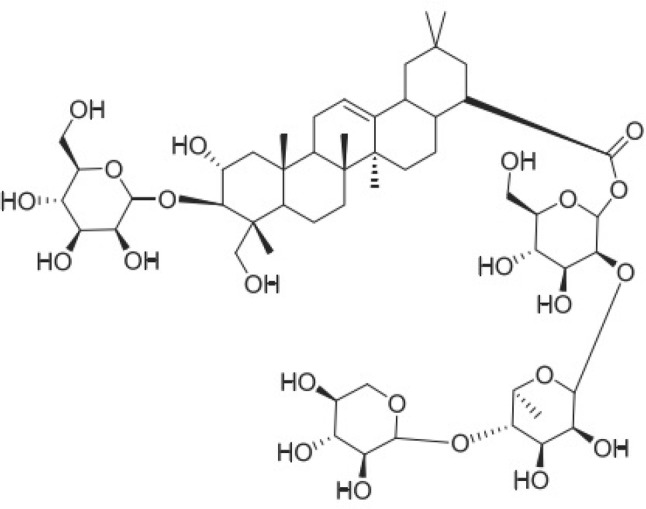
Influenza is an acute viral respiratory illness that causes high morbidity and mortality globally. Therapeutic actions are limited to vaccines and a few anti-viral drugs. Polygala (P.) japonica herba is rich in Polygalasaponin F (PSF, CHO), used for acute bronchitis, pharyngitis, pneumonia, amygdalitis, and respiratory tract infections treatment in China. Hypercytokinemia is often correlated with severe pneumonia caused by several influenza viruses. PSF was reported to have anti-inflammatory effects and its mechanism is associated with the nuclear factor (NF)-κB signaling pathway. The action of PSF to alleviate pulmonary inflammation caused by influenza A virus (IAV) infection requires careful assessment. In the present study, we evaluated the effect and mechanism of PSF on mice with pneumonia caused by influenza H1N1 (A/FM/1/47).
Mice were infected intranasally with fifteen 50% mouse lethal challenge doses (MLD) of influenza virus. BALB/c mice were treated with PSF or oseltamivir (oral administration) for 2 h post-infection and received concomitant treatment for 5 days after infection. On day 6 post-infection, 10 mice per group were killed to collect related samples, measure body weight and lung wet weight, and detect the viral load, cytokine, prostaglandins, pathological changes, and cell pathway protein expression in the lungs. In addition, the survival experiments were carried out to investigate the survival of mice. The expression profile of cell pathway proteins was detected and analyzed using a broad pathway antibody array and confirmed the findings from the array by western blotting.
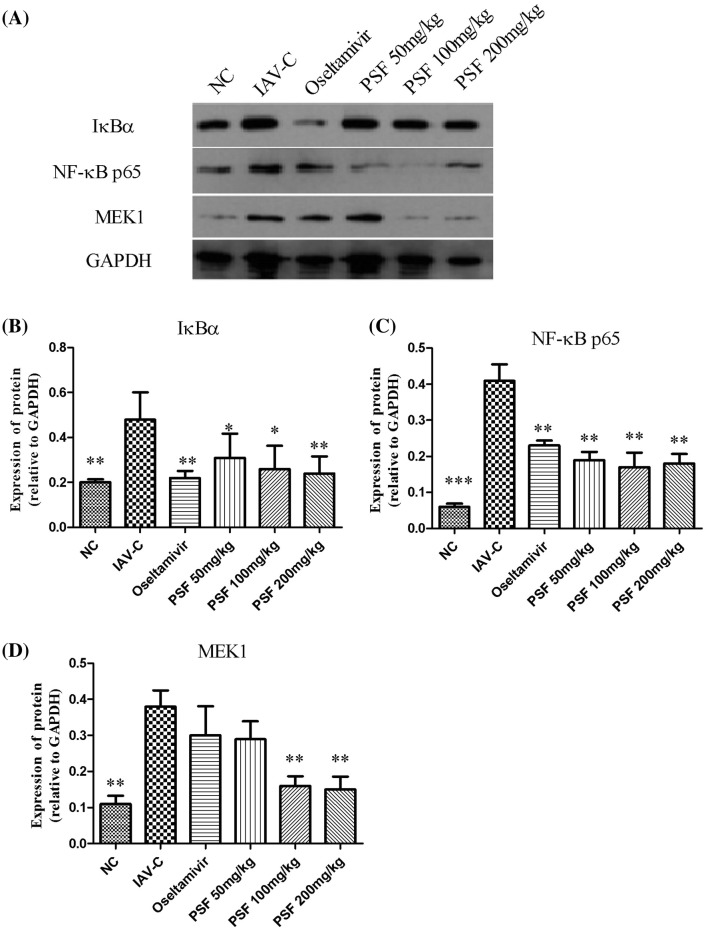
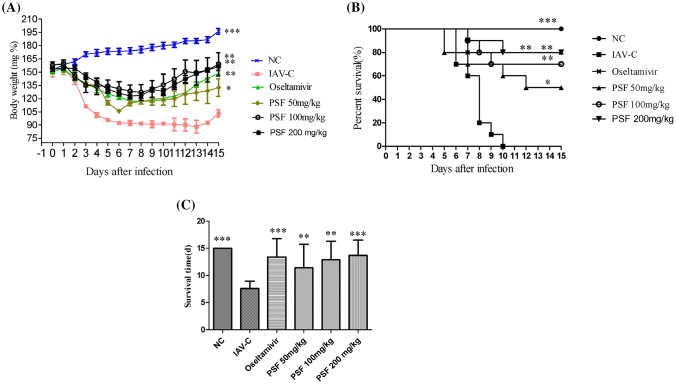
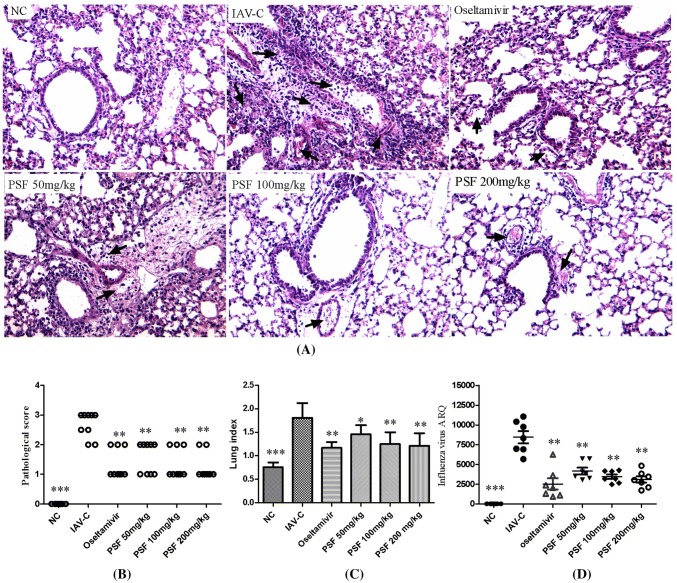
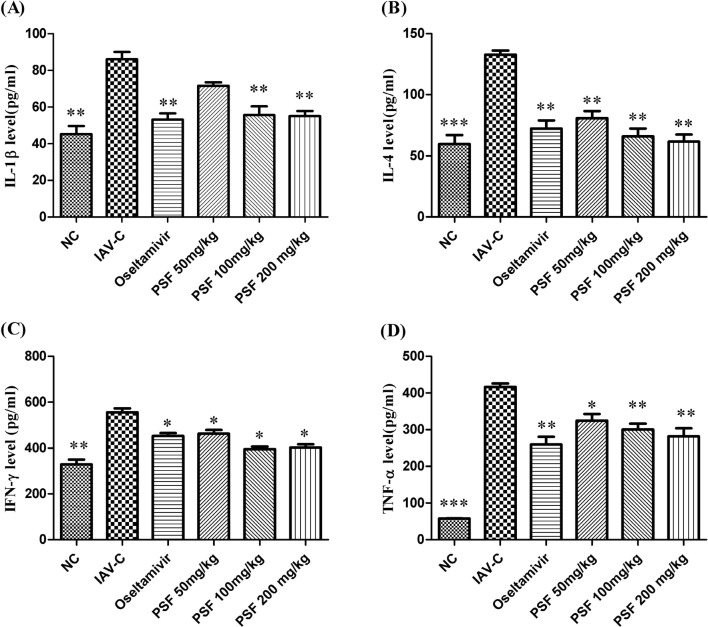
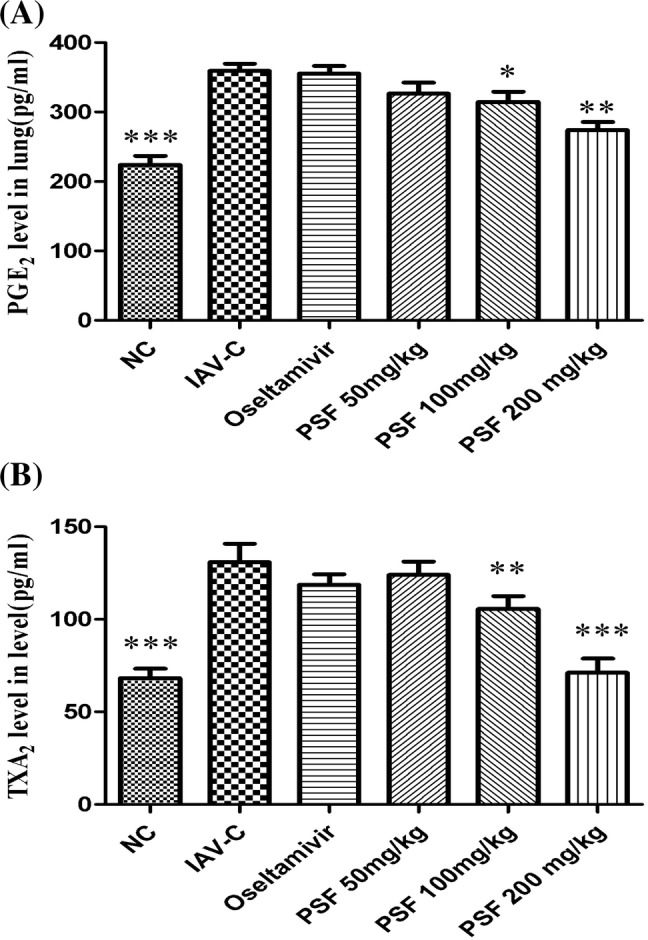
Polygalasaponin F and oseltamivir can protect against influenza viral infection in mice. PSF and oseltamivir significantly relieved the signs and symptoms, reduced body weight loss, and improved the survival rate of H1N1-infected mice. Moreover, PSF efficiently decreased the level of interleukin (IL)-1β, tumor necrosis factor (TNF)-α, IL-4, interferon (IFN)-γ, thromboxane A (TXA), and prostaglandin E (PGE) in lung tissues of mice infected with influenza virus (p < 0.05-0.01). Oseltamivir had a similar effect to lung cytokine of PSF, but did not decrease the levels of TXA and PGE. There was a twofold or greater increase in four cell pathway protein, namely NF-κB p65 (2.68-fold), I-kappa-B-alpha (IκBα) (2.56-fold), and MAPK/ERK kinase 1 (MEK1) (7.15-fold) assessed in the array induced by influenza virus. Western blotting showed that the expression of these proteins was significantly decreased in lung after influenza virus challenge in PSF and oseltamivir-treated mice (p < 0.05-0.01).
Polygalasaponin F appears to be able to augment protection against IAV infection in mice via attenuation of pulmonary inflammatory responses. Its effect on IAV-induced pulmonary inflammation was associated with suppression of Raf/MEK/ERK and NF-κB expressions.
流感是一种急性病毒性呼吸道疾病,在全球范围内导致高发病率和死亡率。治疗方法仅限于疫苗和少数几种抗病毒药物。远志(P.)japonica 草富含远志皂甙 F(PSF,CHO),在中国用于治疗急性支气管炎、咽炎、肺炎、扁桃体炎和呼吸道感染。细胞因子过度表达通常与几种流感病毒引起的严重肺炎有关。PSF 具有抗炎作用,其机制与核因子(NF)-κB 信号通路有关。PSF 缓解甲型流感病毒(IAV)感染引起的肺部炎症的作用需要仔细评估。在本研究中,我们评估了 PSF 对感染 H1N1(A/FM/1/47)流感病毒的肺炎小鼠的作用及其机制。
通过鼻腔感染十五个 50%鼠致死挑战剂量(MLD)的流感病毒使小鼠感染。在感染后 2 小时,BALB/c 小鼠用 PSF 或奥司他韦(口服)治疗,并在感染后 5 天进行联合治疗。感染后第 6 天,每组 10 只小鼠处死收集相关样本,测量体重和肺湿重,检测病毒载量、细胞因子、前列腺素、肺部病理变化和细胞通路蛋白表达。此外,还进行了生存实验以研究小鼠的生存情况。使用广泛的通路抗体阵列检测和分析细胞通路蛋白的表达谱,并通过 Western blot 验证阵列的发现。
远志皂甙 F 和奥司他韦可预防小鼠流感病毒感染。PSF 和奥司他韦可显著缓解症状和体征,减轻体重减轻,并提高 H1N1 感染小鼠的存活率。此外,PSF 可有效降低感染流感病毒的小鼠肺组织中白细胞介素(IL)-1β、肿瘤坏死因子(TNF)-α、IL-4、干扰素(IFN)-γ、血栓素 A(TXA)和前列腺素 E(PGE)的水平(p<0.05-0.01)。奥司他韦对 PSF 肺细胞因子具有相似作用,但不能降低 TXA 和 PGE 的水平。在流感病毒诱导的阵列中,有四种细胞通路蛋白的表达增加了两倍或更多,即核因子(NF)-κB p65(2.68 倍)、I-κBα(IκBα)(2.56 倍)和丝裂原活化蛋白激酶/细胞外信号调节激酶激酶 1(MEK1)(7.15 倍)。Western blot 显示,PSF 和奥司他韦治疗的小鼠感染流感病毒后,肺组织中这些蛋白的表达明显降低(p<0.05-0.01)。
PSF 似乎能够通过减轻肺部炎症反应来增强对 IAV 感染的保护作用。其对 IAV 诱导的肺部炎症的作用与 Raf/MEK/ERK 和 NF-κB 表达的抑制有关。