Guo Yilong, Wu Huaqiang, Gao Bin, Qian He
Institute of Microelectronics, Tsinghua University, Beijing, China.
Front Neurosci. 2019 Aug 6;13:812. doi: 10.3389/fnins.2019.00812. eCollection 2019.
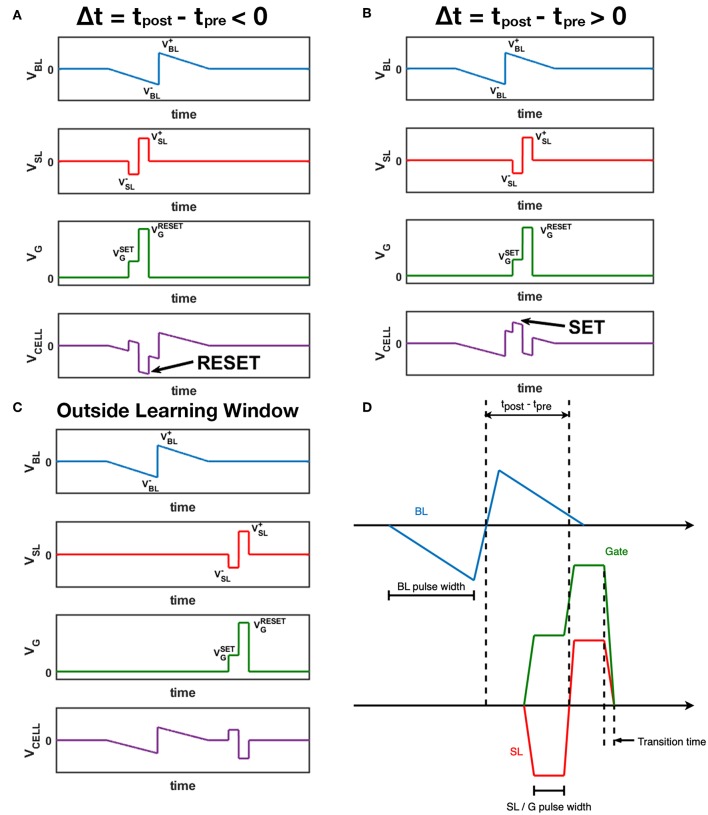
Spiking Neural Networks (SNNs) offer great potential to promote both the performance and efficiency of real-world computing systems, considering the biological plausibility of SNNs. The emerging analog Resistive Random Access Memory (RRAM) devices have drawn increasing interest as potential neuromorphic hardware for implementing practical SNNs. In this article, we propose a novel training approach (called greedy training) for SNNs by diluting spike events on the temporal dimension with necessary controls on input encoding phase switching, endowing SNNs with the ability to cooperate with the inevitable conductance variations of RRAM devices. The SNNs could utilize Spike-Timing-Dependent Plasticity (STDP) as the unsupervised learning rule, and this plasticity has been observed on our one-transistor-one-resistor (1T1R) RRAM devices under voltage pulses with designed waveforms. We have also conducted handwritten digit recognition task simulations on MNIST dataset. The results show that the unsupervised SNNs trained by the proposed method could mitigate the requirement for the number of gradual levels of RRAM devices, and also have immunity to both cycle-to-cycle and device-to-device RRAM conductance variations. Unsupervised SNNs trained by the proposed methods could cooperate with real RRAM devices with non-ideal behaviors better, promising high feasibility of RRAM array based neuromorphic systems for online training.
考虑到脉冲神经网络(SNN)的生物合理性,它在提升现实世界计算系统的性能和效率方面具有巨大潜力。新兴的模拟电阻式随机存取存储器(RRAM)器件作为实现实用SNN的潜在神经形态硬件,已引起越来越多的关注。在本文中,我们提出了一种新颖的SNN训练方法(称为贪婪训练),通过在时间维度上稀释脉冲事件,并对输入编码相位切换进行必要控制,使SNN能够与RRAM器件不可避免的电导变化协同工作。SNN可以利用基于脉冲时间的可塑性(STDP)作为无监督学习规则,并且在具有设计波形的电压脉冲下,我们在单晶体管单电阻(1T1R)RRAM器件上观察到了这种可塑性。我们还在MNIST数据集上进行了手写数字识别任务模拟。结果表明,通过所提出的方法训练的无监督SNN可以减轻对RRAM器件渐变电平数量的要求,并且对RRAM的逐周期和器件间电导变化具有免疫力。通过所提出的方法训练的无监督SNN可以更好地与具有非理想行为的实际RRAM器件协同工作,这为基于RRAM阵列的神经形态系统进行在线训练提供了很高的可行性。