Pantazopoulou Areti, Glick Benjamin S
Department of Molecular Genetics and Cell Biology, The University of Chicago, Chicago, IL, United States.
Front Cell Dev Biol. 2019 Aug 6;7:153. doi: 10.3389/fcell.2019.00153. eCollection 2019.
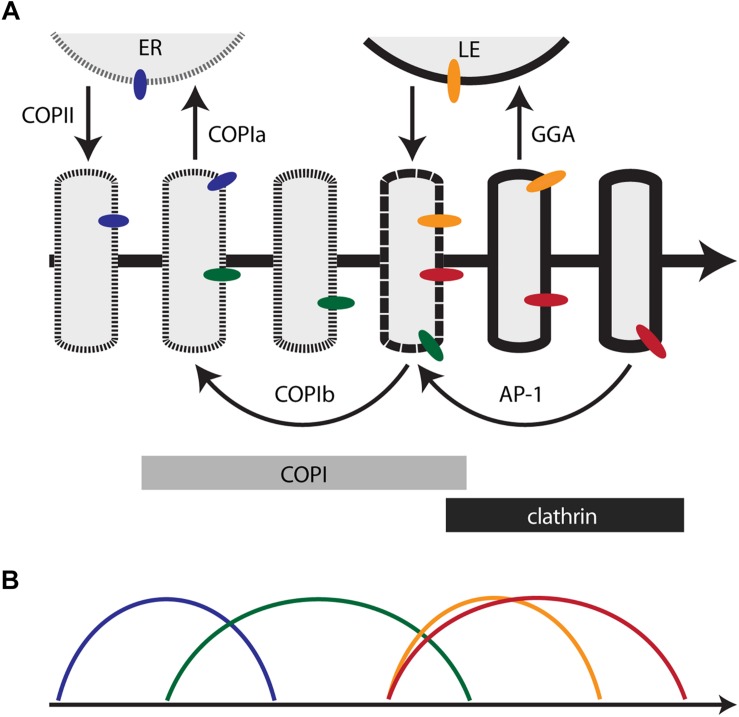
A long-standing assumption is that the cisternae of the Golgi apparatus can be grouped into functionally distinct compartments, yet the molecular identities of those compartments have not been clearly described. The concept of a compartmentalized Golgi is challenged by the cisternal maturation model, which postulates that cisternae form and then undergo progressive biochemical changes. Cisternal maturation can potentially be reconciled with Golgi compartmentation by defining compartments as discrete kinetic stages in the maturation process. These kinetic stages are distinguished by the traffic pathways that are operating. For example, a major transition occurs when a cisterna stops producing COPI vesicles and begins producing clathrin-coated vesicles. This transition separates one kinetic stage, the "early Golgi," from a subsequent kinetic stage, the "late Golgi" or "-Golgi network (TGN)." But multiple traffic pathways drive Golgi maturation, and the periods of operation for different traffic pathways can partially overlap, so there is no simple way to define a full set of Golgi compartments in terms of kinetic stages. Instead, we propose that the focus should be on the series of transitions experienced by a Golgi cisterna as various traffic pathways are switched on and off. These traffic pathways drive changes in resident transmembrane protein composition. Transitions in traffic pathways seem to be the fundamental, conserved determinants of Golgi organization. According to this view, the initial goal is to identify the relevant traffic pathways and place them on the kinetic map of Golgi maturation, and the ultimate goal is to elucidate the logic circuit that switches individual traffic pathways on and off as a cisterna matures.
长期以来的一种假设是,高尔基体的扁平囊泡可被归类为功能上不同的区室,但这些区室的分子特征尚未得到清晰描述。扁平囊泡成熟模型对区室化高尔基体的概念提出了挑战,该模型假定扁平囊泡形成后会经历渐进的生化变化。通过将区室定义为成熟过程中的离散动力学阶段,扁平囊泡成熟有可能与高尔基体区室化相协调。这些动力学阶段通过正在运行的运输途径来区分。例如,当一个扁平囊泡停止产生COP I囊泡并开始产生网格蛋白包被囊泡时,会发生一个主要转变。这个转变将一个动力学阶段,即“早期高尔基体”,与随后的动力学阶段,即“晚期高尔基体”或反式高尔基体网络(TGN)区分开来。但是多种运输途径驱动高尔基体成熟,并且不同运输途径的运行时期可能会部分重叠,所以没有简单的方法根据动力学阶段来定义一整套高尔基体区室。相反,我们建议重点应放在高尔基体扁平囊泡在各种运输途径开启和关闭时所经历的一系列转变上。这些运输途径驱动驻留跨膜蛋白组成的变化。运输途径的转变似乎是高尔基体组织的基本、保守的决定因素。按照这种观点,最初的目标是识别相关的运输途径并将它们置于高尔基体成熟的动力学图谱上,最终目标是阐明当一个扁平囊泡成熟时开启和关闭各个运输途径的逻辑电路。