Grashow Rachel, Weisskopf Marc G, Miller Karen K, Nathan David M, Zafonte Ross, Speizer Frank E, Courtney Theodore K, Baggish Aaron, Taylor Herman A, Pascual-Leone Alvaro, Nadler Lee M, Roberts Andrea L
Department of Environmental Health, Harvard T. H. Chan School of Public Health, Boston, Massachusetts.
Football Players Health Study, Harvard Medical School, Boston, Massachusetts.
JAMA Neurol. 2019 Dec 1;76(12):1428-1438. doi: 10.1001/jamaneurol.2019.2664.
Small studies suggest that head trauma in men may be associated with low testosterone levels and sexual dysfunction through mechanisms that likely include hypopituitarism secondary to ischemic injury and pituitary axonal tract damage. Athletes in contact sports may be at risk for pituitary insufficiencies or erectile dysfunction (ED) because of the high number of head traumas experienced during their careers. Whether multiple symptomatic concussive events are associated with later indicators of low testosterone levels and ED is unknown.
To explore the associations between concussion symptom history and participant-reported indicators of low testosterone levels and ED.
DESIGN, SETTING, AND PARTICIPANTS: This cross-sectional study of former professional US-style football players was conducted in Boston, Massachusetts, from January 2015 to March 2017. Surveys on past football exposures, demographic factors, and current health conditions were sent via electronic and postal mail to participants within and outside of the United States. Analyses were conducted in Boston, Massachusetts; the data analysis began in March 2018 and additional analyses were performed through June 2019. Of the 13 720 male former players eligible to enroll who were contacted, 3506 (25.6%) responded.
Concussion symptom score was calculated by summing the frequency with which participants reported 10 symptoms, such as loss of consciousness, disorientation, nausea, memory problems, and dizziness, at the time of football-related head injury.
Self-reported recommendations or prescriptions for low testosterone or ED medication served as indicators for testosterone insufficiency and ED.
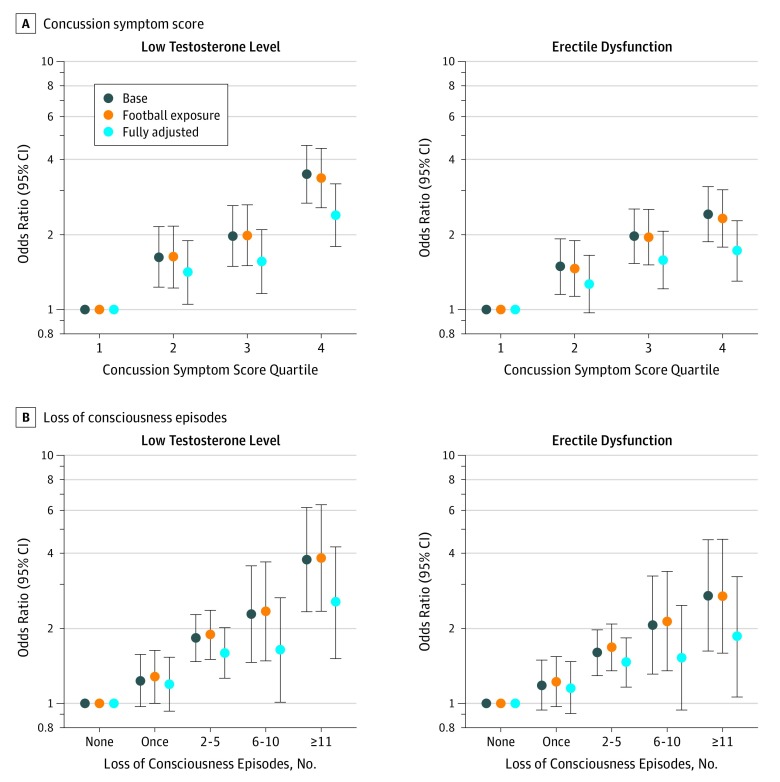
In 3409 former players (mean [SD] age, 52.5 [14.1] years), the prevalence of indicators of low testosterone levels and ED was 18.3% and 22.7%, respectively. The odds of reporting low testosterone levels or ED indicators were elevated for previously established risk factors (eg, diabetes, sleep apnea, and mood disorders). Models adjusted for demographic characteristics, football exposures, and current health factors showed a significant monotonically increasing association of concussion symptom score with the odds of reporting the low testosterone indicator (highest vs lowest quartile, odds ratio, 2.39; 95% CI, 1.79-3.19; P < .001). The ED indicator showed a similar association (highest quartile vs lowest, odds ratio, 1.72; 95% CI, 1.30-2.27; P < .001).
Concussion symptoms at the time of injury among former football players were associated with current participant-reported low testosterone levels and ED indicators. These findings suggest that men with a history of head injury may benefit from discussions with their health care clinicians regarding testosterone deficiency and sexual dysfunction.
小型研究表明,男性头部外伤可能与睾酮水平低下及性功能障碍有关,其机制可能包括继发于缺血性损伤的垂体功能减退和垂体轴突束损伤。从事接触性运动的运动员由于在职业生涯中经历大量头部外伤,可能存在垂体功能不全或勃起功能障碍(ED)的风险。多次有症状的脑震荡事件是否与后期睾酮水平低下和ED的指标相关尚不清楚。
探讨脑震荡症状史与参与者报告的睾酮水平低下和ED指标之间的关联。
设计、地点和参与者:这项对美国前职业美式橄榄球运动员的横断面研究于2015年1月至2017年3月在马萨诸塞州波士顿进行。通过电子邮件和邮政信件向美国境内外的参与者发送了关于过去橄榄球运动接触情况、人口统计学因素和当前健康状况的调查问卷。分析在马萨诸塞州波士顿进行;数据分析于2018年3月开始,并在2019年6月进行了额外分析。在13720名符合条件的男性前运动员中,有3506人(25.6%)回复。
通过将参与者报告的10种症状(如意识丧失、定向障碍、恶心、记忆问题和头晕)在与橄榄球相关的头部受伤时出现的频率相加来计算脑震荡症状评分。
自我报告的低睾酮或ED药物的推荐或处方作为睾酮不足和ED的指标。
在3409名前运动员(平均[标准差]年龄,52.5[14.1]岁)中,低睾酮水平和ED指标的患病率分别为18.3%和22.7%。既往已确定的危险因素(如糖尿病、睡眠呼吸暂停和情绪障碍)使报告低睾酮水平或ED指标的几率升高。在调整了人口统计学特征、橄榄球运动接触情况和当前健康因素的模型中,脑震荡症状评分与报告低睾酮指标的几率呈显著单调递增关联(最高四分位数与最低四分位数相比,比值比,2.39;95%可信区间,1.79 - 3.19;P <.001)。ED指标显示出类似的关联(最高四分位数与最低四分位数相比,比值比,1.72;95%可信区间,1.30 - 2.27;P <.001)。
前橄榄球运动员受伤时的脑震荡症状与当前参与者报告的低睾酮水平和ED指标相关。这些发现表明,有头部受伤史的男性可能会受益于与他们的医疗保健临床医生就睾酮缺乏和性功能障碍进行的讨论。