Ultra-low Magnetic Field Team, Korea Research Institute of Standards and Science (KRISS), 267, Gajeong-ro, Yuseong-gu, Daejeon, 34113, Republic of Korea.
Department of Chemistry, Korea Military Academy, 574, Hwarang-ro, Nowon-gu, Seoul, 01805, Republic of Korea.
Sci Rep. 2019 Aug 27;9(1):12422. doi: 10.1038/s41598-019-48827-5.
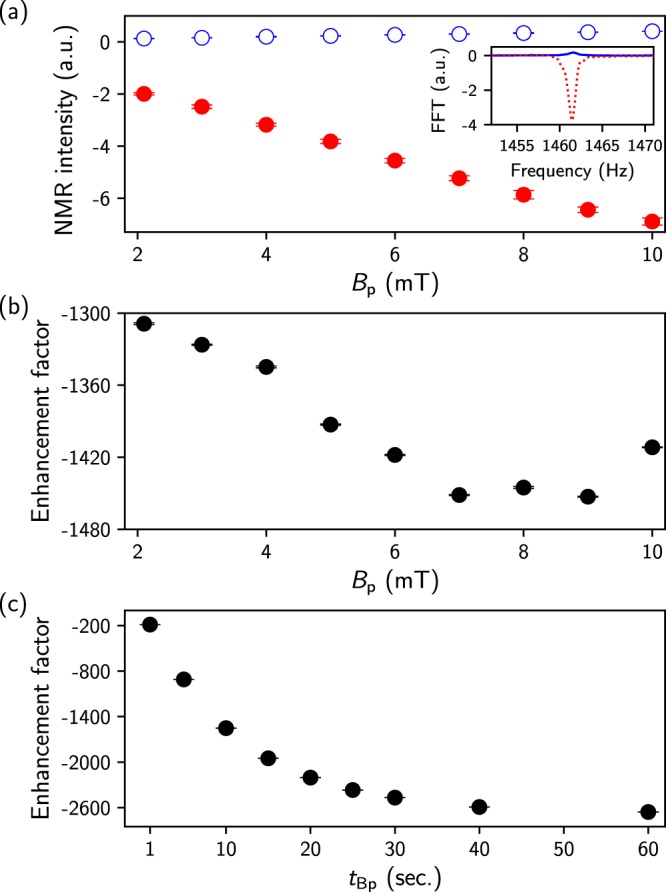
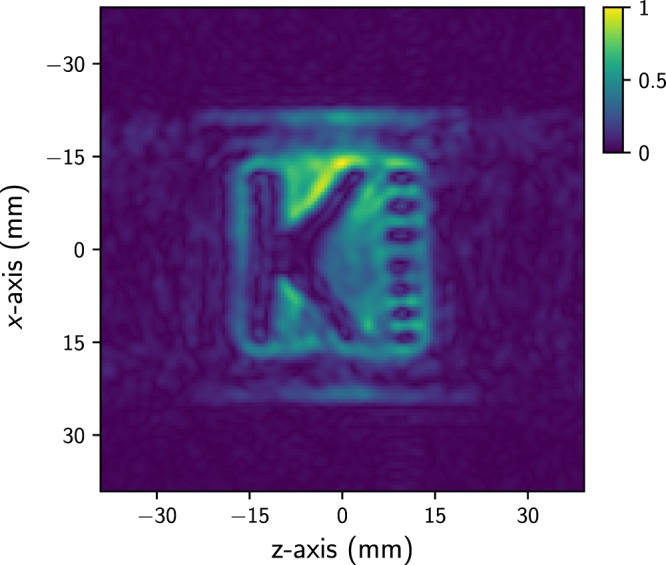
The signal amplification by reversible exchange (SABRE) technique is a very promising method for increasing magnetic resonance (MR) signals. SABRE can play a particularly large role in studies with a low or ultralow magnetic field because they suffer from a low signal-to-noise ratio. In this work, we conducted real-time superconducting quantum interference device (SQUID)-based nuclear magnetic resonance (NMR)/magnetic resonance imaging (MRI) studies in a microtesla-range magnetic field using the SABRE technique after designing a bubble-separated phantom. A maximum enhancement of 2658 for H was obtained for pyridine in the SABRE-NMR experiment. A clear SABRE-enhanced MR image of the bubble-separated phantom, in which the para-hydrogen gas was bubbling at only the margin, was successfully obtained at 34.3 μT. The results show that SABRE can be successfully incorporated into an ultralow-field MRI system, which enables new SQUID-based MRI applications. SABRE can shorten the MRI operation time by more than 6 orders of magnitude and establish a firm basis for future low-field MRI applications.
信号放大可逆交换(SABRE)技术是一种非常有前途的方法,可以增加磁共振(MR)信号。SABRE 在低场或超低场的研究中可以发挥特别大的作用,因为它们的信噪比低。在这项工作中,我们在微特斯拉磁场范围内设计了一个气泡分离的仿体后,使用 SABRE 技术进行了实时超导量子干涉器件(SQUID)基于的核磁共振(NMR)/磁共振成像(MRI)研究。在 SABRE-NMR 实验中,吡啶的 H 获得了最大 2658 的增强。在 34.3 μT 时,成功地获得了仅在边缘冒泡的气泡分离仿体的清晰 SABRE 增强 MR 图像。结果表明,SABRE 可以成功地纳入超低场 MRI 系统,从而实现新的基于 SQUID 的 MRI 应用。SABRE 可以将 MRI 操作时间缩短 6 个数量级以上,为未来的低场 MRI 应用奠定坚实的基础。