Saaybi Stephanie, AlArab Natally, Hannoun Salem, Saade Maritherese, Tutunji Rayyan, Zeeni Carine, Shbarou Rolla, Hourani Roula, Boustany Rose-Mary
Division of Pediatric Neurology, Departments of Pediatrics and Adolescent Medicine/Biochemistry and Molecular Genetics, American University of Beirut Medical Center, Beirut, Lebanon.
Department of Pediatrics and Adolescent Medicine, MedStar Georgetown University Hospital, Washington, DC, United States.
Front Neurol. 2019 Aug 13;10:877. doi: 10.3389/fneur.2019.00877. eCollection 2019.
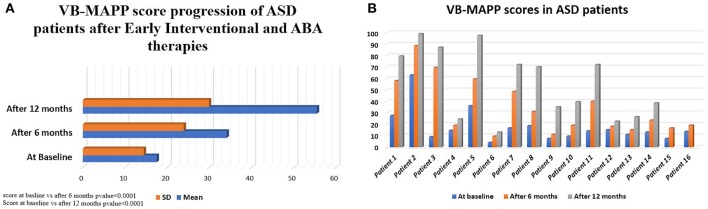
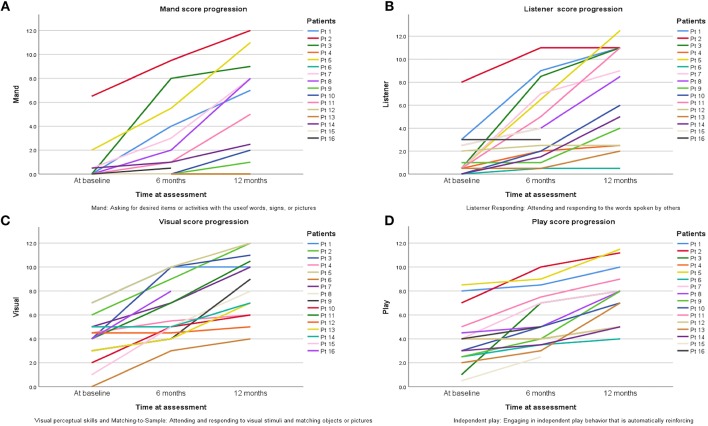
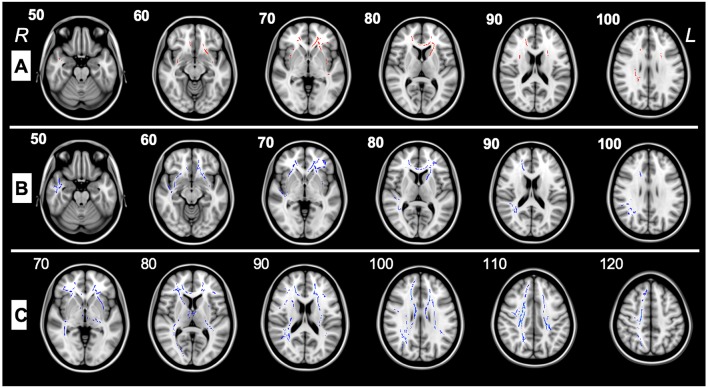
This pilot study aims to identify white matter (WM) tract abnormalities in Autism Spectrum Disorders (ASD) toddlers and pre-schoolers by Diffusion Tensor Imaging (DTI), and to correlate imaging findings with clinical improvement after early interventional and Applied Behavior Analysis (ABA) therapies by Verbal Behavior Milestones Assessment and Placement Program (VB-MAPP). DTI scans were performed on 17 ASD toddlers/pre-schoolers and seven age-matched controls. Nine ASD patients had follow-up MRI 12 months following early intervention and ABA therapy. VB-MAPP was assessed and compared at diagnosis, 6 and 12 months after therapies. Tract-Based Spatial Statistics (TBSS) was used to measure fractional anisotropy (FA), mean diffusivity (MD), axial diffusivity (AD), and radial (RD) diffusivity. VB-MAPP scores improved at 6 and 12 months after early intervention and ABA therapy compared to scores at baseline. TBSS analysis showed significant FA decrease and/or RD increase in ASD patients before therapy vs. controls in inferior fronto-occipital fasciculi, uncinate fasciculi, left superior fronto-occipital fasciculus, forceps minor, left superior fronto-occipital fasciculus, right superior longitudinal fasciculus, corona radiate bilaterally, and left external capsule. A significantly FA increase in 21 tracts and ROIs is reported in post- vs. pre-therapy DTI analysis. DTI findings highlighted ASD patient WM abnormalities at diagnosis and confirmed the benefits of 12 months of early intervention and ABA therapy on clinical and neuro imaging outcomes.
这项初步研究旨在通过扩散张量成像(DTI)识别自闭症谱系障碍(ASD)幼儿和学龄前儿童的白质(WM)束异常,并通过言语行为里程碑评估与安置计划(VB-MAPP)将成像结果与早期干预和应用行为分析(ABA)治疗后的临床改善情况相关联。对17名ASD幼儿/学龄前儿童和7名年龄匹配的对照者进行了DTI扫描。9名ASD患者在早期干预和ABA治疗12个月后进行了随访MRI检查。在诊断时、治疗后6个月和12个月对VB-MAPP进行评估和比较。基于体素的空间统计学(TBSS)用于测量分数各向异性(FA)、平均扩散率(MD)、轴向扩散率(AD)和径向扩散率(RD)。与基线时的分数相比,早期干预和ABA治疗后6个月和12个月时VB-MAPP分数有所提高。TBSS分析显示,与对照组相比,治疗前ASD患者在额枕下束、钩束、左侧额枕上束、小钳、左侧额枕上束、右侧额上纵束、双侧放射冠和左侧外囊中的FA显著降低和/或RD增加。在治疗后与治疗前的DTI分析中,报告了21个束和感兴趣区(ROI)的FA显著增加。DTI结果突出了诊断时ASD患者的WM异常,并证实了12个月的早期干预和ABA治疗对临床和神经影像学结果的益处。