From the Department of Psychiatry and Behavioral Sciences (Miller), School of Medicine, and Department of Psychology (Gillett, Gotlib), Stanford University, California; Department of Psychology (Manczak), University of Denver, Colorado; and Emotion and Development Branch, National Institute of Mental Health (Kircanski), Bethesda, Maryland.
Psychosom Med. 2019 Sep;81(7):641-648. doi: 10.1097/PSY.0000000000000714.
Exposure to high levels of fine particle air pollution (PM2.5) is associated with adolescent pathophysiology. It is unclear, however, if PM2.5 is associated with physiology within psychosocial contexts, such as social stress, and whether some adolescents are particularly vulnerable to PM2.5-related adverse effects. This study examined the association between PM2.5 and autonomic reactivity to social stress in adolescents and tested whether symptoms of anxiety and depression moderated this association.
Adolescents from Northern California (N = 144) participated in a modified Trier Social Stress Test while providing high-frequency heart rate variability and skin conductance level data. PM2.5 data were recorded from CalEnviroScreen. Adolescents reported on their own symptoms of anxiety and depression using the Youth Self-Report, which has been used in prior studies and has good psychometric properties (Cronbach's α in this sample was .86).
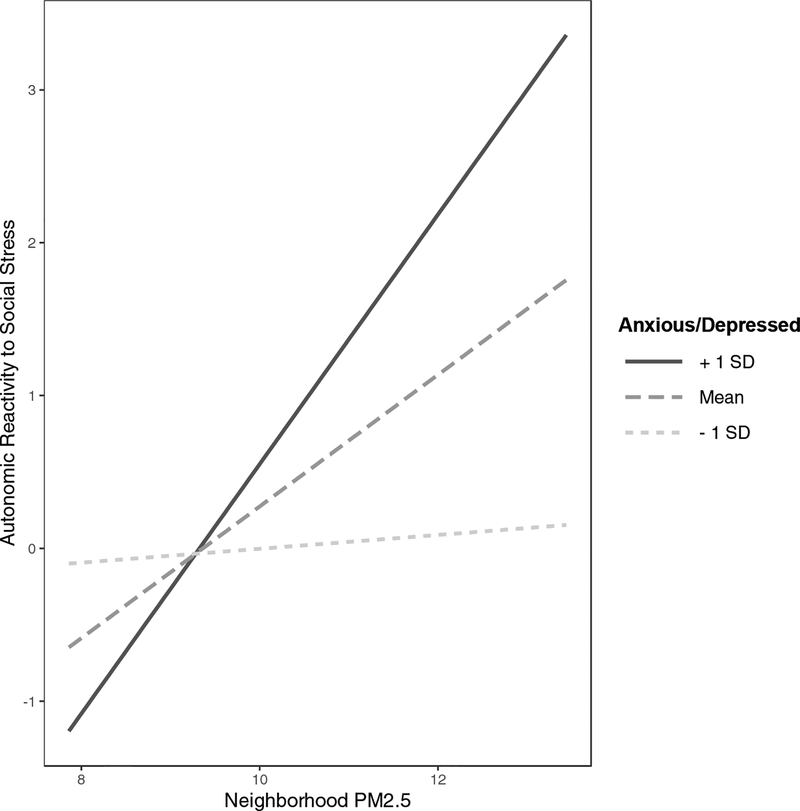
Adolescents residing in neighborhoods characterized by higher concentrations of PM2.5 demonstrated greater autonomic reactivity (i.e., indexed by lower heart rate variability and higher skin conductance level) (β = .27; b = .44, p = .001, 95% CI = 0.19 to 0.68) in response to social stress; this association was not accounted for by socioeconomic factors. In addition, adolescents who reported more severe anxiety and depression symptoms showed the strongest association between PM2.5 and autonomic reactivity to social stress (β = .53; b = .86, p < .001, 95% CI = 0.48 to 1.23).
Exposure to PM2.5 may heighten adolescent physiological reactivity to social stressors. Moreover, adolescents who experience anxiety and depression may be particularly vulnerable to the adverse effects of PM2.5 on stress reactivity.
暴露于高水平的细颗粒物空气污染(PM2.5)与青少年的病理生理学有关。然而,目前尚不清楚 PM2.5 是否与社会心理环境中的生理机能有关,例如社会压力,以及是否有些青少年特别容易受到 PM2.5 相关不良影响的影响。本研究探讨了 PM2.5 与青少年对社会压力的自主反应之间的关系,并检验了焦虑和抑郁症状是否调节了这种关系。
来自北加州的青少年(N=144)在进行改良的特里尔社会应激测试的同时,提供高频心率变异性和皮肤电导率水平数据。PM2.5 数据来自 CalEnviroScreen 记录。青少年使用青少年自我报告(Youth Self-Report)报告自己的焦虑和抑郁症状,该报告已在先前的研究中使用,并具有良好的心理计量学特性(本样本中的 Cronbach's α 为.86)。
居住在 PM2.5 浓度较高的社区的青少年在对社会压力的自主反应中表现出更大的反应性(即心率变异性降低和皮肤电导率水平升高)(β=0.27;b=0.44,p=0.001,95%CI=0.19 至 0.68);这种关联与社会经济因素无关。此外,报告有更严重的焦虑和抑郁症状的青少年表现出 PM2.5 与社会应激自主反应之间最强的关联(β=0.53;b=0.86,p<0.001,95%CI=0.48 至 1.23)。
暴露于 PM2.5 可能会增加青少年对社会压力源的生理反应性。此外,经历焦虑和抑郁的青少年可能特别容易受到 PM2.5 对应激反应的不良影响。