Department of Urology, Institute of Urology, West China Hospital, Sichuan University, 37, Guo Xue Road, Chengdu, 610041, China.
State Key Laboratory of Biotherapy and Cancer Center, Collaborative Innovation Center for Biotherapy, West China Hospital, Sichuan University, Chengdu, China.
BMC Cancer. 2019 Sep 2;19(1):871. doi: 10.1186/s12885-019-6055-9.
The relationship between first-degree family history of female breast cancer and prostate cancer risk in the general population remains unclear. We performed a meta-analysis to determine the association between first-degree family history of female breast cancer and prostate cancer risk.
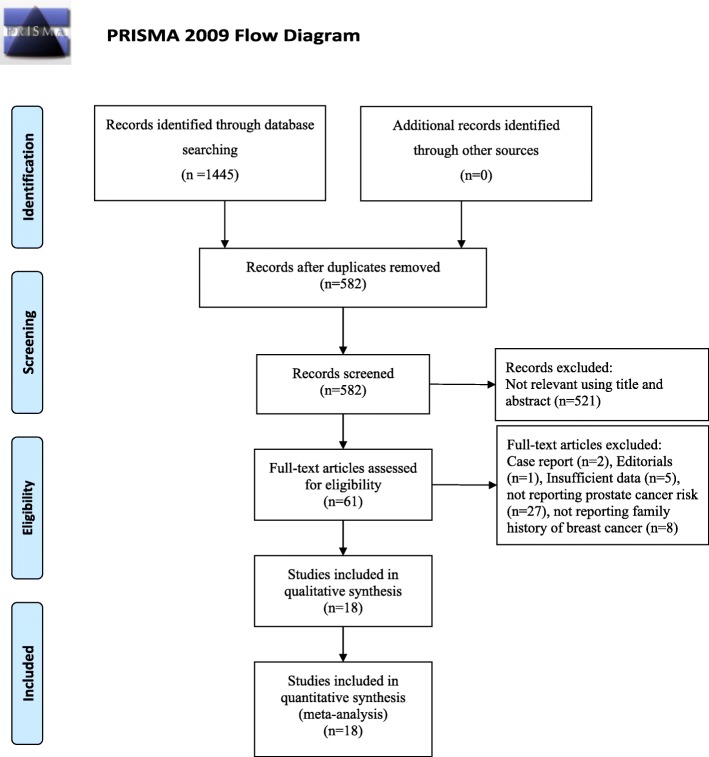
Databases, including MEDLINE, Embase, and Web of Science, were searched for all associated studies that evaluated associations between first-degree family history of female breast cancer and prostate cancer risk up to December 31, 2018. Information on study characteristics and outcomes were extracted based on the Preferred Reporting Items for Systematic Review and Meta-analysis (PRISMA) statement and Meta-analysis of Observational Studies in Epidemiology (MOOSE) guidelines. The quality of evidence was assessed using the GRADE approach.
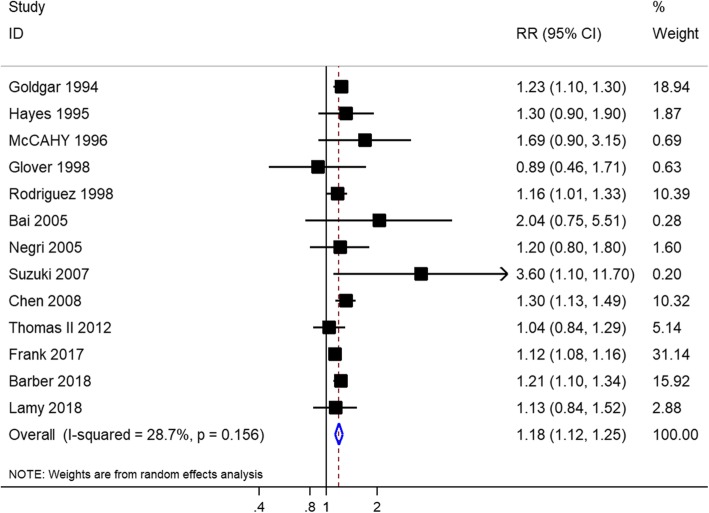
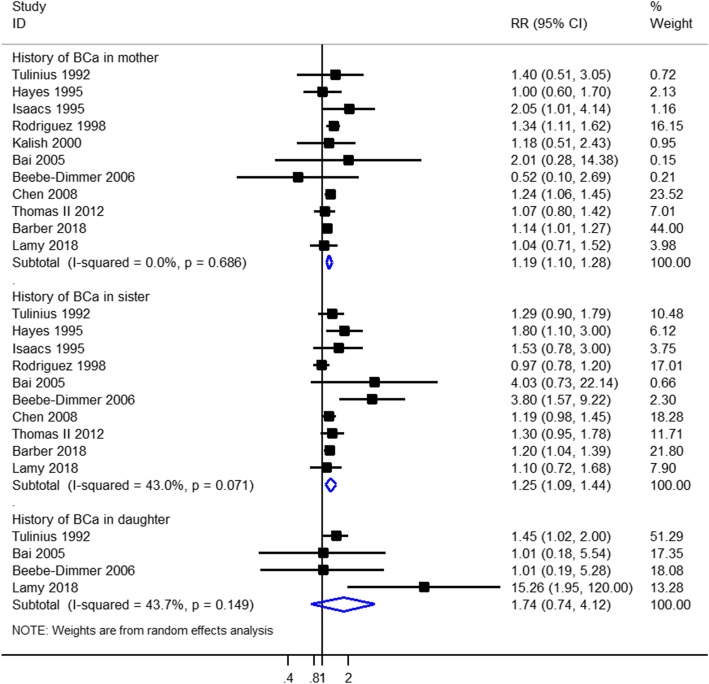
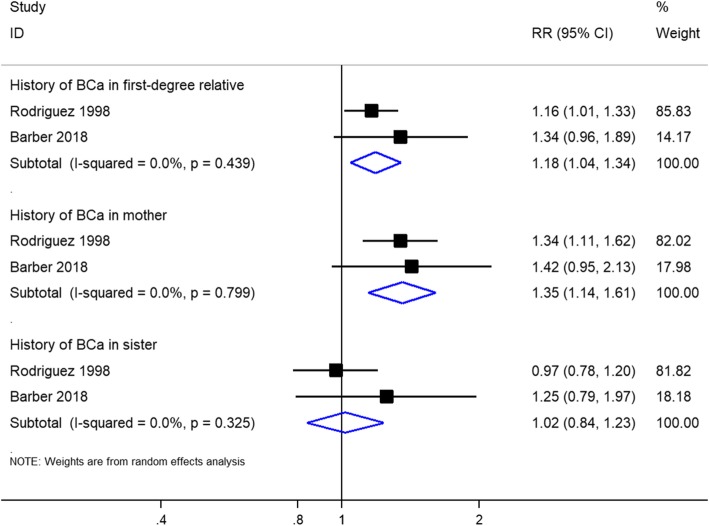
Eighteen studies involving 17,004,892 individuals were included in the meta-analysis. Compared with no family history of female breast cancer, history of female breast cancer in first-degree relatives was associated with an increased risk of prostate cancer [relative risk (RR) 1.18, 95% confidence interval (CI) 1.12-1.25] with moderate-quality evidence. A history of breast cancer in mothers only (RR 1.19, 95% CI 1.10-1.28) and sisters only (RR 1.71, 95% CI 1.43-2.04) was associated with increased prostate cancer risk with moderate-quality evidence. However, a family history of breast cancer in daughters only was not associated with prostate cancer incidence (RR 1.74, 95% CI 0.74-4.12) with moderate-quality evidence. A family history of female breast cancer in first-degree relatives was associated with an 18% increased risk of lethal prostate cancer (95% CI 1.04-1.34) with low-quality evidence.
This review demonstrates that men with a family history of female breast cancer in first-degree relatives had an increased risk of prostate cancer, including risk of lethal prostate cancer. These findings may guide screening, earlier detection, and treatment of men with a family history of female breast cancer in first-degree relatives.
一般人群中一级亲属乳腺癌家族史与前列腺癌风险之间的关系尚不清楚。我们进行了一项荟萃分析,以确定一级亲属乳腺癌家族史与前列腺癌风险之间的关联。
检索了 MEDLINE、Embase 和 Web of Science 等数据库,以获取截至 2018 年 12 月 31 日评估一级亲属乳腺癌家族史与前列腺癌风险之间关联的所有相关研究。根据系统评价和荟萃分析的首选报告项目(PRISMA)声明和观察性研究荟萃分析(MOOSE)指南,提取研究特征和结果信息。使用 GRADE 方法评估证据质量。
荟萃分析纳入了 18 项涉及 17004892 人的研究。与一级亲属无乳腺癌家族史相比,一级亲属有乳腺癌病史与前列腺癌风险增加相关[相对风险(RR)1.18,95%置信区间(CI)1.12-1.25],证据质量为中等。仅母亲(RR 1.19,95%CI 1.10-1.28)和姐妹(RR 1.71,95%CI 1.43-2.04)有乳腺癌病史与前列腺癌风险增加相关,证据质量为中等。然而,仅女儿有乳腺癌家族史与前列腺癌发病风险无关(RR 1.74,95%CI 0.74-4.12),证据质量为中等。一级亲属有乳腺癌家族史与致命性前列腺癌风险增加 18%相关(95%CI 1.04-1.34),证据质量低。
本综述表明,一级亲属有乳腺癌家族史的男性患前列腺癌的风险增加,包括致命性前列腺癌的风险。这些发现可能为一级亲属有乳腺癌家族史的男性提供筛查、早期检测和治疗指导。