Laboratory of Medical Entomology, Institute René Rachou, Oswaldo Cruz Foundation, Minas Gerais, FIOCRUZ, Belo Horizonte, MG, Brazil.
Biosystems Informatics and Genomics Group, Institute René Rachou, Oswaldo Cruz Foundation, Minas Gerais, FIOCRUZ, Belo Horizonte, MG, Brazil.
PLoS One. 2019 Sep 3;14(9):e0219523. doi: 10.1371/journal.pone.0219523. eCollection 2019.
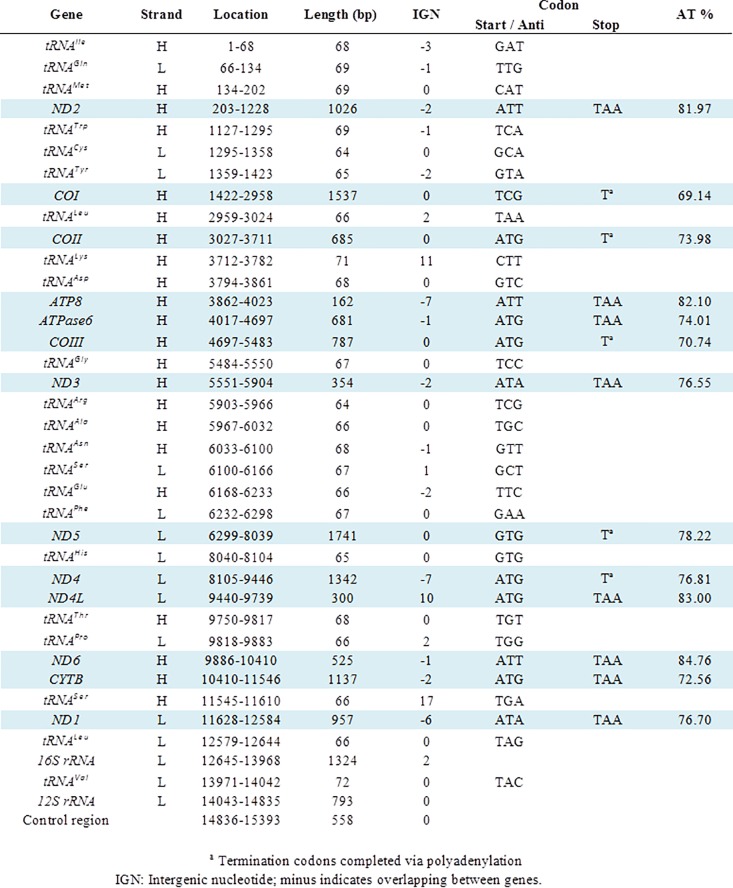
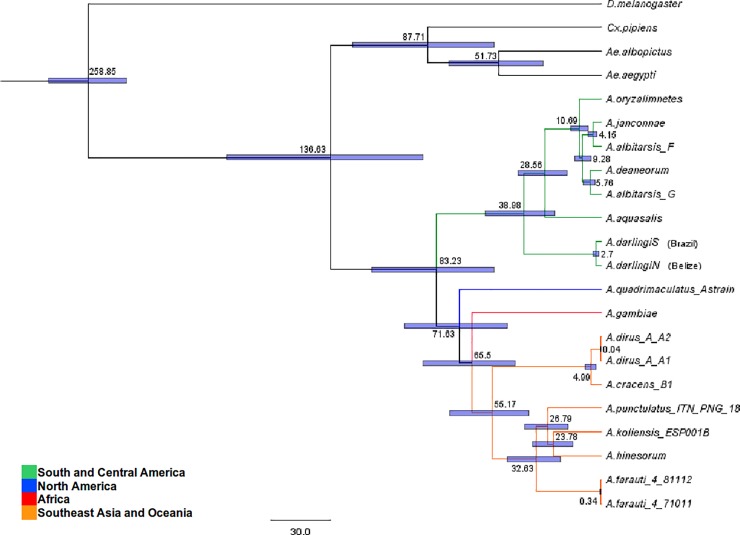
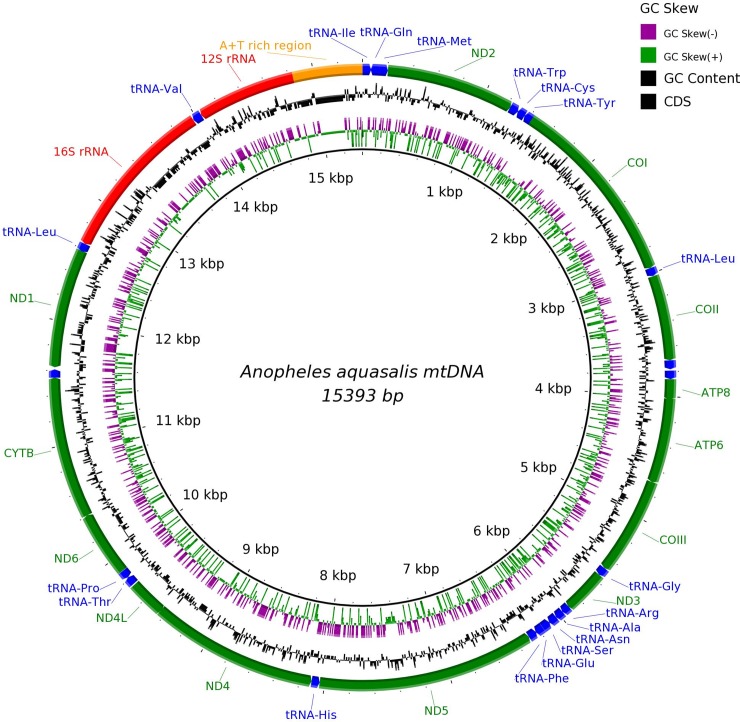
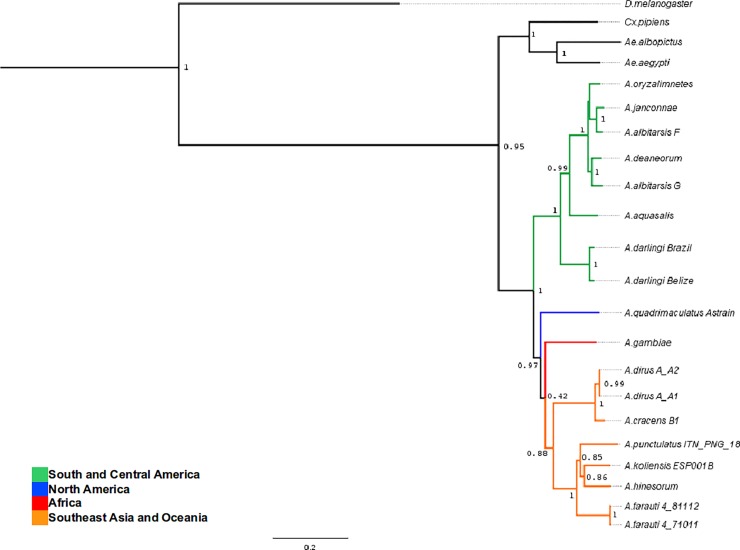
Whole mitogenome sequences (mtDNA) have been exploited for insect ecology studies, using them as molecular markers to reconstruct phylogenies, or to infer phylogeographic relationships and gene flow. Recent Anopheles phylogenomic studies have provided information regarding the time of deep lineage divergences within the genus. Here we report the complete 15,393 bp mtDNA sequences of Anopheles aquasalis, a Neotropical human malaria vector. When comparing its structure and base composition with other relevant and available anopheline mitogenomes, high similarity and conserved genomic features were observed. Furthermore, 22 mtDNA sequences comprising anopheline and Dipteran sibling species were analyzed to reconstruct phylogenies and estimate dates of divergence between taxa. Phylogenetic analysis using complete mtDNA sequences suggests that A. aquasalis diverged from the Anopheles albitarsis complex ~28 million years ago (MYA), and ~38 MYA from Anopheles darlingi. Bayesian analysis suggests that the most recent ancestor of Nyssorhynchus and Anopheles + Cellia was extant ~83 MYA, corroborating current estimates of ~79-100 MYA. Additional sampling and publication of African, Asian, and North American anopheline mitogenomes would improve the resolution of the Anopheles phylogeny and clarify early continental dispersal routes.
全线粒体基因组序列(mtDNA)已被用于昆虫生态学研究,将其作为分子标记用于重建系统发育,或推断系统地理学关系和基因流。最近的按蚊系统基因组学研究提供了有关该属内深系分化时间的信息。本文报道了新热带地区人类疟疾媒介按蚊aquasalis 的完整 15393bp mtDNA 序列。当将其结构和碱基组成与其他相关和可用的按蚊线粒体基因组进行比较时,观察到高度相似性和保守的基因组特征。此外,分析了 22 条包含按蚊和双翅目近缘种的 mtDNA 序列,以重建系统发育并估计分类单元之间的分歧时间。使用完整 mtDNA 序列进行的系统发育分析表明,A. aquasalis 与 Anopheles albitarsis 复合体分化约 2800 万年前(MYA),与 Anopheles darlingi 分化约 3800 万年前。贝叶斯分析表明,Nyssorhynchus 和 Anopheles + Cellia 的最近共同祖先存在于约 8300 万年前,与目前约 7900-10000 万年前的估计相符。更多的非洲、亚洲和北美的按蚊线粒体基因组的采样和发表将提高按蚊系统发育的分辨率,并阐明早期的大陆扩散路线。