Feng Shaobin, Farha Fadi, Li Qingjuan, Wan Yueliang, Xu Yang, Zhang Tao, Ning Huansheng
School of Computer and Communication Engineering, University of Science and Technology Beijing, Beijing 100083, China.
Beijing Engineering Research Center for Cyberspace Data Analysis and Applications, Beijing 100083, China.
Sensors (Basel). 2019 Aug 30;19(17):3760. doi: 10.3390/s19173760.
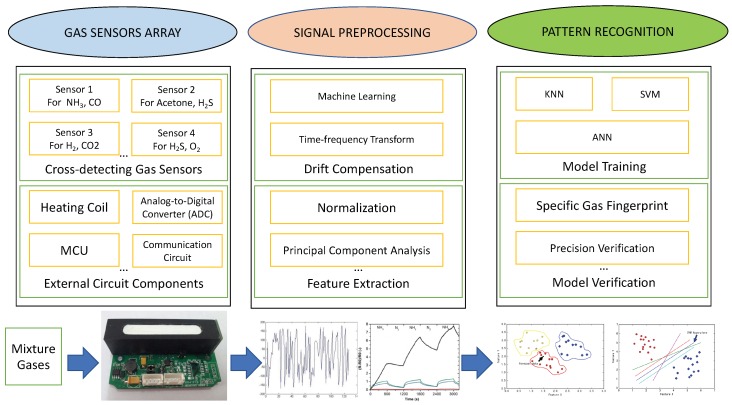
With the development of the Internet-of-Things (IoT) technology, the applications of gas sensors in the fields of smart homes, wearable devices, and smart mobile terminals have developed by leaps and bounds. In such complex sensing scenarios, the gas sensor shows the defects of cross sensitivity and low selectivity. Therefore, smart gas sensing methods have been proposed to address these issues by adding sensor arrays, signal processing, and machine learning techniques to traditional gas sensing technologies. This review introduces the reader to the overall framework of smart gas sensing technology, including three key points; gas sensor arrays made of different materials, signal processing for drift compensation and feature extraction, and gas pattern recognition including Support Vector Machine (SVM), Artificial Neural Network (ANN), and other techniques. The implementation, evaluation, and comparison of the proposed solutions in each step have been summarized covering most of the relevant recently published studies. This review also highlights the challenges facing smart gas sensing technology represented by repeatability and reusability, circuit integration and miniaturization, and real-time sensing. Besides, the proposed solutions, which show the future directions of smart gas sensing, are explored. Finally, the recommendations for smart gas sensing based on brain-like sensing are provided in this paper.
随着物联网(IoT)技术的发展,气体传感器在智能家居、可穿戴设备和智能移动终端等领域的应用有了飞跃式发展。在如此复杂的传感场景中,气体传感器表现出交叉敏感性和低选择性的缺陷。因此,人们提出了智能气体传感方法,通过在传统气体传感技术中加入传感器阵列、信号处理和机器学习技术来解决这些问题。本文综述向读者介绍了智能气体传感技术的总体框架,包括三个关键点:由不同材料制成的气体传感器阵列、用于漂移补偿和特征提取的信号处理,以及包括支持向量机(SVM)、人工神经网络(ANN)等技术的气体模式识别。总结了所提出解决方案在每个步骤中的实现、评估和比较,涵盖了最近发表的大部分相关研究。本文综述还强调了以重复性和可重用性、电路集成和小型化以及实时传感为代表的智能气体传感技术所面临的挑战。此外,还探讨了展示智能气体传感未来方向的所提出解决方案。最后,本文给出了基于类脑传感的智能气体传感建议。