Ihara Yukari, Takeshita Toru, Kageyama Shinya, Matsumi Rie, Asakawa Mikari, Shibata Yukie, Sugiura Yuki, Ishikawa Kunio, Takahashi Ichiro, Yamashita Yoshihisa
Section of Preventive and Public Health Dentistry, Division of Oral Health, Growth and Development, Faculty of Dental Science, Kyushu University, Fukuoka, Japan.
Section of Orthodontics and Dentofacial Orthopedics, Division of Oral Health, Growth and Development, Faculty of Dental Science, Kyushu University, Fukuoka, Japan.
mSystems. 2019 Sep 3;4(5):e00360-19. doi: 10.1128/mSystems.00360-19.
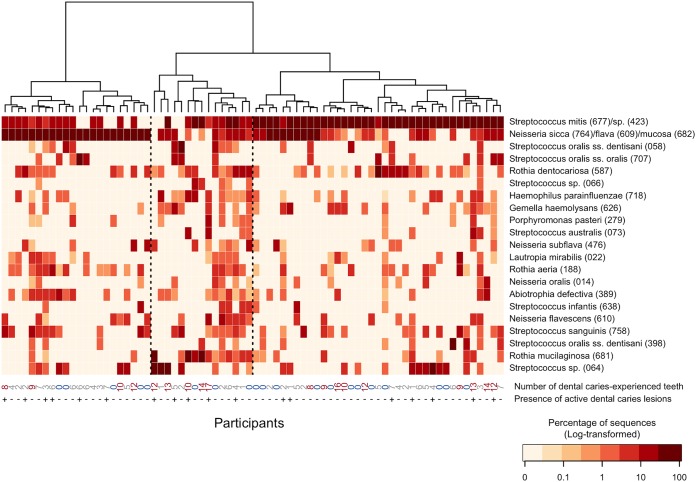
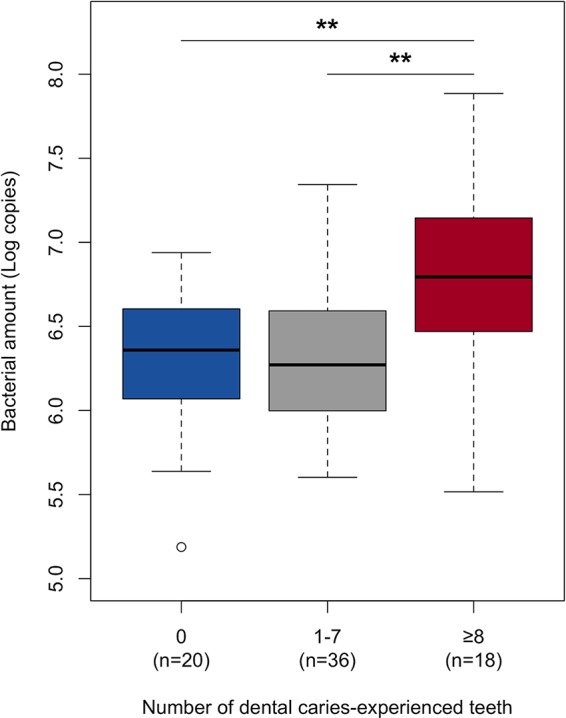
Development of dental plaque begins with the adhesion of salivary bacteria to the acquired pellicle covering the tooth surface. In this study, we collected dental plaque formed on hydroxyapatite disks for 6 h from 74 young adults and identified initial colonizing taxa based on full-length 16S rRNA gene sequences. A long-read, single-molecule sequencer, PacBio Sequel, provided 100,109 high-quality full-length 16S rRNA gene sequence reads from the early plaque microbiota, which were assigned to 90 oral bacterial taxa. The microbiota obtained from every individual mostly comprised the 21 predominant taxa with the maximum relative abundance of over 10% (95.8 ± 6.2%, mean ± SD), which included species as well as nonstreptococcal species. A hierarchical cluster analysis of their relative abundance distribution suggested three major patterns of microbiota compositions: a / sp. HMT-423-dominant profile, a //-dominant profile, and a complex profile with high diversity. No notable variations in the community structures were associated with the dental caries status, although the total bacterial amounts were larger in the subjects with a high number of caries-experienced teeth (≥8) than in those with no or a low number of caries-experienced teeth. Our results revealed the bacterial taxa primarily involved in early plaque formation on hydroxyapatite disks in young adults. Selective attachment of salivary bacteria to the tooth surface is an initial and repetitive phase in dental plaque development. We employed full-length 16S rRNA gene sequence analysis with a high taxonomic resolution using a third-generation sequencer, PacBio Sequel, to determine the bacterial composition during early plaque formation in 74 young adults accurately and in detail. The results revealed 21 bacterial taxa primarily involved in early plaque formation on hydroxyapatite disks in young adults, which include several streptococcal species as well as nonstreptococcal species, such as / / and Given that no notable variations in the microbiota composition were associated with the dental caries status, the maturation process, rather than the specific bacterial species that are the initial colonizers, is likely to play an important role in the development of dysbiotic microbiota associated with dental caries.
牙菌斑的形成始于唾液细菌附着在覆盖牙齿表面的获得性薄膜上。在本研究中,我们从74名年轻成年人中收集了在羟基磷灰石盘上形成6小时的牙菌斑,并根据全长16S rRNA基因序列鉴定了最初定殖的分类群。一台长读长单分子测序仪PacBio Sequel从早期牙菌斑微生物群中提供了100109条高质量的全长16S rRNA基因序列读数,这些读数被归类为90种口腔细菌分类群。从每个个体获得的微生物群大多由21个优势分类群组成,最大相对丰度超过10%(95.8±6.2%,平均值±标准差),其中包括链球菌属物种以及非链球菌属物种。对其相对丰度分布的层次聚类分析表明微生物群组成有三种主要模式:一种是以血链球菌HMT-423为主的模式、一种是以口腔链球菌为主的模式以及一种具有高多样性的复杂模式。尽管有大量龋齿经历牙齿(≥8颗)的受试者的细菌总量比没有或只有少量龋齿经历牙齿的受试者的细菌总量大,但群落结构没有明显变化与龋齿状况相关。我们的结果揭示了主要参与年轻成年人羟基磷灰石盘上早期牙菌斑形成的细菌分类群。唾液细菌选择性附着在牙齿表面是牙菌斑形成的初始和重复阶段。我们使用第三代测序仪PacBio Sequel进行具有高分类分辨率的全长16S rRNA基因序列分析,以准确、详细地确定74名年轻成年人早期牙菌斑形成过程中的细菌组成。结果揭示了21种主要参与年轻成年人羟基磷灰石盘上早期牙菌斑形成的细菌分类群,其中包括几种链球菌属物种以及非链球菌属物种,如口腔纤毛菌和龋齿放线菌。鉴于微生物群组成没有明显变化与龋齿状况相关,成熟过程而非作为最初定殖者的特定细菌物种可能在与龋齿相关的生态失调微生物群的发展中起重要作用。