Lee Jin-Hui, Oh Myung-Min, Son Ki-Ho
Division of Animal, Horticultural and Food Science, Chungbuk National University, Cheongju, South Korea.
Brain Korea Center for Bio-Resource Development, Chungbuk National University, Cheongju, South Korea.
Front Plant Sci. 2019 Aug 20;10:1042. doi: 10.3389/fpls.2019.01042. eCollection 2019.
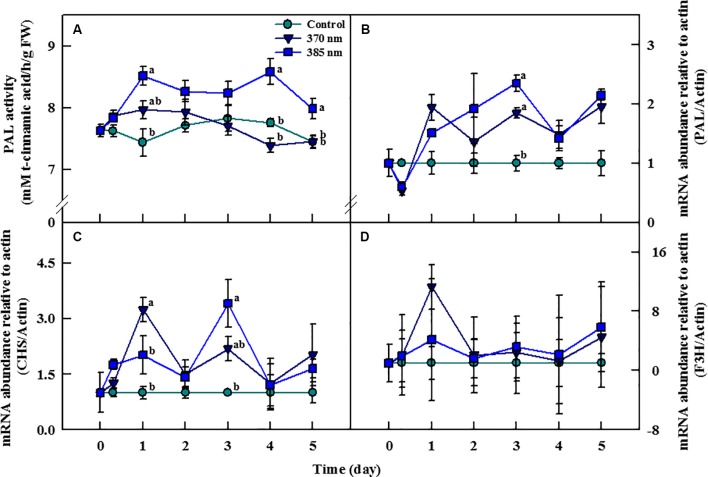
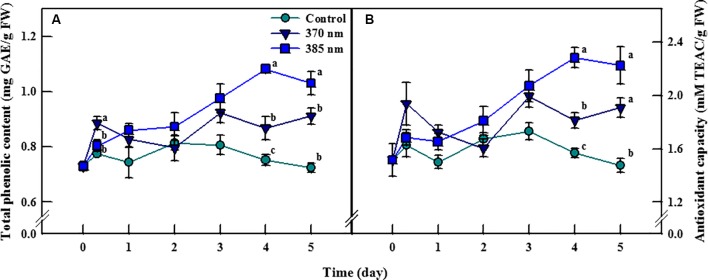
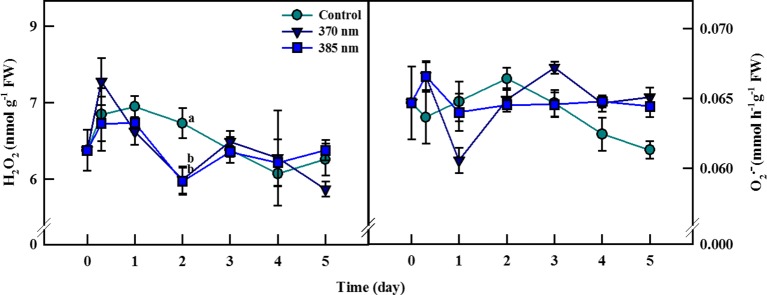
The aim of this study was to determine the influence of two types of UV-A LEDs on the growth and accumulation of phytochemicals in kale ( var. ). Fourteen-day-old kale seedlings were transferred to a growth chamber and cultivated for 3 weeks. The kale plants were subsequently subjected to two types of UV-A LEDs (370 and 385 nm) of 30 W/m for 5 days. Growth characteristics were all significantly increased in plants exposed to UV-A LEDs, especially at the 385 nm level, for which dry weight of shoots and roots were significantly increased by 2.22 and 2.5 times, respectively, at 5 days of treatment. Maximum quantum efficiency of photosystem II photochemistry (Fv/Fm ratio) began to decrease after 3 h of treatment compared to the control. The total phenolic content of plants exposed to the two types of UV-A LEDs increased by 25% at 370 nm and 42% at 385 nm at 5 days of treatment, and antioxidant capacity also increased. The two types of UV-A LEDs also induced increasing contents of caffeic acid, ferulic acid, and kaempferol. The reactive oxygen species (ROS) temporarily increased in plants exposed to the two types of UV-A LEDs after 3 h of treatment. Moreover, transcript levels of phenylalanine ammonia-lyase (PAL), chalcone synthase (CHS), and flavanone 3-hydroxylase (F3H) genes and PAL enzyme activity were higher in plants treated with UV-A LEDs. Our results suggested that short-term UV-A LEDs were effective in increasing growth and improving antioxidant phenolic compounds in kale, thereby representing a potentially effective strategy for enhancing the production of phytochemicals.
本研究的目的是确定两种类型的UV-A发光二极管对羽衣甘蓝(品种 )生长和植物化学物质积累的影响。将14日龄的羽衣甘蓝幼苗转移到生长室中培养3周。随后,将羽衣甘蓝植株置于两种类型的UV-A发光二极管(370和385纳米)下,光照强度为30瓦/平方米,持续5天。暴露于UV-A发光二极管的植株的生长特性均显著增加,尤其是在385纳米水平,处理5天时,地上部和根部的干重分别显著增加了2.22倍和2.5倍。与对照相比,处理3小时后光系统II光化学的最大量子效率(Fv/Fm比值)开始下降。处理5天时,暴露于两种类型UV-A发光二极管的植株的总酚含量在370纳米时增加了25%,在385纳米时增加了42%,抗氧化能力也有所提高。这两种类型的UV-A发光二极管还诱导了咖啡酸·阿魏酸和山奈酚含量的增加。处理3小时后,暴露于两种类型UV-A发光二极管的植株中的活性氧(ROS)暂时增加。此外,用UV-A发光二极管处理的植株中苯丙氨酸解氨酶(PAL)、查尔酮合酶(CHS)和黄烷酮3-羟化酶(F3H)基因的转录水平以及PAL酶活性较高。我们的结果表明,短期UV-A发光二极管能有效促进羽衣甘蓝的生长并改善其抗氧化酚类化合物,从而代表了一种提高植物化学物质产量的潜在有效策略。