Pandit Pallavi, Schwartzkopf Matthias, Rothkirch André, Roth Stephan V, Bernstorff Sigrid, Gupta Ajay
Deutsches Elektronen-Synchrotron (DESY), Notkestraße 85, D-22607 Hamburg, Germany.
KTH Royal Institute of Technology, Department of Fibre and Polymer Technology, Teknikringen 56-58, SE-100 44 Stockholm, Sweden.
Nanomaterials (Basel). 2019 Sep 3;9(9):1249. doi: 10.3390/nano9091249.
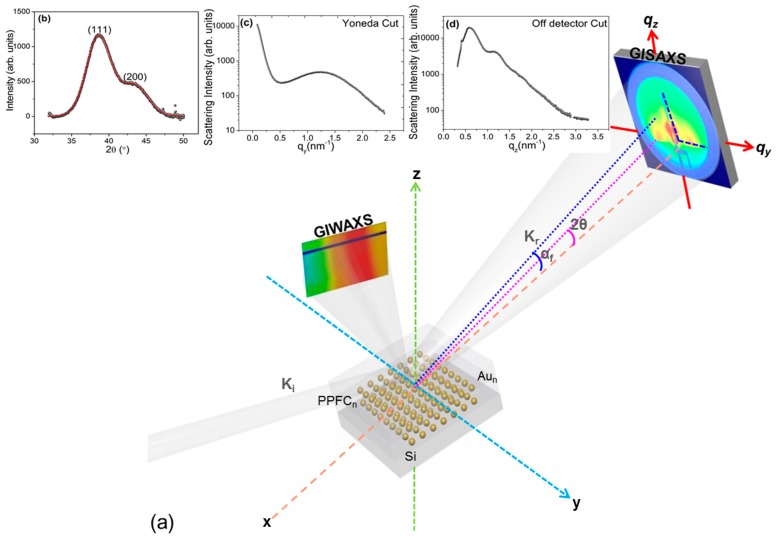
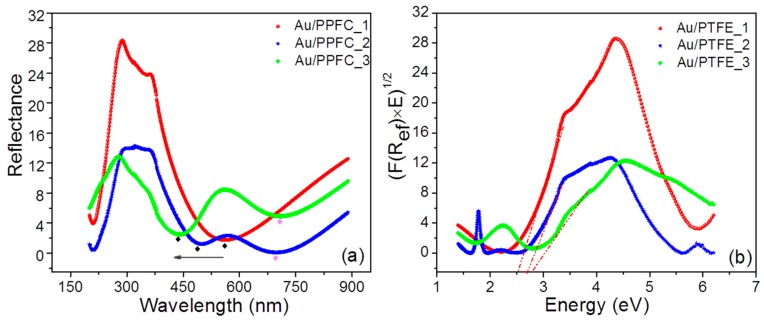
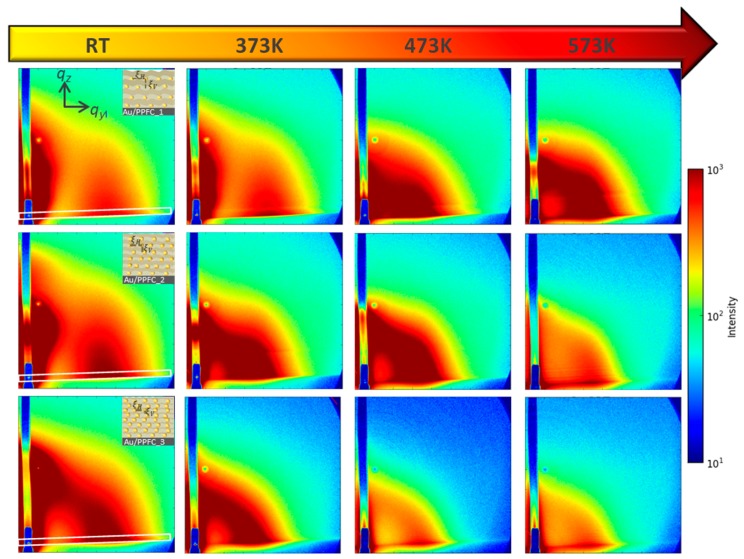
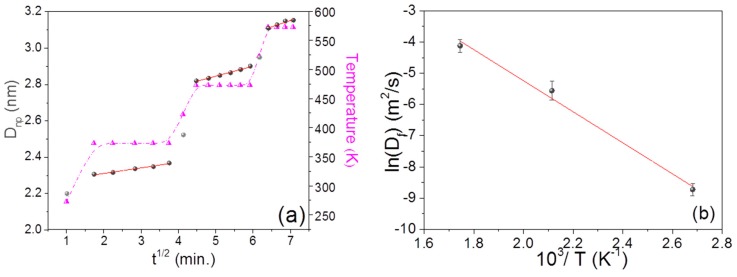
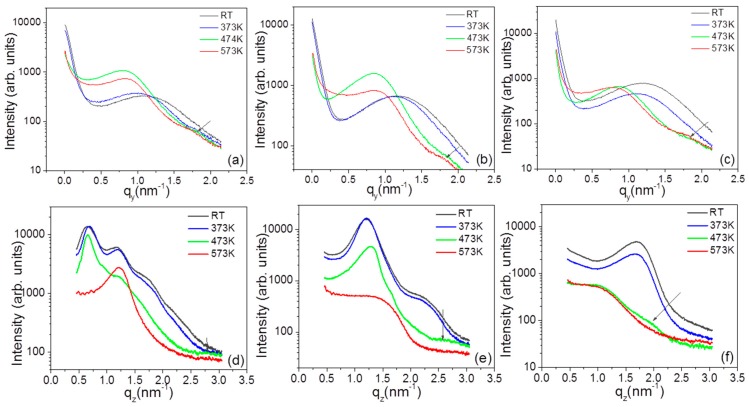
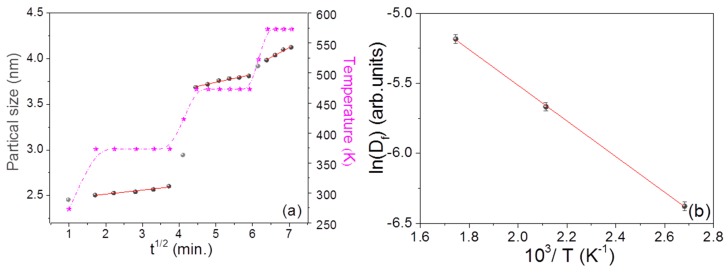
A new strategy to nanoengineer gold/fluorocarbon multilayer (ML) nanostructures is reported. We have investigated the morphological changes occurring at the metal-polymer interface in ML structures with varying volume fraction of gold (Au) and the kinetic growth aspect of the microscale properties of nano-sized Au in plasma polymer fluorocarbon (PPFC). Investigations were carried out at various temperatures and annealing times by means of grazing incidence small-angle and wide-angle X-ray scattering (GISAXS and GIWAXS). We have fabricated a series of MLs with varying volume fraction (0.12, 0.27, 0.38) of Au and bilayer periodicity in ML structure. They show an interesting granular structure consisting of nearly spherical nanoparticles within the polymer layer. The nanoparticle (NP) morphology changes due to the collective effects of NPs diffusion within ensembles in the in-plane vicinity and interlayer with increasing temperature. The in-plane NPs size distinctly increases with increasing temperature. The NPs become more spherical, thus reducing the surface energy. Linear growth of NPs with temperature and time shows diffusion-controlled growth of NPs in the ML structure. The structural stability of the multilayer is controlled by the volume ratio of the metal in polymer. At room temperature, UV-Vis shows a blue shift of the plasmon peak from 560 nm in ML Au/PTFE_1 to 437 nm in Au/PTFE_3. We have identified the fabrication and postdeposition annealing conditions to limit the local surface plasmon resonance (LSPR) shift from Δ λ L S P R = 180 nm (Au/PTFE_1) to Δ λ L S P R = 67 nm (Au/PTFE_3 ML)) and their optical response over a wide visible wavelength range. A variation in the dielectric constant of the polymer in presence of varying Au inclusion is found to be a possible factor affecting the LSPR frequency. Our findings may provide insights in nanoengineering of ML structure that can be useful to systematically control the growth of NPs in polymer matrix.
报道了一种用于纳米工程金/氟碳多层(ML)纳米结构的新策略。我们研究了在具有不同金(Au)体积分数的ML结构中金属-聚合物界面处发生的形态变化,以及等离子体聚合物氟碳(PPFC)中纳米尺寸Au的微观尺度性质的动力学生长方面。通过掠入射小角和广角X射线散射(GISAXS和GIWAXS)在不同温度和退火时间下进行了研究。我们制备了一系列具有不同Au体积分数(0.12、0.27、0.38)和ML结构中双层周期性的ML。它们呈现出一种有趣的颗粒结构,由聚合物层内近乎球形的纳米颗粒组成。由于纳米颗粒在面内附近和层间集合体中的扩散的集体效应,纳米颗粒(NP)形态随温度升高而变化。面内纳米颗粒尺寸随温度升高而明显增大。纳米颗粒变得更接近球形,从而降低了表面能。纳米颗粒随温度和时间的线性生长表明ML结构中纳米颗粒的生长受扩散控制。多层的结构稳定性由聚合物中金属的体积比控制。在室温下,紫外-可见光谱显示表面等离子体峰从ML Au/PTFE_1中的560 nm蓝移至Au/PTFE_3中的437 nm。我们确定了制备和沉积后退火条件,以将局部表面等离子体共振(LSPR)位移从ΔλLSPR = 180 nm(Au/PTFE_)限制到ΔλLSPR = 67 nm(Au/PTFE_3 ML)),并确定了它们在宽可见波长范围内的光学响应。发现在存在不同Au含量的情况下聚合物介电常数的变化是影响LSPR频率的一个可能因素。我们的发现可能为ML结构的纳米工程提供见解,这对于系统地控制聚合物基质中纳米颗粒的生长可能是有用的。