Department of Population Health, London School of Hygiene and Tropical Medicine, London WC1E 7HT, UK
Centre on Climate Change and Planetary Health, London School of Hygiene and Tropical Medicine, London, UK.
BMJ. 2019 Sep 4;366:l4786. doi: 10.1136/bmj.l4786.
To estimate the potential impact on body mass index (BMI) and prevalence of obesity of a 20% price increase in high sugar snacks.
Modelling study.
General adult population of the United Kingdom.
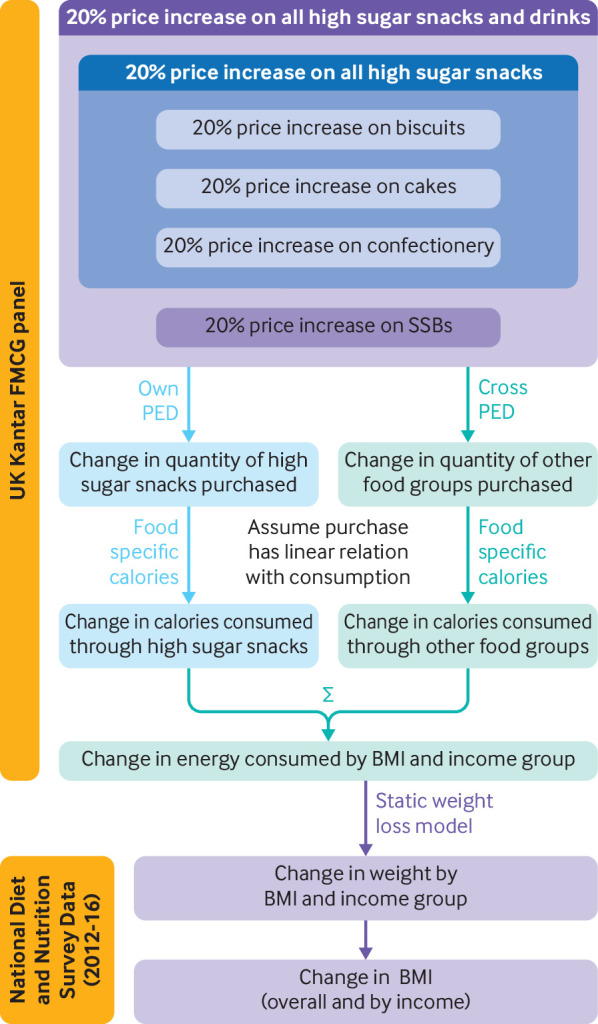
36 324 households with data on product level household expenditure from UK Kantar FMCG (fast moving consumer goods) panel for January 2012 to December 2013. Data were used to estimate changes in energy (kcal, 1 kcal=4.18 kJ=0.00418 MJ) purchase associated with a 20% price increase in high sugar snacks. Data for 2544 adults from waves 5 to 8 of the National Diet and Nutrition Survey (2012-16) were used to estimate resulting changes in BMI and prevalence of obesity.
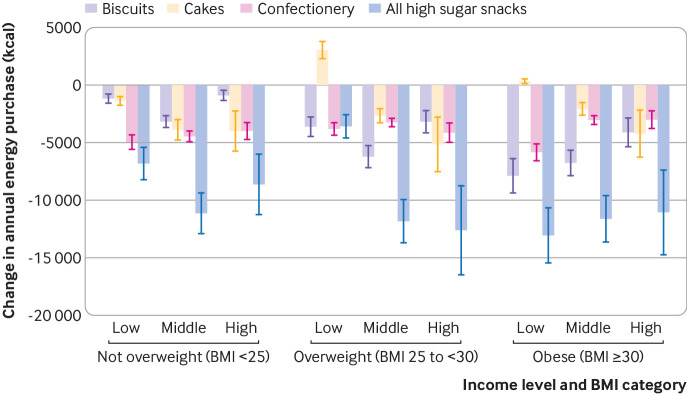
The effect on per person take home energy purchases of a 20% price increase for three categories of high sugar snacks: confectionery (including chocolate), biscuits, and cakes. Health outcomes resulting from the price increase were measured as changes in weight, BMI (not overweight (BMI <25), overweight (BMI ≥25 and <30), and obese (BMI ≥30)), and prevalence of obesity. Results were stratified by household income and BMI.
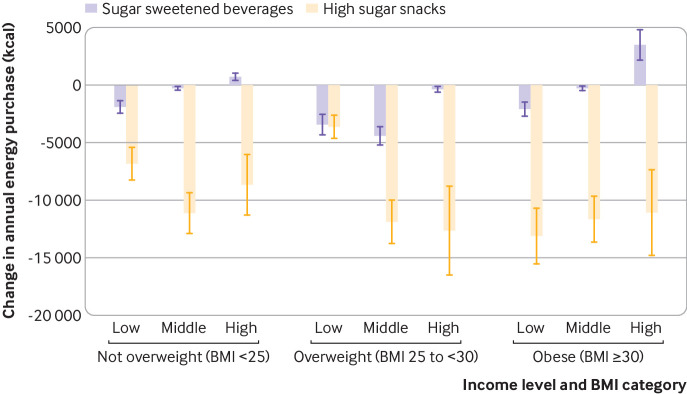
For income groups combined, the average reduction in energy consumption for a 20% price increase in high sugar snacks was estimated to be 8.9×10 kcal (95% confidence interval -13.1×10 to -4.2×10 kcal). Using a static weight loss model, BMI was estimated to decrease by 0.53 (95% confidence interval -1.01 to -0.06) on average across all categories and income groups. This change could reduce the UK prevalence of obesity by 2.7 percentage points (95% confidence interval -3.7 to -1.7 percentage points) after one year. The impact of a 20% price increase in high sugar snacks on energy purchase was largest in low income households classified as obese and smallest in high income households classified as not overweight.
Increasing the price of high sugar snacks by 20% could reduce energy intake, BMI, and prevalence of obesity. This finding was in a UK context and was double that modelled for a similar price increase in sugar sweetened beverages.
估计含糖量高的零食价格上涨 20%对体重指数(BMI)和肥胖患病率的潜在影响。
建模研究。
英国普通成年人群。
2012 年 1 月至 2013 年 12 月期间,英国 Kantar FMCG(快速消费品)面板上有 36324 户家庭的数据,这些家庭的数据显示了产品层面的家庭支出。数据用于估计含糖量高的零食价格上涨 20%时能量(千卡,1 千卡=4.18 千焦=0.00418 兆焦)购买量的变化。使用来自 2012-16 年全国饮食与营养调查(National Diet and Nutrition Survey)第 5 波至第 8 波的 2544 名成年人的数据,估计由此导致的 BMI 变化和肥胖患病率变化。
三类含糖量高的零食(糖果[包括巧克力]、饼干和蛋糕)价格上涨 20%对每人带回家的能量购买量的影响。价格上涨带来的健康结果测量为体重、BMI(体重不足(BMI<25)、超重(BMI≥25 且<30)和肥胖(BMI≥30))和肥胖患病率的变化。结果按家庭收入和 BMI 进行分层。
在收入组合并的情况下,估计含糖量高的零食价格上涨 20%时,能量消耗平均减少 8.9×10 千卡(95%置信区间-13.1×10 至-4.2×10 千卡)。使用静态减肥模型,所有类别和收入组的 BMI 平均估计降低 0.53(95%置信区间-1.01 至-0.06)。一年后,这种变化可能会使英国肥胖患病率降低 2.7 个百分点(95%置信区间-3.7 至-1.7 个百分点)。含糖量高的零食价格上涨 20%对低收入家庭(肥胖)的能量购买影响最大,对高收入家庭(体重不足)的影响最小。
将含糖量高的零食价格提高 20%可能会减少能量摄入、BMI 和肥胖的患病率。这一发现是在英国背景下得出的,与含糖饮料类似价格上涨的模型结果相比增加了一倍。