Department of Otolaryngology-Head & Neck Surgery, Flinders Medical Centre, College of Medicine and Public Health, Flinders University, Adelaide, South Australia, Australia
Department of Otolaryngology-Head & Neck Surgery, The University of Adelaide, Adelaide, South Australia, Australia.
mSphere. 2019 Sep 4;4(5):e00456-19. doi: 10.1128/mSphere.00456-19.
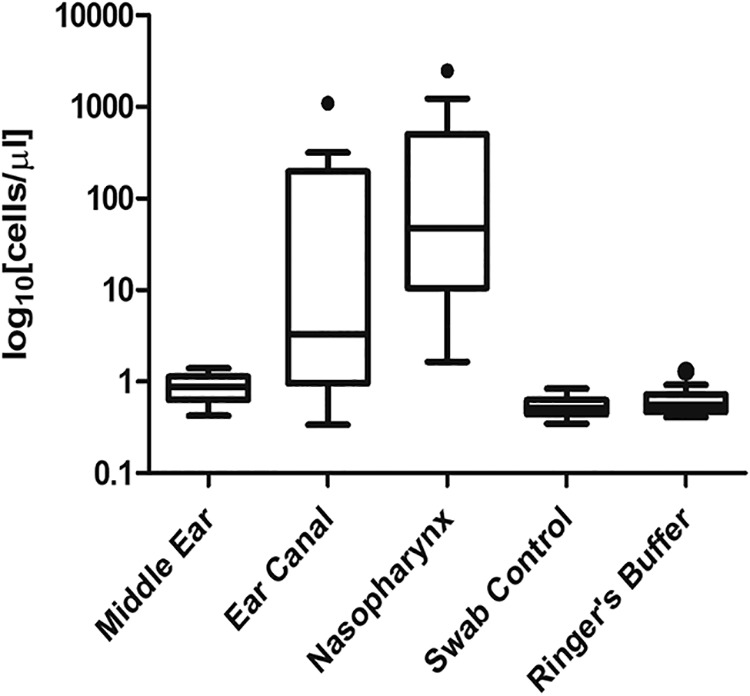
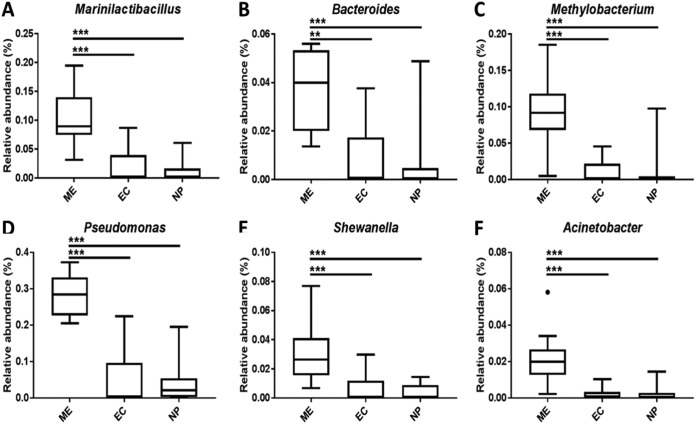
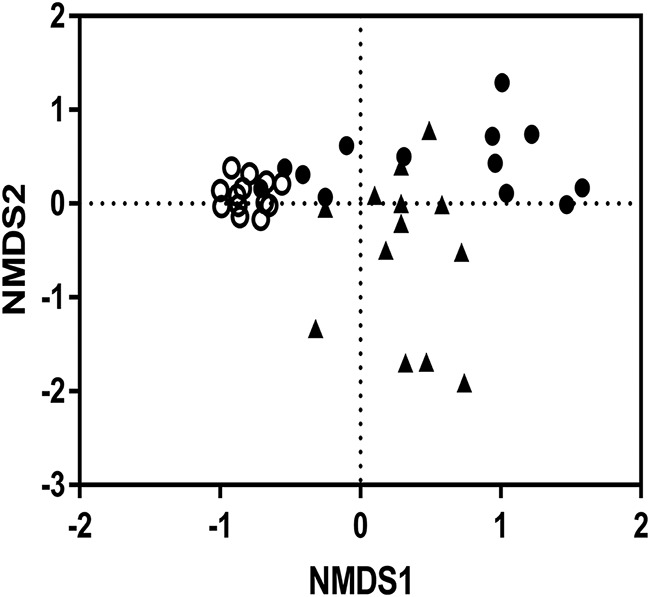
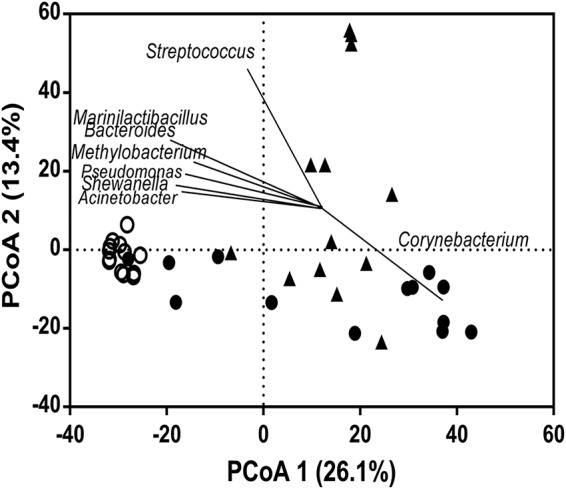
Otitis media (OM) is a cluster of diseases of the middle ear that commonly result from bacterial infection. OM subtypes in which the tympanic membrane is intact (acute otitis media and otitis media with effusion) are presumed to result from pathogen translocation through the eustachian tube. Recent molecular-based studies have suggested that a diverse middle ear microbiome exists in the absence of disease. These have been largely unsupported by culture and feature species that commonly contaminate low-biomass sequencing data. Combining culture-based and molecular techniques, we undertook a detailed investigation of the evidence for bacterial colonization of the healthy middle ear. Middle ear (ME), nasopharynx (NP), and external ear canal (EC) swabs were collected from a total of 25 adult patients undergoing cochlear implant, stapedotomy, or translabyrinthine vestibular schwannoma resection. Diagnostic culture, microscopy, quantitative PCR, and 16S rRNA gene amplicon sequencing were used to assess sample bacterial content. EC and NP microbiota were consistent with previous reports. In contrast, bacterial levels in ME samples were not significantly above those in unused control swabs. Commonly detected taxa were among recognized sequencing contaminants (, , and ). Linear regression of dominant ME taxa confirmed a negative relationship between relative abundance and bacterial load, consistent with contamination. No bacteria were detected by microscopy or diagnostic culture in any middle ear sample. Our findings cast substantial doubt on previous reports identifying a healthy middle ear microbiome using 16S amplicon sequencing. Recent molecular-based studies have suggested that a diverse middle ear microbiome in adults and children can exist in the absence of disease. These studies have been largely unsupported by culture and feature species that commonly contaminate low-biomass sequencing data. While 16S rRNA gene amplicon sequencing has proven to be a highly informative technique in many clinical contexts, it is susceptible to spurious signal arising from sequencing reagent contaminants where sample biomass is low. Combining culture-based and molecular techniques, we undertook a detailed investigation of the evidence for bacterial colonization of the healthy middle ear. In finding no evidence of viable bacterial cells in middle ear samples, our study further underlines the importance of careful consideration of amplicon sequence data derived from very-low-biomass contexts and the value of analytical approaches that combine culture and molecular techniques.
中耳炎(OM)是中耳一系列疾病的统称,通常由细菌感染引起。鼓膜完整的 OM 亚型(急性中耳炎和分泌性中耳炎)被认为是病原体通过咽鼓管转移引起的。最近基于分子的研究表明,在没有疾病的情况下,中耳存在多样化的微生物组。这些研究在很大程度上没有得到培养的支持,其特征是常见的污染低生物量测序数据的物种。通过结合培养和分子技术,我们对健康中耳细菌定植的证据进行了详细调查。从总共 25 名接受耳蜗植入、镫骨切开术或迷路性前庭神经鞘瘤切除术的成年患者中采集中耳(ME)、鼻咽(NP)和外耳道(EC)拭子。使用诊断培养、显微镜检查、定量 PCR 和 16S rRNA 基因扩增子测序来评估样本细菌含量。EC 和 NP 微生物群与以前的报告一致。相比之下,ME 样本中的细菌水平并不明显高于未使用的对照拭子。常见的检测到的分类群是公认的测序污染物(,,和)。ME 主要分类群的线性回归证实了相对丰度与细菌负荷之间的负相关关系,这与污染一致。在任何中耳样本中都没有通过显微镜检查或诊断培养检测到细菌。我们的研究结果对以前使用 16S 扩增子测序鉴定健康中耳微生物组的报告提出了重大质疑。最近的分子研究表明,成人和儿童的多样化中耳微生物组可以在没有疾病的情况下存在。这些研究在很大程度上没有得到培养的支持,其特征是常见的污染低生物量测序数据的物种。虽然 16S rRNA 基因扩增子测序在许多临床环境中已被证明是一种非常有信息的技术,但它容易受到来自低生物量样本中测序试剂污染物的虚假信号的影响。通过结合培养和分子技术,我们对健康中耳细菌定植的证据进行了详细调查。在中耳样本中未发现有活力的细菌细胞的证据,这进一步强调了在非常低生物量的背景下仔细考虑扩增子序列数据的重要性,以及结合培养和分子技术的分析方法的价值。