University of Cologne, Faculty of Medicine and University Hospital Cologne, Department of Neurology, Germany; Cognitive Neuroscience, Institute of Neuroscience and Medicine (INM-3), Research Centre Jülich, Germany, Wilhelm-Johnen-Straße, 52428 Jülich, Germany.
University of Cologne, Faculty of Medicine and University Hospital Cologne, Department of Neurology, Germany.
Neuroimage Clin. 2019;23:101915. doi: 10.1016/j.nicl.2019.101915. Epub 2019 Jul 2.
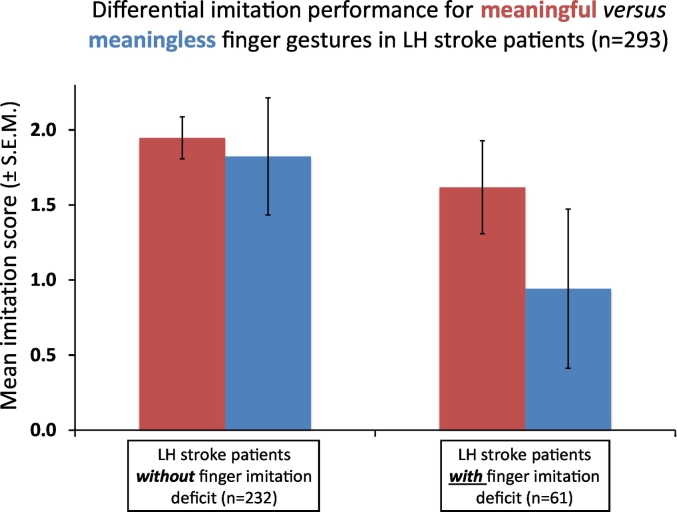
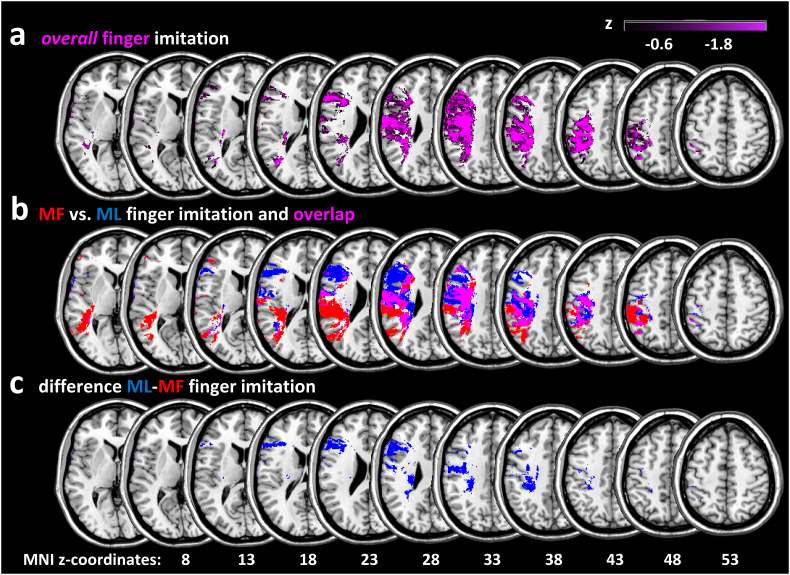
Behavioural studies in apraxic patients revealed dissociations between the processing of meaningful (MF) and meaningless (ML) gestures. Consequently, the existence of two differential neural mechanisms for the imitation of either gesture type has been postulated. While the indirect (semantic) route exclusively enables the imitation of MF gestures, the direct route can be used for the imitation of any gesture type, irrespective of meaning, and thus especially for ML gestures. Concerning neural correlates, it is debated which of the visuo-motor streams (i.e., the ventral steam, the ventro-dorsal stream, or the dorso-dorsal stream) supports the postulated indirect and direct imitation routes. To probe the hypotheses that regions of the dorso-dorsal stream are involved differentially in the imitation of ML gestures and that regions of the ventro-dorsal stream are involved differentially in the imitation of MF gestures, we analysed behavioural (imitation of MF and ML finger gestures) and lesion data of 293 patients with a left hemisphere (LH) stroke. Confirming previous work, the current sample of LH stroke patients imitated MF finger gestures better than ML finger gestures. The analysis using voxel-based lesion symptom mapping (VLSM) revealed that LH damage to dorso-dorsal stream areas was associated with an impaired imitation of ML finger gestures, whereas damage to ventro-dorsal regions was associated with a deficient imitation of MF finger gestures. Accordingly, the analyses of the imitation of visually uniform and thus highly comparable MF and ML finger gestures support the dual-route model for gesture imitation at the behavioural and lesion level in a substantial patient sample. Furthermore, the data show that the direct route for ML finger gesture imitation depends on the dorso-dorsal visuo-motor stream while the indirect route for MF finger gesture imitation is related to regions of the ventro-dorsal visuo-motor stream.
行为研究在失用症患者中揭示了有意义(MF)和无意义(ML)手势处理之间的分离。因此,有人假设存在两种用于模仿任何手势类型的不同神经机制。虽然间接(语义)途径仅允许模仿 MF 手势,但直接途径可用于模仿任何手势类型,而与意义无关,因此特别适用于 ML 手势。关于神经相关性,有争议的是,哪种视动流(即腹侧流、腹侧-背侧流或背侧-背侧流)支持假设的间接和直接模仿途径。为了探究假设,即背侧-背侧流的区域在 ML 手势模仿中差异参与,而背侧-背侧流的区域在 MF 手势模仿中差异参与,我们分析了 293 名左侧(LH)中风患者的行为(模仿 MF 和 ML 手指手势)和病变数据。证实了先前的工作,当前的 LH 中风患者样本模仿 MF 手指手势优于 ML 手指手势。使用基于体素的病变症状映射(VLSM)的分析表明,LH 损伤背侧-背侧流区域与 ML 手指手势模仿受损有关,而背侧-腹侧区域的损伤与 MF 手指手势模仿受损有关。因此,对视觉均匀且高度可比的 MF 和 ML 手指手势的模仿分析在大量患者样本中支持行为和病变水平的手势模仿双途径模型。此外,数据表明,ML 手指手势模仿的直接途径依赖于背侧-背侧视动流,而 MF 手指手势模仿的间接途径与背侧-腹侧视动流区域有关。