Bowers Norick R, Boehm Alexandra E, Roorda Austin
School of Optometry and Vision Science Graduate Group, University of California-Berkeley, Berkeley, CA, USA.
J Vis. 2019 Sep 3;19(11):8. doi: 10.1167/19.11.8.
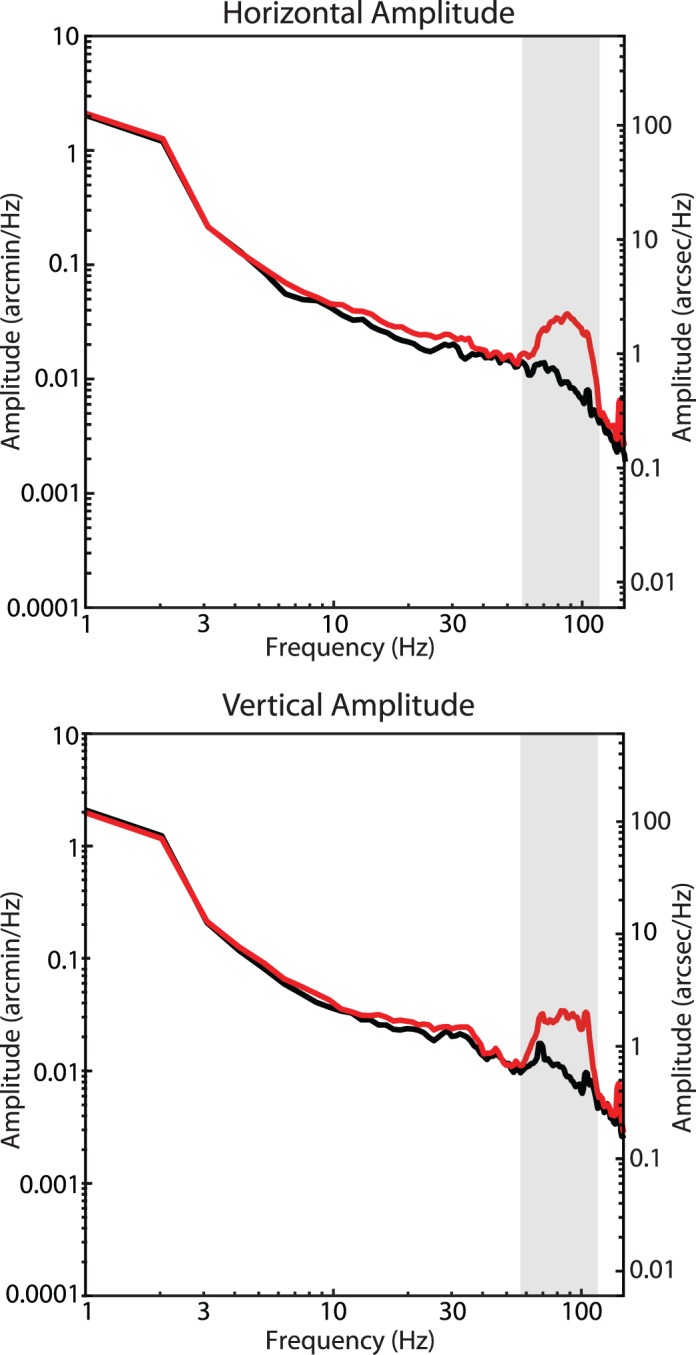
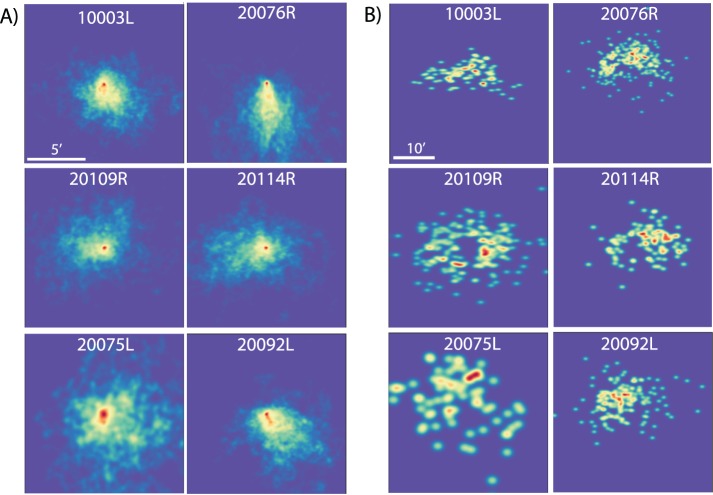
The study of fixational eye motion has implications for the neural and computational underpinnings of vision. One component of fixational eye motion is tremor, a high-frequency oscillatory jitter reported to be anywhere from ∼11-60 arcseconds in amplitude. In order to isolate the effects of tremor on the retinal image directly and in the absence of optical blur, high-frequency, high-resolution eye traces were collected in six subjects from videos recorded with an adaptive optics scanning laser ophthalmoscope. Videos were acquired while subjects engaged in an active fixation task where they fixated on a tumbling E stimulus and reported changes in its orientation. Spectral analysis was conducted on periods of ocular drift, with all drifts being concatenated together after removal of saccades from the trace. The resultant amplitude spectra showed a slight deviation from the traditional 1/f nature of optical drift in the frequency range of 50-100 Hz, which is indicative of tremor. However, this deviation rarely exceeded 1 arcsecond and the consequent standard deviation of retinal image motion over the tremor band (50-100 Hz) was just over 5 arcseconds. Given such a small amplitude, it is unlikely tremor will contribute in any meaningful way to the visual percept.
注视性眼动研究对视觉的神经和计算基础具有重要意义。注视性眼动的一个组成部分是震颤,这是一种高频振荡抖动,据报道其幅度在11 - 60角秒之间。为了在不存在光学模糊的情况下直接分离震颤对视网膜图像的影响,使用自适应光学扫描激光检眼镜记录的视频,从6名受试者中采集了高频、高分辨率的眼动轨迹。在受试者进行主动注视任务时采集视频,他们注视一个翻滚的字母E刺激并报告其方向变化。对眼动漂移期进行频谱分析,在从轨迹中去除扫视后,将所有漂移连接在一起。所得的幅度谱在50 - 100 Hz频率范围内与传统的1/f光学漂移性质略有偏差,这表明存在震颤。然而,这种偏差很少超过1角秒,并且在震颤频段(50 - 100 Hz)上视网膜图像运动的相应标准差刚刚超过5角秒。鉴于幅度如此之小,震颤不太可能以任何有意义的方式对视觉感知产生影响。