Nogueira Diogo E S, Rodrigues Carlos A V, Carvalho Marta S, Miranda Cláudia C, Hashimura Yas, Jung Sunghoon, Lee Brian, Cabral Joaquim M S
1Department of Bioengineering and iBB, Institute for Bioengineering and Biosciences, Instituto Superior Técnico, Universidade de Lisboa, Av. Rovisco Pais, 1049-001 Lisbon, Portugal.
2The Discoveries Centre for Regenerative and Precision Medicine, Lisbon Campus, Instituto Superior Técnico, Universidade de Lisboa, Lisbon, Portugal.
J Biol Eng. 2019 Sep 14;13:74. doi: 10.1186/s13036-019-0204-1. eCollection 2019.
Since their inception, human induced pluripotent stem cells (hiPSCs) have held much promise for pharmacological applications and cell-based therapies. However, their potential can only be realised if large numbers of cells can be produced reproducibly on-demand. While bioreactors are ideal systems for this task, due to providing agitation and control of the culture parameters, the common impeller geometries were not designed for the expansion of mammalian cells, potentially leading to sub-optimal results.
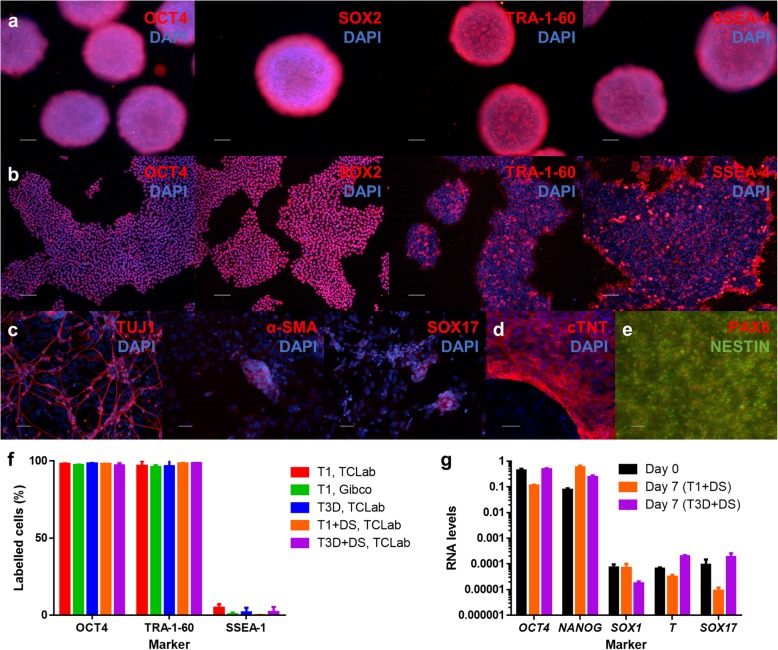
This work reports for the first time the usage of the novel Vertical-Wheel single-use bioreactors for the expansion of hiPSCs as floating aggregates. Cultures were performed in the PBS MINI 0.1 bioreactor with 60 mL of working volume. Two different culture media were tested, mTeSR1 and mTeSR3D, in a repeated batch or fed-batch mode, respectively, as well as dextran sulfate (DS) supplementation. mTeSR3D was shown to sustain hiPSC expansion, although with lower maximum cell density than mTeSR1. Dextran sulfate supplementation led to an increase in 97 and 106% in maximum cell number when using mTeSR1 or mTeSR3D, respectively. For supplemented media, mTeSR1 + DS allowed for a higher cell density to be obtained with one less day of culture. A maximum cell density of (2.3 ± 0.2) × 10 cells∙mL and a volumetric productivity of (4.6 ± 0.3) × 10 cells∙mL∙d were obtained after 5 days with mTeSR1 + DS, resulting in aggregates with an average diameter of 346 ± 11 μm. The generated hiPSCs were analysed by flow cytometry and qRT-PCR and their differentiation potential was assayed, revealing the maintenance of their pluripotency after expansion.
The results here described present the Vertical-Wheel bioreactor as a promising technology for hiPSC bioprocessing. The specific characteristics of this bioreactor, namely in terms of the innovative agitation mechanism, can make it an important system in the development of hiPSC-derived products under current Good Manufacturing Practices.
自人类诱导多能干细胞(hiPSC)问世以来,它们在药理学应用和基于细胞的治疗方面具有很大的前景。然而,只有在能够按需可重复地大量生产细胞时,它们的潜力才能得以实现。虽然生物反应器是完成这项任务的理想系统,因为它能提供搅拌并控制培养参数,但常见的叶轮几何形状并非为哺乳动物细胞的扩增而设计,这可能导致结果不理想。
本研究首次报道了使用新型垂直轮一次性生物反应器以悬浮聚集体的形式扩增hiPSC。在工作体积为60 mL的PBS MINI 0.1生物反应器中进行培养。分别以重复批次或补料分批模式测试了两种不同的培养基mTeSR1和mTeSR3D,以及添加硫酸葡聚糖(DS)。结果表明,mTeSR3D能够维持hiPSC的扩增,尽管其最大细胞密度低于mTeSR1。添加硫酸葡聚糖后,使用mTeSR1或mTeSR3D时最大细胞数量分别增加了97%和106%。对于添加了DS的培养基,mTeSR1 + DS在少培养一天的情况下就能获得更高的细胞密度。使用mTeSR1 + DS培养5天后,获得的最大细胞密度为(2.3 ± 0.2)×10⁶个细胞∙mL,体积产率为(4.6 ± 0.3)×10⁵个细胞∙mL∙d,形成的聚集体平均直径为346 ± 11 μm。通过流式细胞术和qRT-PCR对生成的hiPSC进行分析,并检测其分化潜能,结果表明扩增后它们的多能性得以维持。
本文所述结果表明垂直轮生物反应器是一种用于hiPSC生物加工的有前景的技术。该生物反应器的特定特性,即在创新搅拌机制方面的特性,使其能够成为按照现行药品生产质量管理规范开发hiPSC衍生产品的重要系统。