Department of Environmental Medicine and Public Health, Icahn School of Medicine at Mount Sinai, New York, NY, USA.
Department of Environmental Health Sciences, Mailman School of Public Health, Columbia University Medical Center, New York, NY, USA.
Epigenetics. 2020 Jan-Feb;15(1-2):174-182. doi: 10.1080/15592294.2019.1656159. Epub 2019 Sep 5.
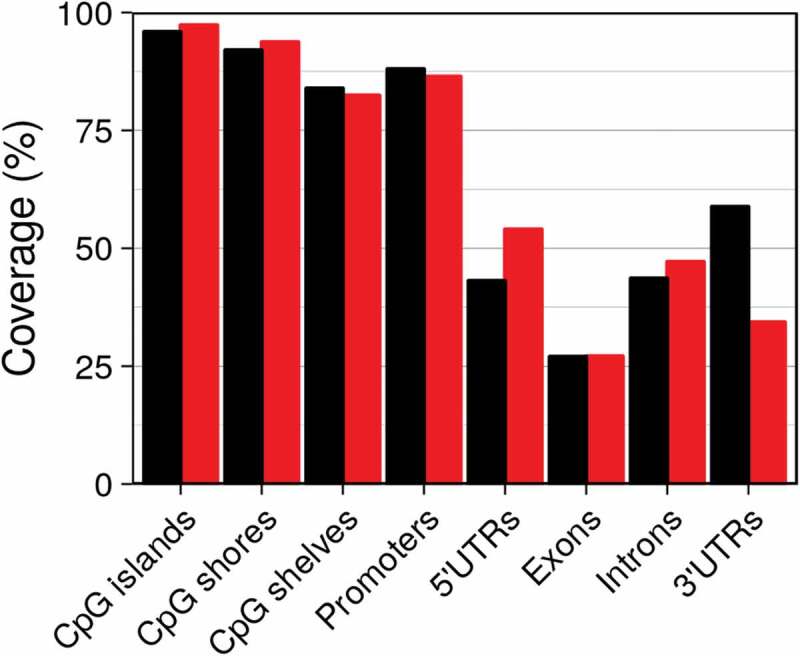
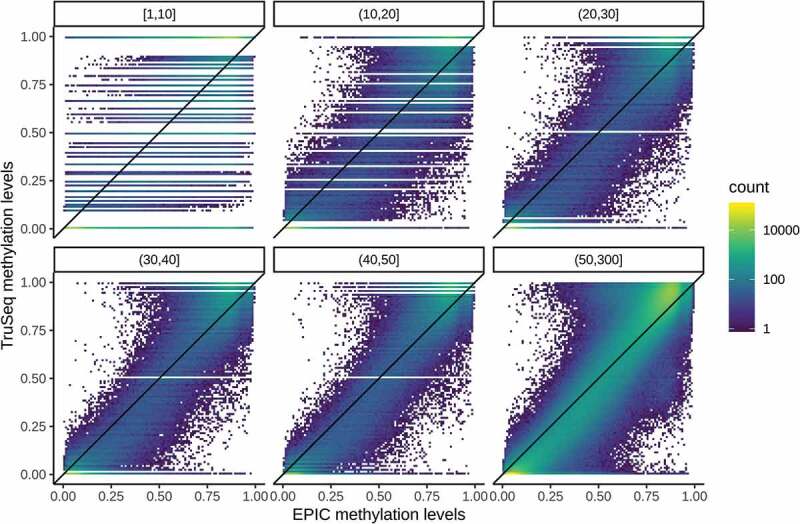
DNA methylation microarrays have been the platform of choice for epigenome-wide association studies in epidemiology, but declining costs have rendered targeted bisulphite sequencing a feasible alternative. Nonetheless, the literature for researchers seeking guidance on which platform to choose is sparse. To fill this gap, we conducted a comparison study in which we processed cord blood samples from four newborns in duplicates using both the Illumina HumanMethylationEPIC BeadChip and the Illumina TruSeq Methyl Capture EPIC Kit, and evaluated both platforms in regard to coverage, reproducibility, and identification of differential methylation. We conclude that with current analytic goals microarrays still outperform bisulphite sequencing for precise quantification of DNA methylation.
DNA 甲基化微阵列一直是流行病学中全基因组关联研究的首选平台,但成本的降低使得靶向亚硫酸氢盐测序成为一种可行的替代方法。尽管如此,对于寻求指导选择哪种平台的研究人员来说,相关文献仍然很少。为了填补这一空白,我们进行了一项比较研究,我们使用 Illumina HumanMethylationEPIC BeadChip 和 Illumina TruSeq Methyl Capture EPIC 试剂盒对来自 4 名新生儿的脐带血样本进行了重复处理,并比较了两种平台在覆盖度、重现性和差异甲基化鉴定方面的性能。我们得出结论,就当前的分析目标而言,微阵列在精确量化 DNA 甲基化方面仍然优于亚硫酸氢盐测序。