Nagarathna R, Rajesh S K, Amit S, Patil S, Anand A, Nagendra H R
Medical Director, VYASA, Bengaluru, Karnataka, India.
Division of Yoga and Life Sciences, Swami Vivekananda Yoga Anusandhana Samsthana, Bengaluru, Karnataka, India.
Int J Yoga. 2019 Sep-Dec;12(3):193-205. doi: 10.4103/ijoy.IJOY_38_19.
The rapidly increasing diabetes burden, reaching epidemic proportions despite decades of efforts, reflects our failure to translate the proven evidence for prevention of diabetes. Yoga, with its holistic approach, alters the habituated patterns of lifestyles and behaviour. Motivated by the accumulating evidence, the Government of India funded a large randomized controlled trial.
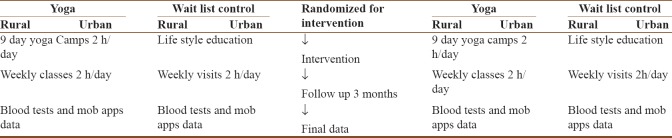
The twin objectives were: (a) estimate the prevalence of prediabetes and diabetes through a parallel multisite stratified cluster sampling method and (b) implement NMB 2017 (), a randomized control trial using yoga based lifestyle program.
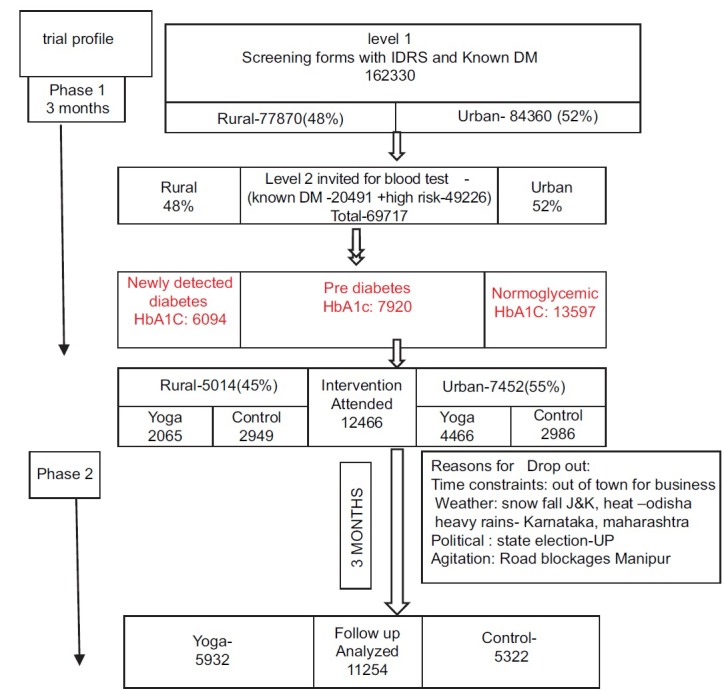
Screening for Indian Diabetes Risk score(IDRS) was conducted in randomly selected clusters in all 7 zones (65 districts from 29 states/union territories) of India. This was followed by detailed assessments in those with known diabetes and high risk (≥60) on IDRS. Those who satisfied the selection criteria and consented were recruited for the two armed waitlisted randomized control trial. A validated remedial diabetesspecific integrated yoga lifestyle module was taught to the experimental arm by certified volunteers of Indian Yoga Association. Followup assessments were done after 3 months in both groups. In this article, we report the methodology of the trial.
Response to door to door visits (n-240,968 adults >20yrs) in randomly selected urban and rural households for screening was 162,330; detailed assessments (A1c, lipid profile, BMI, stress, tobacco etc) were performed on 50,199 individuals. Of these 12466 (6531 yoga 5935 control) consented and for the RCT; 52% females, 48% males; 38% rural, 62% urban; BMI 21.1 ± 3.8; waist circumference 91.7 ± 11.9. A1c in diabetes subjects in yoga group was 7.63 ± 2.17 and 7.86 ± 2.13 in control group.
This unique methodology provides the evidence to implement a validated yoga life style module using yoga volunteers in all parts of the country which is an urgent need to prevent India from becoming the global capital for diabetes.
尽管经过数十年努力,糖尿病负担仍在迅速增加,已达到流行程度,这反映出我们未能将已证实的糖尿病预防证据转化应用。瑜伽以其整体方法,改变了习惯化的生活方式和行为模式。受越来越多证据的推动,印度政府资助了一项大型随机对照试验。
双重目标是:(a) 通过平行多地点分层整群抽样方法估计糖尿病前期和糖尿病的患病率;(b) 实施NMB 2017(),这是一项使用基于瑜伽的生活方式计划的随机对照试验。
在印度所有7个区域(来自29个邦/联邦属地的65个区)的随机选择的群组中进行印度糖尿病风险评分(IDRS)筛查。随后对已知患有糖尿病且IDRS高风险(≥60)的人群进行详细评估。那些符合入选标准并同意的人被招募参加双臂等待名单随机对照试验。由印度瑜伽协会的认证志愿者向试验组教授经过验证的针对糖尿病的综合瑜伽生活方式模块。两组在3个月后进行随访评估。在本文中,我们报告了该试验的方法。
在随机选择的城乡家庭中进行挨家挨户访问(n = 240,968名年龄>20岁的成年人)以进行筛查,回应者有162,330人;对50,199人进行了详细评估(糖化血红蛋白、血脂谱、体重指数、压力、烟草等)。其中12466人(6531人参加瑜伽组,5935人参加对照组)同意参加随机对照试验;女性占52%,男性占48%;农村占38%,城市占62%;体重指数21.1±3.8;腰围91.7±11.9。瑜伽组糖尿病患者的糖化血红蛋白为7.63±2.17,对照组为7.86±2.13。
这种独特的方法为在全国范围内使用瑜伽志愿者实施经过验证的瑜伽生活方式模块提供了证据,这是防止印度成为全球糖尿病之都的迫切需要。