Fountoulakis Konstantinos N, Gonda Xenia
13rd Department of Psychiatry, School of Medicine, General Hospital AHEPA, Aristotle University of Thessaloniki, 1 Kyriakidi Street, 24636 Thessaloniki, Greece.
2Department of Psychiatry and Psychotherapy, Semmelweis University, Kútvölgyi út 4, Budapest, 1125 Hungary.
Ann Gen Psychiatry. 2019 Sep 17;18:21. doi: 10.1186/s12991-019-0247-1. eCollection 2019.
Although there are several models on the structure of human temperament, character and personality, the majority follow a single approach, providing a unilateral and overly theoretical construct which is unsuitable for clinical application. The current study aimed to develop a complex and comprehensive model of temperament and character by empirically combining relevant existing theories.
The study included 734 healthy general population subjects aged 40.80 ± 11.48 years, who completed the TEMPS-A, TCI and NEO-PI-3 questionnaires. Data were analyzed in a multistep approach using Exploratory Factor analysis and forward stepwise linear regression.
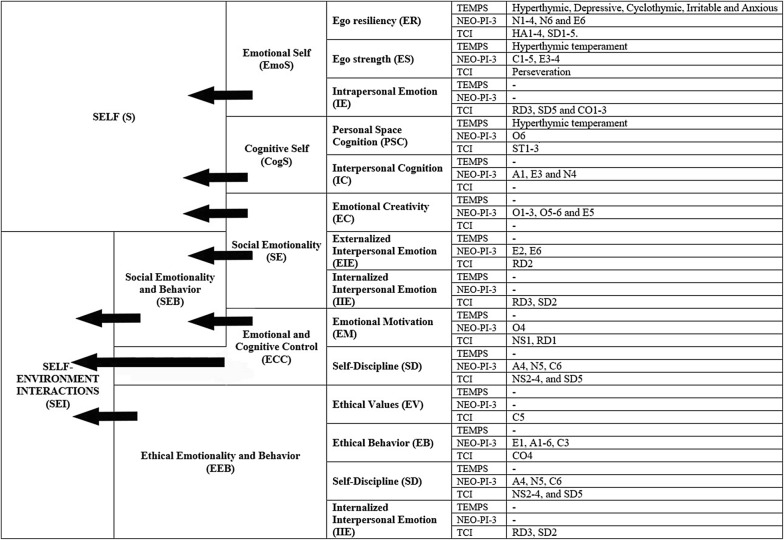
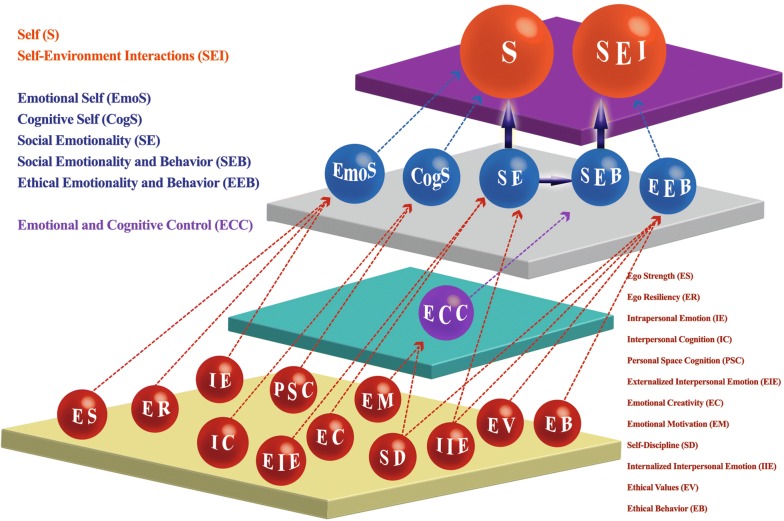
The results yielded two highest order factors (Self and Self-Environment Interaction), six middle order factors (Emotional Self, Cognitive Self, Social Emotionality, Emotional and Cognitive Control, Ethical Emotionality and Behavior, Social Emotionality and Behavior) and 12 factors at the bottom (Ego Resiliency, Ego Strength, Intrapersonal Emotion, Personal Space Cognition, Interpersonal Cognition, Emotional Creativity, Externalized Interpersonal Emotion, Internalized Interpersonal Emotion, Emotional Motivation, Self-Discipline, Ethical Values and Ethical Behavior).
The current study developed a complex hierarchical model of temperament and character on the basis of empirical data from several temperament theories. An important feature of the new temperamental model is the frequent admixture of emotional and cognitive processes within the same module. This model expands the field to include elements probably corresponding to meta-cognition mechanisms and complex interactions between affective and cognitive control, which may provide useful in understanding and treating affective disorders as well.
尽管有多种关于人类气质、性格和人格结构的模型,但大多数都采用单一方法,提供的是一种片面且过于理论化的结构,不适用于临床应用。本研究旨在通过实证结合现有相关理论,开发一个复杂而全面的气质和性格模型。
该研究纳入了734名年龄在40.80±11.48岁的健康普通人群受试者,他们完成了TEMPS - A、TCI和NEO - PI - 3问卷。采用探索性因素分析和向前逐步线性回归的多步骤方法对数据进行分析。
结果产生了两个最高阶因素(自我和自我 - 环境交互)、六个中间阶因素(情绪自我、认知自我、社会情绪性、情绪和认知控制、道德情绪和行为、社会情绪和行为)以及12个底层因素(自我弹性、自我力量、人际内情绪、个人空间认知、人际认知、情绪创造力、外化人际情绪、内化人际情绪、情绪动机、自律、道德价值观和道德行为)。
本研究基于来自多种气质理论的实证数据,开发了一个复杂的气质和性格层次模型。新气质模型的一个重要特征是在同一模块中频繁混合情绪和认知过程。该模型扩展了领域,纳入了可能对应元认知机制以及情感和认知控制之间复杂相互作用的元素,这可能对理解和治疗情感障碍也有帮助。