Center for Public Health and Ecosystem Research, Hanoi University of Public Health, Hanoi, Vietnam.
Institute of Environment and Sustainable Development, Vietnam Union of Science and Technology Associations, Hanoi, Vietnam.
PLoS One. 2019 Sep 25;14(9):e0223115. doi: 10.1371/journal.pone.0223115. eCollection 2019.
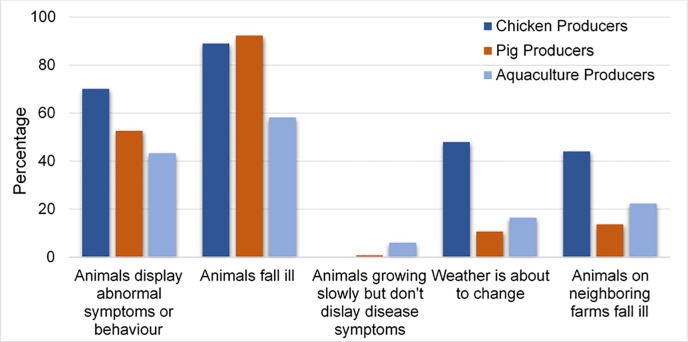
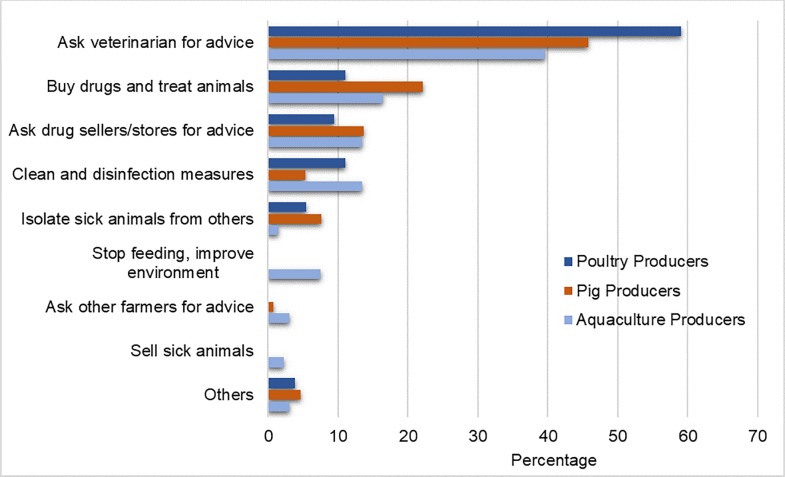
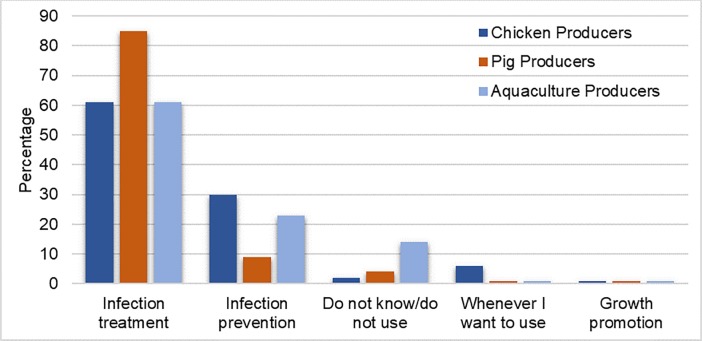
The use of antibiotics in livestock production is considered a major driver of antibiotic resistance on a global scale. In Vietnam, small- and medium-scale livestock producers dominate the domestic market and regulatory pushes have done little to decrease antibiotic use. In order to inform future policy directions, this study aims to explore knowledge, attitudes, and practices amongst livestock producers to identify their perspectives on antibiotic use and resistance. A total of 392 small- and medium-scale producers specialized in pig, poultry and aquaculture production participated in the study. The results showed that the primary reason for antibiotic use reported by producers was for the treatment of infections (69%). However, prophylactic use was also evident, with farmers reporting other reasons for antibiotic use such as "animals display abnormal symptoms or behaviour" (55%), the "weather is about to change" (25%), or "animals on neighboring farms fall ill" (27%). Only one-fifth of producers demonstrated favorable attitudes towards antibiotic use and preventing antibiotic resistance. Moreover, administering antibiotics remained the preferred countermeasure directly applied by farmers at the first indication of disease (17%), compared to enacting hygiene (10%) or quarantine (5%) measures. The results showed divergent trends amongst producers, with pig producers demonstrating higher levels of knowledge, more favorable attitudes, and higher self-reported utilization of good practice. Better knowledge, attitudes, and practices were also associated with producers who engaged in efforts to explore information on antibiotic use and resistance, which improved incrementally with the number of sources consulted and hours invested. However, there were some areas where increased knowledge or more favorable attitude scores did not translate into better practices. For instance, producers with higher levels of formal education performed significantly better than those with lower education in terms of knowledge and attitude, though both groups reported similar practices. The findings of this study may support future interventions to prevent both antibiotic misuse and the development of antimicrobial resistance.
在全球范围内,畜牧业中抗生素的使用被认为是抗生素耐药性的主要驱动因素。在越南,中小规模的畜牧业生产者占据了国内市场的主导地位,而监管措施几乎没有减少抗生素的使用。为了为未来的政策方向提供信息,本研究旨在探索畜牧业生产者的知识、态度和实践,以了解他们对抗生素使用和耐药性的看法。共有 392 名专门从事猪、家禽和水产养殖生产的中小规模生产者参加了这项研究。结果表明,生产者报告使用抗生素的主要原因是治疗感染(69%)。然而,预防用药也很明显,农民报告了其他使用抗生素的原因,如“动物出现异常症状或行为”(55%)、“天气即将变化”(25%)或“邻近农场的动物生病”(27%)。只有五分之一的生产者对抗生素使用和预防抗生素耐药性表现出有利的态度。此外,在疾病出现的第一迹象时,农民直接采取的首选措施是使用抗生素(17%),而不是采取卫生(10%)或隔离(5%)措施。结果显示,生产者之间存在分歧趋势,猪生产者表现出更高的知识水平、更有利的态度,以及更高的自我报告良好实践的利用率。更好的知识、态度和实践也与那些努力探索抗生素使用和耐药性信息的生产者有关,随着咨询来源数量的增加和投入时间的增加,这种情况逐渐得到改善。然而,有些领域增加的知识或更有利的态度得分并没有转化为更好的实践。例如,在知识和态度方面,具有较高正规教育水平的生产者明显优于受教育程度较低的生产者,尽管两组报告的实践情况相似。本研究的结果可能支持未来预防抗生素滥用和抗微生物耐药性发展的干预措施。