Krauss Patrick, Prebeck Karin, Schilling Achim, Metzner Claus
Cognitive Computational Neuroscience Group at the Chair of English Philology and Linguistics, Department of English and American Studies, Friedrich-Alexander University Erlangen-Nürnberg, Erlangen, Germany.
Neuroscience Lab, Experimental Otolaryngology, University Hospital Erlangen, Erlangen, Germany.
Front Comput Neurosci. 2019 Sep 11;13:64. doi: 10.3389/fncom.2019.00064. eCollection 2019.
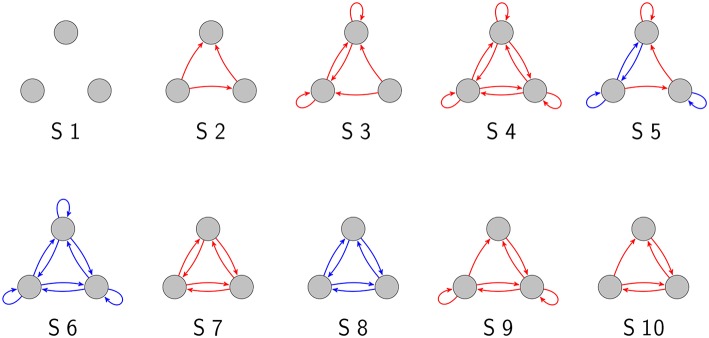
Stochastic Resonance (SR) and Coherence Resonance (CR) are non-linear phenomena, in which an optimal amount of noise maximizes an objective function, such as the sensitivity for weak signals in SR, or the coherence of stochastic oscillations in CR. Here, we demonstrate a related phenomenon, which we call "Recurrence Resonance" (RR): noise can also improve the information flux in recurrent neural networks. In particular, we show for the case of three-neuron motifs with ternary connection strengths that the mutual information between successive network states can be maximized by adding a suitable amount of noise to the neuron inputs. This striking result suggests that noise in the brain may not be a problem that needs to be suppressed, but indeed a resource that is dynamically regulated in order to optimize information processing.
随机共振(SR)和相干共振(CR)是非线性现象,其中适量的噪声可使目标函数最大化,比如在随机共振中对微弱信号的敏感度,或在相干共振中随机振荡的相干性。在此,我们展示了一种相关现象,我们称之为“递归共振”(RR):噪声也可以改善递归神经网络中的信息流。特别是,对于具有三元连接强度的三神经元基序的情况,我们表明通过向神经元输入添加适量噪声,可以使连续网络状态之间的互信息最大化。这一惊人结果表明,大脑中的噪声可能不是一个需要抑制的问题,而实际上是一种为优化信息处理而动态调节的资源。