Beckwith Esteban J, French Alice S
Department of Life Sciences, Imperial College London, London, United Kingdom.
Front Physiol. 2019 Sep 11;10:1167. doi: 10.3389/fphys.2019.01167. eCollection 2019.
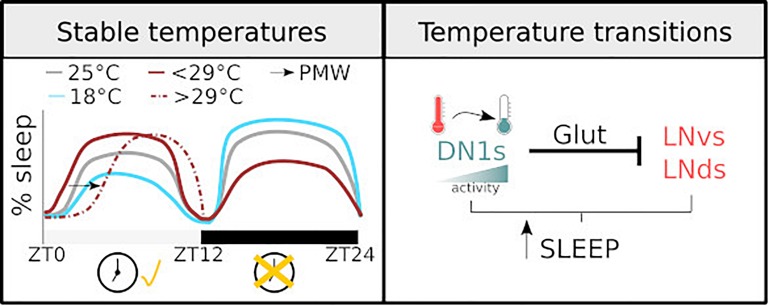
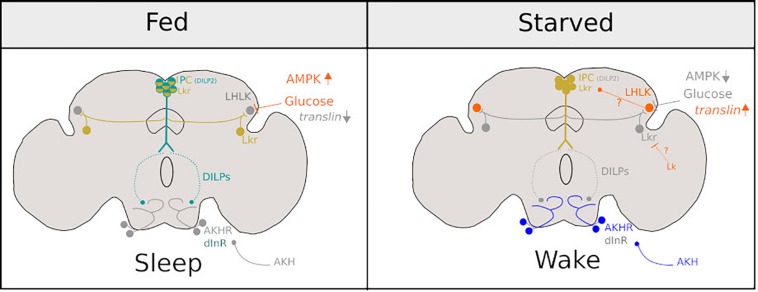
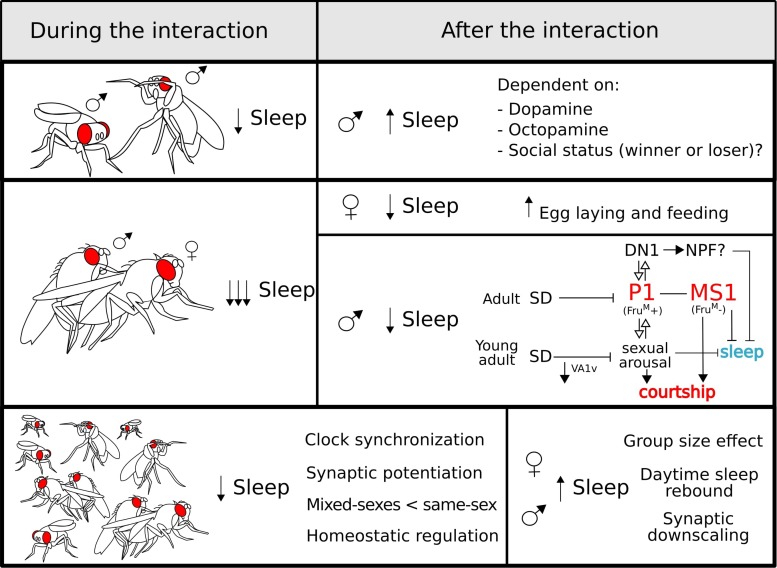
A prominent idea emerging from the study of sleep is that this key behavioural state is regulated in a complex fashion by ecologically and physiologically relevant environmental factors. This concept implies that sleep, as a behaviour, is plastic and can be regulated by external agents and changes in internal state. constitutes a resourceful model system to study behaviour. In the year 2000, the utility of the fly to study sleep was realised, and has since extensively contributed to this exciting field. At the centre of this review, we will discuss studies showing that temperature, food availability/quality, and interactions with conspecifics can regulate sleep. Indeed the relationship can be reciprocal and sleep perturbation can also affect feeding and social interaction. In particular, different environmental temperatures as well as gradual changes in temperature regulate when, and how much flies sleep. Moreover, the satiation/starvation status of an individual dictates the balance between sleep and foraging. Nutritional composition of diet also has a direct impact on sleep amount and its fragmentation. Likewise, aggression between males, courtship, sexual arousal, mating, and interactions within large groups of animals has an acute and long-lasting effect on sleep amount and quality. Importantly, the genes and neuronal circuits that relay information about the external environment and internal state to sleep centres are starting to be elucidated in the fly and are the focus of this review. In conclusion, sleep, as with most behaviours, needs the full commitment of the individual, preventing participation in other vital activities. A vast array of behaviours that are modulated by external and internal factors compete with the need to sleep and thus have a significant role in regulating it.
睡眠研究中出现的一个突出观点是,这种关键的行为状态受到生态和生理相关环境因素的复杂调节。这一概念意味着,睡眠作为一种行为是可塑的,可以受到外部因素和内部状态变化的调节。构成了一个研究行为的丰富模型系统。2000年,人们认识到果蝇在睡眠研究中的作用,此后它为这个令人兴奋的领域做出了广泛贡献。在本综述的核心部分,我们将讨论一些研究,这些研究表明温度、食物供应/质量以及与同种个体的相互作用可以调节睡眠。事实上,这种关系可能是相互的,睡眠干扰也会影响进食和社交互动。特别是,不同的环境温度以及温度的逐渐变化会调节果蝇何时睡眠以及睡眠时长。此外,个体的饱腹感/饥饿状态决定了睡眠和觅食之间的平衡。饮食的营养成分也直接影响睡眠量及其碎片化程度。同样,雄性之间的攻击、求偶、性唤起、交配以及大群动物内部的相互作用对睡眠量和质量都有急性和长期的影响。重要的是,在果蝇中,将有关外部环境和内部状态的信息传递到睡眠中枢的基因和神经回路开始得到阐明,这也是本综述的重点。总之,睡眠与大多数行为一样,需要个体全身心投入,从而无法参与其他重要活动。大量受外部和内部因素调节的行为与睡眠需求相互竞争,因此在调节睡眠方面发挥着重要作用。