Varsi Cecilie, Solberg Nes Lise, Kristjansdottir Olöf Birna, Kelders Saskia M, Stenberg Una, Zangi Heidi Andersen, Børøsund Elin, Weiss Karen Elizabeth, Stubhaug Audun, Asbjørnsen Rikke Aune, Westeng Marianne, Ødegaard Marte, Eide Hilde
Center for Shared Decision Making and Collaborative Care Research, Division of Medicine, Oslo University Hospital, Oslo, Norway.
Institute of Clinical Medicine, Faculty of Medicine, University of Oslo, Oslo, Norway.
J Med Internet Res. 2019 Sep 27;21(9):e14255. doi: 10.2196/14255.
There is growing evidence of the positive effects of electronic health (eHealth) interventions for patients with chronic illness, but implementation of such interventions into practice is challenging. Implementation strategies that potentially impact implementation outcomes and implementation success have been identified. Which strategies are actually used in the implementation of eHealth interventions for patients with chronic illness and which ones are the most effective is unclear.
This systematic realist review aimed to summarize evidence from empirical studies regarding (1) which implementation strategies are used when implementing eHealth interventions for patients with chronic illnesses living at home, (2) implementation outcomes, and (3) the relationship between implementation strategies, implementation outcomes, and degree of implementation success.
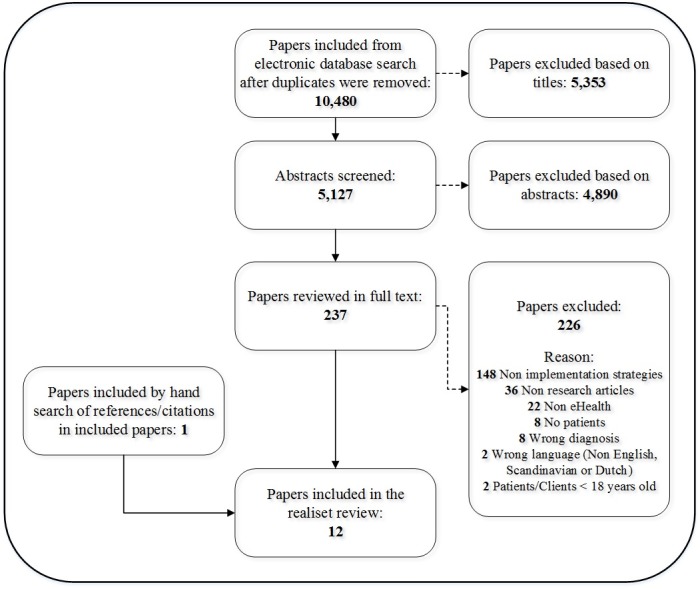
A systematic literature search was performed in the electronic databases MEDLINE, Embase, PsycINFO, Scopus, Allied and Complementary Medicine Database, Cumulative Index to Nursing and Allied Health Literature, and Cochrane Library. Studies were included if they described implementation strategies used to support the integration of eHealth interventions into practice. Implementation strategies were categorized according to 9 categories defined by the Expert Recommendations for Implementing Change project: (1) engage consumers, (2) use evaluative and iterative strategies, (3) change infrastructure, (4) adapt and tailor to the context, (5) develop stakeholder interrelationships, (6) use financial strategies, (7) support clinicians, (8) provide interactive assistance, and (9) train and educate stakeholders. Implementation outcomes were extracted according to the implementation outcome framework by Proctor and colleagues: (1) acceptability, (2) adoption, (3) appropriateness, (4) cost, (5) feasibility, (6) fidelity, (7) penetration, and (8) sustainability. Implementation success was extracted according to the study authors' own evaluation of implementation success in relation to the used implementation strategies.
The implementation strategies management support and engagement, internal and external facilitation, training, and audit and feedback were directly related to implementation success in several studies. No clear relationship was found between the number of implementation strategies used and implementation success.
This is the first review examining implementation strategies, implementation outcomes, and implementation success of studies reporting the implementation of eHealth programs for patients with chronic illnesses living at home. The review indicates that internal and external facilitation, audit and feedback, management support, and training of clinicians are of importance for eHealth implementation. The review also points to the lack of eHealth studies that report implementation strategies in a comprehensive way and highlights the need to design robust studies focusing on implementation strategies in the future.
PROSPERO CRD42018085539; https://www.crd.york.ac.uk/prospero/display_record.php?RecordID=85539.
越来越多的证据表明,电子健康(eHealth)干预措施对慢性病患者具有积极作用,但将此类干预措施应用于实际医疗中具有挑战性。已经确定了可能影响实施结果和实施成功的实施策略。然而,在针对慢性病患者实施电子健康干预措施时,实际使用了哪些策略以及哪些策略最为有效尚不清楚。
本系统现实主义综述旨在总结实证研究中的证据,内容涉及:(1)为居家慢性病患者实施电子健康干预措施时使用了哪些实施策略;(2)实施结果;(3)实施策略、实施结果与实施成功程度之间的关系。
在电子数据库MEDLINE、Embase、PsycINFO、Scopus、联合与补充医学数据库、护理及相关健康文献累积索引以及Cochrane图书馆中进行了系统的文献检索。纳入的研究需描述用于支持将电子健康干预措施整合到实际医疗中的实施策略。实施策略根据“实施变革专家建议”项目定义的9个类别进行分类:(1)吸引消费者参与;(2)使用评估和迭代策略;(3)改变基础设施;(4)根据具体情况进行调整和定制;(5)发展利益相关者的相互关系;(6)使用财务策略;(7)支持临床医生;(8)提供交互式协助;(9)培训和教育利益相关者。根据Proctor及其同事的实施结果框架提取实施结果:(1)可接受性;(2)采用情况;(3)适宜性;(—)成本;(5)可行性;(6)保真度;(7)渗透率;(8)可持续性。根据研究作者对与所使用的实施策略相关的实施成功的自身评估提取实施成功情况。
在多项研究中,实施策略管理支持与参与、内部和外部促进、培训以及审核与反馈与实施成功直接相关。所使用的实施策略数量与实施成功之间未发现明确的关系。
这是首次对报告为居家慢性病患者实施电子健康项目的研究的实施策略、实施结果和实施成功情况进行的综述。该综述表明,内部和外部促进、审核与反馈、管理支持以及临床医生培训对电子健康的实施很重要。该综述还指出缺乏全面报告实施策略的电子健康研究,并强调未来需要设计侧重于实施策略的有力研究。
PROSPERO CRD42018085539;https://www.crd.york.ac.uk/prospero/display_record.php?RecordID=85539 。