Zhang Ximei, Johnston Eric R, Wang Yaosheng, Yu Qiang, Tian Dashuan, Wang Zhiping, Zhang Yanqing, Gong Daozhi, Luo Chun, Liu Wei, Yang Junjie, Han Xingguo
Key Laboratory of Dryland Agriculture, MOA, Institute of Environment and Sustainable Development in Agriculture, Chinese Academy of Agricultural Sciences, Beijing, China
Biosciences Division, Oak Ridge National Laboratory, Oak Ridge, Tennessee, USA.
mSystems. 2019 Oct 1;4(5):e00374-19. doi: 10.1128/mSystems.00374-19.
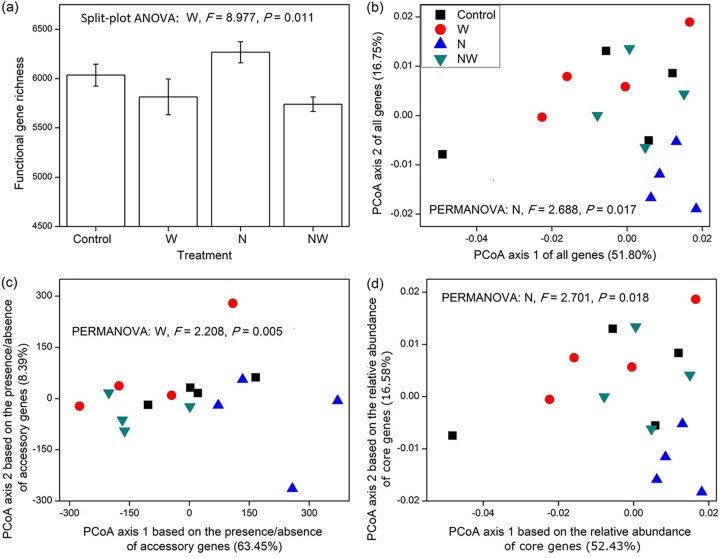
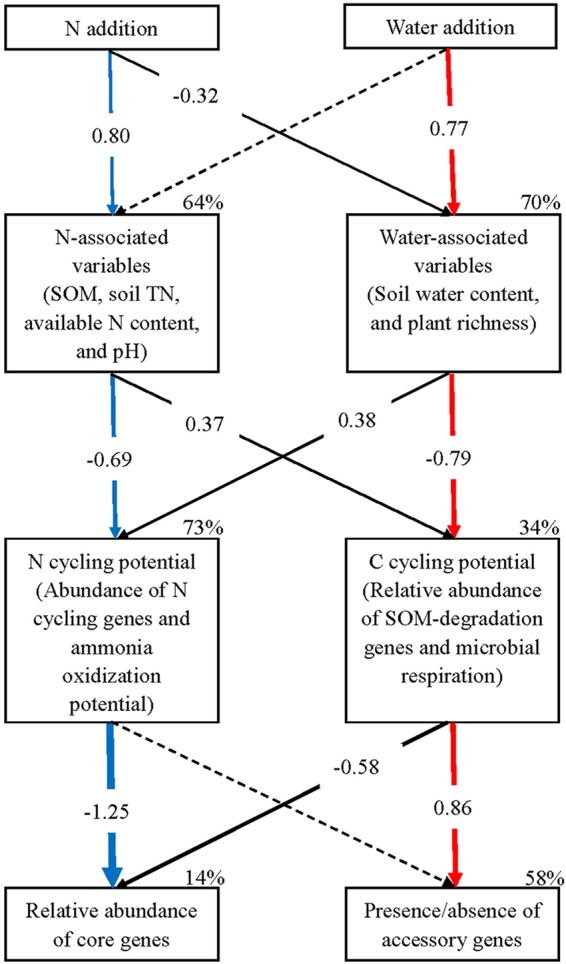
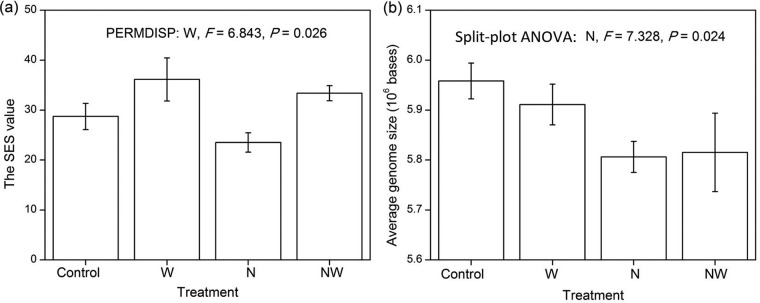
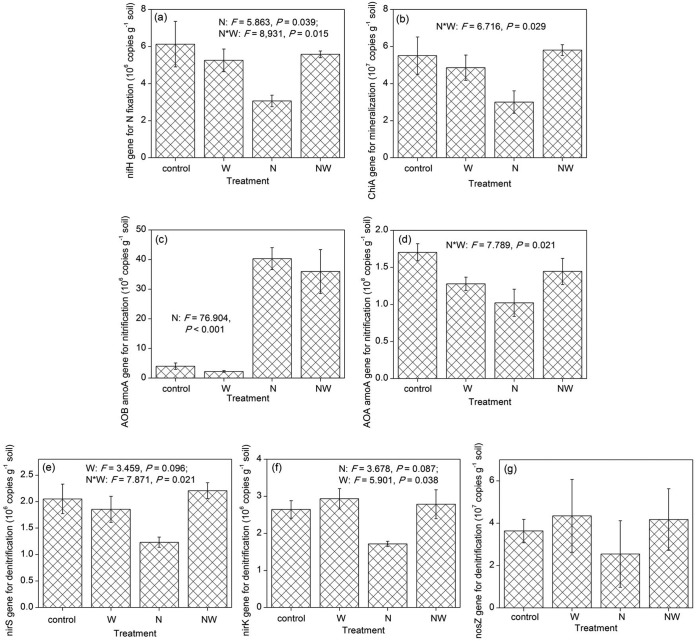
It is a central ecological goal to explore the effects of global change factors on soil microbial communities. The vast functional gene repertoire of soil microbial communities is composed of both core and accessory genes, which may be governed by distinct drivers. This intuitive hypothesis, however, remains largely unexplored. We conducted a 5-year nitrogen and water addition experiment in the Eurasian steppe and quantified microbial gene diversity via shotgun metagenomics. Nitrogen addition led to an 11-fold increase in the abundance (based on quantitative PCR [qPCR]) of ammonia-oxidizing bacteria, which have mainly core community genes and few accessory community genes. Thus, nitrogen addition substantially increased the relative abundance of many core genes at the whole-community level. Water addition stimulated both plant diversity and microbial respiration; however, increased carbon/energy resources from plants did not counteract increased respiration, so soil carbon/energy resources became more limited. Thus, water addition selected for microorganisms with genes responsible for degrading recalcitrant soil organic matter. Accordingly, many other microorganisms without these genes (but likely with other accessory community genes due to relatively stable average microbial genome size) were selected against, leading to the decrease in the diversity of accessory community genes. In summary, nitrogen addition primarily affected core community genes through nitrogen-cycling processes, and water addition primarily regulated accessory community genes through carbon-cycling processes. Although both gene components may significantly respond as the intensity of nitrogen/water addition increases, our results demonstrated how these common global change factors distinctly impact each component. Our results demonstrated increased ecosystem nitrogen and water content as the primary drivers of the core and accessory components of soil microbial community functional diversity, respectively. Our findings suggested that more attention should be paid to certain components of community functional diversity under specific global change conditions. Our findings also indicated that microbial communities have adapted to nitrogen addition by strengthening the function of ammonia oxidization to deplete the excess nitrogen, thus maintaining ecosystem homeostasis. Because community gene richness is primarily determined by the presence/absence of accessory community genes, our findings further implied that strategies such as maintaining the amount of soil organic matter could be adopted to effectively improve the functional gene diversity of soil microbial communities subject to global change factors.
探索全球变化因素对土壤微生物群落的影响是一项核心生态目标。土壤微生物群落庞大的功能基因库由核心基因和辅助基因组成,它们可能受不同驱动因素的支配。然而,这一直观的假设在很大程度上仍未得到探索。我们在欧亚草原进行了一项为期5年的氮添加和水添加实验,并通过鸟枪法宏基因组学对微生物基因多样性进行了量化。氮添加导致氨氧化细菌的丰度(基于定量PCR [qPCR])增加了11倍,氨氧化细菌主要拥有核心群落基因,辅助群落基因较少。因此,氮添加在全群落水平上大幅增加了许多核心基因的相对丰度。水添加刺激了植物多样性和微生物呼吸;然而,来自植物的碳/能量资源增加并未抵消呼吸作用的增强,因此土壤碳/能量资源变得更加有限。因此,水添加选择了具有负责降解难降解土壤有机质基因的微生物。相应地,许多没有这些基因的其他微生物(但由于平均微生物基因组大小相对稳定,可能拥有其他辅助群落基因)被淘汰,导致辅助群落基因多样性降低。总之,氮添加主要通过氮循环过程影响核心群落基因,水添加主要通过碳循环过程调节辅助群落基因。尽管随着氮/水添加强度的增加,这两种基因组分可能都会有显著反应,但我们的结果表明了这些常见的全球变化因素如何分别对每种组分产生明显影响。我们的结果表明,生态系统中氮和水含量的增加分别是土壤微生物群落功能多样性的核心和辅助组分的主要驱动因素。我们的研究结果表明,在特定的全球变化条件下,应更多地关注群落功能多样性的某些组分。我们的研究结果还表明,微生物群落通过加强氨氧化功能来消耗过量的氮,从而适应了氮添加,进而维持了生态系统的稳态。由于群落基因丰富度主要由辅助群落基因的存在与否决定,我们的研究结果进一步暗示,可以采用诸如维持土壤有机质含量等策略来有效提高受全球变化因素影响的土壤微生物群落的功能基因多样性。